Begleiten Sie uns auf eine literarische Weltreise!
Buch zum Bücherregal hinzufügen
Grey
Einen neuen Kommentar schreiben Default profile 50px
Grey
Jetzt das ganze Buch im Abo oder die ersten Seiten gratis lesen!
All characters reduced
A Ramble About Tallaght - History People Places - cover

A Ramble About Tallaght - History People Places

Albert Perris

Verlag: The O'Brien Press

  • 0
  • 0
  • 0

Beschreibung

A fascinating history of an ancient place.
From its first mention in legend in the Book of Invasions, through early Christian monastic settlements, castles and grand residences, Fenian raids and the Battle of Tallaght, there has been huge change in Tallaght. In more recent times it has seen car and motorcycle racing, an aerodrome, the rise and fall of a chocolate factory and a pioneering telecommunications firm. The massive population explosion and rapid modernisation towards the end of the twentieth century means this once-tiny village in Dublin's foothills is now home to over 80,000 people.
Richly illustrated with period photographs and original drawings by Michael O'Brien, Albert Perris tells the often-surprising story of Tallaght.
Verfügbar seit: 06.11.2023.
Drucklänge: 288 Seiten.

Weitere Bücher, die Sie mögen werden

  • Golden Horde The: A Captivating Guide to the European Appanage of the Mongol Empire That Was Ruled by the Descendants of Genghis Khan - cover

    Golden Horde The: A Captivating...

    Captivating History

    • 0
    • 0
    • 0
    Unveil the Epic History of the Golden Horde! 
    Journey back to the times of Genghis Khan and discover how he divided his empire into four parts, shaping the course of history. For over two centuries, the Golden Horde ruled a vast region, influencing lands from the Urals to Poland, from the taiga to the Caspian Sea. 
    Explore the Mysteries of the Eurasian Steppe 
    Learn why the Eurasian Steppe, stretching from the Danube to Manchuria, produced nomadic armies that threatened empires in Europe and China for three thousand years. 
    Unravel the Rise of Moscow 
    Understand how Kievan Rus’ dominated Russian lands while Moscow was just an outpost and how Moscow rose to power by aligning with the Mongols. 
    Discover Shocking Historical Events 
    See how a fight in Caffa led to the Black Death devastating Europe. Be surprised by Venice’s and Genoa’s involvement in the slave trade and its connection to the Golden Horde and Mamluk Egypt. 
    Here are just some of the things you will learn about in this audiobook:Why the Mongols executed the last Abbasid caliph by trampling him to death.The terror tactics of the Mongols, including the massacre of entire cities.Why European horses starved on the steppe while Mongol ponies thrived.The diverse trade items that traveled the Silk RoadHow medieval merchants navigated bureaucracy by bribing customs officials in Crimea. 
    To delve into these captivating stories and the profound impact of the Golden Horde, scroll up and click the “add to cart” button now!
    Zum Buch
  • Writing the Cozy Mystery - Expanded Second Edition - cover

    Writing the Cozy Mystery -...

    Nancy J. Cohen

    • 0
    • 0
    • 0
    Writing the Cozy Mystery is a concise writing guide that describes step-by-step how to write a winning whodunit.  
    Do you want to write a cozy mystery but don’t have a clue where to start? Or perhaps you’re already writing a series, and you need tips on how to keep your material fresh. Writing the Cozy Mystery is a handy reference guide that will help you develop your characters, establish the setting, plot the story, add suspense, plant clues, and solve the crime. 
    This award-winning second edition contains examples from the author’s Bad Hair Day Mysteries along with writing exercises, marketing tips, advice on how to maintain your series, and special considerations for cozy authors. You’ll find everything you need to know in an easy-to-read, clear manner to write your own mystery and to refresh a long-running series. Recommended for cozy writers, mystery fans, and creative writing classes.
    Zum Buch
  • Capitalist's Worst Nightmare Come True The: The Crucifixion of Capital - cover

    Capitalist's Worst Nightmare...

    Richard M. Kiernicki

    • 0
    • 0
    • 0
    The Capitalist's Worst Nightmare Come True: The Crucifixion of Capital: 
    In this break-through multiple-award winning book, Richard exposes the lies, greed, corruption and inequality upon which the capitalist system is built. We have the power to turn the world upside down and free ourselves from the illusions of capitalism forever. 
    "Richard is an ‘outside the box’ thinker and TIME-EQUITY is a bold pathway of change." James B. Fuller, World Alliance for Planetary Health 
    “As time unfolds, it becomes increasingly visible that many of our systems have outlived their purpose. Aligned with our true human spirit, a shift occurs calling for a new approach to value. Richard shows what this could look like.” Nicolette DeVidar, TV Host & Founder, urban2050 
    This book shows how fragile the monetary system is and the elite do not want you to know that. Richard has uncovered their secrets. From mechanic to an exemplary career in the financial industry his self-made billionaire partner told him that his greatest asset is his ability to see things differently because he doesn't have an MBA. His "unconventional" methods were featured in a national financial magazine and TV show. He learned that the majority have to fail financially for the few to win. 
    The thrust of this book is to show us that there are possibilities beyond what we’ve come to accept as our reality; this comes from an unending drive to imagine beyond the conventional wisdom. TIME-EQUITY is the realistic alternative we’ve been waiting for to usher in an age of equality, true democracy, a sustainable planet and quite possibly the first era of peacefulness amongst humanity to work together in realizing our unlimited potential. 
    Published by Downloads From Heaven Publishers 
    richardmkiernicki.com/author
    Zum Buch
  • Zeppelins of World War I The: The History and Legacy of Zeppelin Air Raids during the Great War - cover

    Zeppelins of World War I The:...

    Editors Charles River

    • 0
    • 0
    • 0
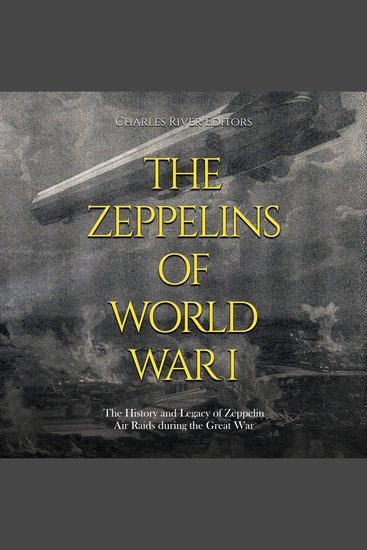
    While airplanes had never before appeared above the field of war, other aerial vehicles had already been in use for decades, and balloons had carried soldiers above the landscape for centuries to provide a high observation point superior to most geological features. The French used a balloon for this purpose at the Battle of Fleurus in 1794, and by the American Civil War, military hydrogen balloons saw frequent use, filled from wagons generating hydrogen from iron filings and sulfuric acid.  
    	In fact, with advances in dirigible technology, many military thinkers and even aeronautical enthusiasts believed that blimps would remain the chief military aerial asset for the foreseeable future. These men thought airplanes would play a secondary role at best and might even prove a uselessly expensive gimmick soon to fade back into obscurity, leaving the majestic bulk of the dirigible as sole master of the skies.  
    	The Zeppelins, slow and large as they were, proved to be easy targets for fire from the ground, so they were too vulnerable for reconnaissance in the warzone. Instead, they were used for the task of bombing targets. Bombs were dropped on Paris in August 1914, and Zeppelins bombed Belgian forces as the Germans advanced on Liège. The Germans also used them to bomb England’s eastern ports and London in an attempt to disrupt military supplies. On the other side, British pilots destroyed a Zeppelin on the ground at Düsseldorf.  
    	This was bombing at its simplest; the explosives were kept on hooks on the side of the machines and dropped by a crew member by hand. These small forays into aerial bombardment barely even hinted at the bombing campaigns to come, but Zeppelin raids on Britain would continue for nearly four years, killing more than 500 people and injuring 1,300. These raids and the attempts to stop them would be carried out at the cutting edge of new technology. 
    Zum Buch
  • Alternative History of Britain An - The Tudors - cover

    Alternative History of Britain...

    Timothy Venning

    • 0
    • 0
    • 0
    Timothy Venning's series of alternative histories explores the pathways of British events from the Anglo-Saxon Age to the English Civil War. In this volume, he presents an in-depth analysis of the Tudor period. Venning discusses the fateful moments at which history could easily have taken a different turn. 


    In a fascinating series of "what if" scenarios, Venning presents a detailed look at the possible and likely results. While speculative, the scenarios are all plausible and rooted in a firm understanding of actually events and their context. In so doing, Venning gives listeners a clearer understanding of the factors at play and why things happened the way they did, as well as a tantalizing view of what might have been. 


    Key questions discussed include: 


    ● Did the pretenders Lambert Simnel and Perkin Warbeck ever have a realistic chance of a successful invasion/coup? 


    ● If Henry Fitzroy, Henry VIIIs illegitimate son, had not died young, might he have been a suitable King? 


    ● What if Edward VI had not died at fifteen but reigned into the 1560s and 70s? 


    ● How might the Spanish Armada have succeeded in landing an army in England, and with what likely outcome?
    Zum Buch
  • Democracy Rules - cover

    Democracy Rules

    Jan-Werner Müller

    • 0
    • 0
    • 0
    A much-anticipated guide to saving democracy, from one of our most essential political thinkers. 


    Everyone knows that democracy is in trouble, but do we know what democracy actually is? Jan-Werner Müller, author of the widely translated and acclaimed What Is Populism?, takes us back to basics in Democracy Rules. In this short, elegant volume, he explains how democracy is founded not just on liberty and equality, but also on uncertainty. The latter will sound unattractive at a time when the pandemic has created unbearable uncertainty for so many. But it is crucial for ensuring democracy's dynamic and creative character, which remains one of its signal advantages over authoritarian alternatives that seek to render politics (and individual citizens) completely predictable. 


    Müller shows that we need to re-invigorate the intermediary institutions that have been deemed essential for democracy's success ever since the nineteenth century: political parties and free media. Contrary to conventional wisdom, these are not spent forces in a supposed age of post-party populist leadership and post-truth. Müller suggests concretely how democracy's critical infrastructure of intermediary institutions could be renovated, re-empowering citizens while also preserving a place for professionals such as journalists and judges.
    Zum Buch