Rejoignez-nous pour un voyage dans le monde des livres!
Ajouter ce livre à l'électronique
Grey
Ecrivez un nouveau commentaire Default profile 50px
Grey
Abonnez-vous pour lire le livre complet ou lisez les premières pages gratuitement!
All characters reduced
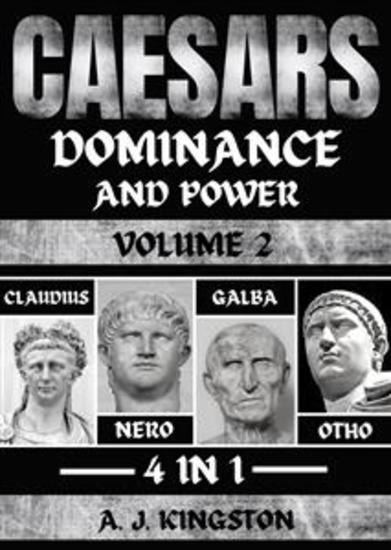
Caesars: Dominance And Power - 4 In 1 Claudius Nero Galba & Otho - cover

Caesars: Dominance And Power - 4 In 1 Claudius Nero Galba & Otho

A.J. A.J.Kingston

Maison d'édition: A.J.Kingston

  • 0
  • 0
  • 0

Synopsis

Step back in time to the world of ancient Rome with "Caesars: Dominance and Power," a four-in-one book bundle that explores the fascinating lives and reigns of four of the most intriguing emperors in history: Claudius, Nero, Galba, and Otho.
Each of the four books in this bundle delves deep into the personality and rule of a different emperor, offering a comprehensive and engaging exploration of their lives and legacies. In "Claudius: The Unlikely Emperor," you'll discover how a man once deemed an imbecile rose to become one of Rome's most just and successful emperors, while "Nero: The Legacy of a Damned Emperor" takes a closer look at the mad tyrant who played the lyre while Rome burned.
"Galba: The Short-Lived Emperor" explores the rise and fall of a man who struggled to hold onto power and ultimately met a violent end, and "Otho: The Forgotten Emperor" sheds light on the brief but significant reign of a man who briefly seized power after Galba's assassination.
Together, these four books offer a captivating and comprehensive exploration of ancient Rome and the individuals who shaped its history. Whether you're a history buff or simply fascinated by the world of ancient empires, "Caesars: Dominance and Power" is a must-read. So why wait? Order your copy today and embark on a journey through one of the most intriguing and tumultuous eras in history.
Disponible depuis: 08/04/2023.

D'autres livres qui pourraient vous intéresser

  • The Ripple Effect - China's Complex Presence in Southeast Asia - cover

    The Ripple Effect - China's...

    Enze Han

    • 0
    • 0
    • 0
    Many studies of China's relations with and influence on Southeast Asia tend to focus on how Beijing has used its power asymmetry to achieve regional influence. Yet, scholars and pundits often fail to appreciate the complexity of the contemporary Chinese state and society, and just how fragmented, decentralized, and internationalized China is today. 


    In The Ripple Effect, Enze Han argues that a focus on the Chinese state alone is not sufficient for a comprehensive understanding of China's influence in Southeast Asia. Instead, we must look beyond the Chinese state, to non-state actors from China, such as private businesses and Chinese migrants. These actors affect people's perception of China in a variety of ways, and they often have wide-ranging as well as long-lasting effects on bilateral relations. Looking beyond the Chinese state's intentional influence reveals many situations that result in unanticipated changes in Southeast Asia. Han proposes that to understand this increasingly globalized China, we need more conceptual flexibility regarding which Chinese actors are important to China's relations, and how they wield this influence, whether intentional or not.
    Voir livre
  • Public Sector Marketing Pro - The Definitive Guide to Digital Marketing and Social Media for Government and Public Sector - cover

    Public Sector Marketing Pro -...

    Joanne Sweeney

    • 0
    • 0
    • 0
    Do you need to transform your communications department into a specialist digital and social media team? The newly revised Public Sector Marketing Pro is the definitive guide for government and public sector agencies, politicians, political parties and NGOs on how to successfully reach and engage with the public in the Digital Age. With over 20 years' experience in journalism, digital marketing, and communications, Joanne Sweeney highlights how communication has changed in our post-pandemic world. New and updated chapters include case studies from public health officials on how they modified their tactics as the public demanded more information quicker than ever before. This crash course in digital public engagement will teach you how to: 
    - Transform outdated communications strategy into agile digital plans 
    - Respond to the public in real time on social media-even if you're understaffed 
    - Effectively respond to crises online 
    - Leverage digital communications to meet your organisation's larger objectives 
    - Understand and adapt to the changes that occurred during the pandemic 
    Public Sector Marketing Pro is your ultimate training manual to becoming a skilled leader in your field and online.
    Voir livre
  • Learn Like a Pro - Strategies for Accelerated Learning and Mastery - cover

    Learn Like a Pro - Strategies...

    Leah Senft

    • 0
    • 0
    • 0
    Learn Like a Pro: Strategies for Accelerated Learning and Mastery 
    In a world that prizes adaptability and continuous growth, the ability to learn quickly and effectively is a superpower. This audiobook is your comprehensive guide to mastering the art of accelerated learning and achieving true expertise. 
    We delve deep into the science and techniques of efficient learning, providing you with a treasure trove of strategies, insights, and practical tips. 'Learn Like a Pro' is your roadmap to navigate the complex landscape of modern education and self-improvement, enabling you to acquire knowledge, skills, and expertise at an accelerated pace. 
    Whether you're a student, a professional, or simply someone seeking to expand your horizons, this audiobook equips you with the tools and wisdom to become a pro at learning. Join us on this transformative journey, and let 'Learn Like a Pro' be your trusted companion in the quest for accelerated mastery.
    Voir livre
  • The Rise of Nazi Germany - How Hitler Seized Power and Led Europe into Conflict - cover

    The Rise of Nazi Germany - How...

    Sage Winters

    • 0
    • 0
    • 0
    The rise of Nazi Germany is a tale deeply rooted in the tumultuous conditions following World War I, when Germany was thrust into a period of economic collapse, social disarray, and political chaos. The Treaty of Versailles, signed in 1919, aimed to punish Germany for its role in the war, imposing harsh reparations and territorial losses that humiliated the nation. This punitive treaty left the German people feeling betrayed, their economy in ruins, and their national pride shattered. The Weimar Republic, established in 1919, was meant to provide a democratic alternative, but it struggled from the outset. Political extremism, rampant inflation, and unemployment crippled the fledgling democracy, leaving it vulnerable to authoritarian ideologies. 
      
    Amid this backdrop of suffering and instability, Adolf Hitler emerged as a figure who would exploit the widespread discontent. Born in Austria in 1889, Hitler’s early life was marked by struggle and obscurity. He moved to Munich in the early 1910s, where he became involved in nationalist politics. His service in World War I, where he was wounded, further shaped his worldview, and he developed a deep sense of resentment toward the Treaty of Versailles, which he believed had unfairly punished Germany. Hitler’s fervent nationalism, combined with a distorted racial ideology, began to form the core of his future political movement. 
      
    In the early 1920s, Hitler joined the National Socialist German Workers' Party (NSDAP), a small but growing political group. His powerful oratory skills and intense charisma quickly made him the party’s leader. Hitler’s ability to tap into the frustration and fear of the German people gave him a platform to spread his ideas of racial superiority, anti-Semitism, and militaristic expansion. His rise coincided with the economic devastation caused by the Great Depression, which further destabilized Germany and provided fertile ground for Nazi propaganda.
    Voir livre
  • Escaping the Gulags: The History of the Most Famous Attempts to Escape the Soviet Union’s Notorious Labor Camps - cover

    Escaping the Gulags: The History...

    Editors Charles River

    • 0
    • 0
    • 0
    One of the most idiosyncratic horrors of Soviet Russia was the Gulag system, an extensive network of forced labor and concentration camps. Part of the rationale behind this system was that it could serve as slave labor in the drive for industrialization, while also serving as a form of punishment. The name Gulag is in fact an acronym, approximating to “Main Administration of Camps” (in Russian: Glavnoe Upravlenie Lagerei) and operated by the Soviet Union’s Ministry of the Interior.[1] The Gulag consisted of internment camps, forced labor camps, psychiatric hospital facilities, and special laboratories, and its prisoners were known as zeks. Such was the closed and secretive nature of the Soviet state that to this day, knowledge of the Gulag system comes mainly from Western studies, firsthand accounts by prisoners such as Aleksandr Solzhenitsyn, and some local studies after the fall of communism. 
    	The most recognisable version of the Gulag, a term that was never pluralized in Russia itself, existed from the 1930s-1950s, a period in which a huge network of camps and prisons was established across the vast Soviet federation. Prisoners were often used as forced labor, made to do physically arduous and soul-destroying tasks. Some workers helped to build large infrastructure projects, and indeed the system was partly rationalized in terms of economics.  
    	By the early 1960s, Gulags were synonymous with various forms of punishments, including house arrest, imprisonment in isolated places, or confinement to a mental hospital where a prisoner would be declared insane or diagnosed with a “political” form of psychosis. In its later years, the Gulags held a particular place in the public’s imagination, both within the USSR and in the outside world. They could mean exile, brutal punishment, or simply being banished to Siberia.
    Voir livre
  • The Journey's End - An Investigation of Death and Dying in Modern America - cover

    The Journey's End - An...

    Michael Doring Connelly

    • 0
    • 0
    • 0
    In the tradition of Atul Gawande’s Being Mortal, this compassionate work helps individuals develop a more accepting view of dying while teaching them what to expect and how to navigate the healthcare system at the end of life. 
      
    In elderhood, the health care system has a narrow view of how to provide care. It focuses on extending a patient's life at all costs, with an over-reliance on machines and procedures, instead of caring holistically for the person. Accordingly, many of us will likely spend our final weeks in long-term care facilities or an ICU. 
      
    Dying at home, peacefully, and surrounded by family is almost impossible in our world—and our fear of death is a major contributor to this impossibility. Fittingly, the central idea of this book is that in old age, or when facing a terminal diagnosis, it is more important to understand your life rather than to extend it. While this may seem simple, its implications are profound. 
      
    A natural death means accepting that, at some point, we are old enough or sick enough to die. In our cynical and overly clinical age, it is difficult to reflect on the meaning of one's life, but that kind of honest introspection is exactly what we need. Accordingly, The Journey’s End seeks to help people manage their healthcare, their expectations, and their decisions in the final phase of life.
    Voir livre