Rejoignez-nous pour un voyage dans le monde des livres!
Ajouter ce livre à l'électronique
Grey
Ecrivez un nouveau commentaire Default profile 50px
Grey
Abonnez-vous pour lire le livre complet ou lisez les premières pages gratuitement!
All characters reduced
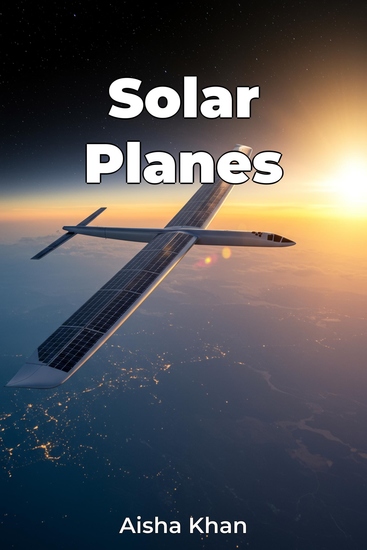
Solar Planes - cover

Solar Planes

Aisha Khan

Traducteur A AI

Maison d'édition: Publifye

  • 0
  • 0
  • 0

Synopsis

Solar Planes explores the exciting potential of solar-powered aviation, examining how aircraft can harness sunlight to achieve sustainable air travel. It delves into the core areas of converting solar energy for flight, the engineering intricacies of solar aircraft design, and the environmental and economic implications of this groundbreaking technology. Did you know aviation substantially contributes to global carbon emissions, making solar planes a vital pathway toward sustainable transportation? This book stands out by offering a comprehensive, technically grounded exploration, going beyond surface-level discussions to provide detailed analysis of the engineering challenges and environmental benefits.

 
The book begins by introducing the principles of solar energy and its application to flight. It then develops these ideas through major sections: (1) an examination of photovoltaic cell technology, focusing on efficiency, weight, and cost, (2) a detailed analysis of solar aircraft design, including aerodynamics, structural considerations, and energy storage solutions, (3) and an assessment of the environmental benefits and economic feasibility of solar-powered aviation compared to conventional aircraft.

 
The book assesses the potential of solar-powered air travel while maintaining scientific rigor, making it valuable for students, engineers, researchers, policymakers, and aviation enthusiasts alike.
Disponible depuis: 06/03/2025.
Longueur d'impression: 79 pages.

D'autres livres qui pourraient vous intéresser

  • String Theory - Exploring the Fundamental Building Blocks of the Universe - cover

    String Theory - Exploring the...

    Mark Hedges

    • 0
    • 0
    • 0
    String theory is one of the most profound and ambitious areas of modern physics, proposing that the fundamental building blocks of the universe are not point particles, as traditionally believed, but rather tiny, vibrating strings. These strings, though incredibly small, can exist in multiple forms, each corresponding to a different type of particle. String theory has the potential to unify the four known fundamental forces of nature—gravity, electromagnetism, the weak nuclear force, and the strong nuclear force—into a single, coherent framework. This vision of a unified theory of everything is one of the most exciting prospects in theoretical physics. 
    The roots of string theory date back to the late 1960s, when theoretical physicists began exploring the idea that the strong nuclear force, which binds quarks together in protons and neutrons, might be mediated by a one-dimensional object, a string, rather than a point-like particle. Initially, this idea was pursued primarily as a means of explaining certain aspects of quantum mechanics and particle interactions. However, as the theory evolved, it began to offer potential solutions to some of the most vexing problems in physics, including the unification of forces and the nature of gravity. 
    One of the key features of string theory is the concept of extra dimensions. In classical physics, we live in a universe of three spatial dimensions and one time dimension. However, string theory suggests that the universe may have many more dimensions, hidden from our everyday perception. These extra dimensions are compactified, meaning they are curled up so small that they are effectively invisible at macroscopic scales. The number of extra dimensions in string theory varies depending on the specific version of the theory, but the most popular form, known as superstring theory, suggests the existence of ten dimensions.
    Voir livre
  • Introduction to Plasma Physics and Controlled Fusion - cover

    Introduction to Plasma Physics...

    Mark Hedges

    • 0
    • 0
    • 0
    Plasma physics is the study of ionized gases, where a significant fraction of the particles are charged, creating a medium that exhibits collective behavior influenced by electromagnetic fields. Plasma is often referred to as the fourth state of matter, alongside solids, liquids, and gases. In a plasma, the thermal energy is sufficient to ionize atoms, resulting in a mixture of positively charged ions and free electrons. This ionization leads to unique properties such as electrical conductivity, response to magnetic fields, and the ability to generate complex, collective phenomena like waves and instabilities. Plasma physics combines elements of fluid dynamics, electromagnetism, and statistical mechanics to describe the behavior of charged particles and fields. 
    Plasmas are characterized by several key parameters, including the electron and ion densities, temperature, and degree of ionization. The Debye length, which measures the distance over which electrostatic interactions are screened out by the collective response of charges, is a fundamental scale in plasma physics.
    Voir livre
  • Life as We Know It - Stories of People Climate and Hope in a Changing World - cover

    Life as We Know It - Stories of...

    Bill Weir

    • 0
    • 0
    • 0
    Award-winning journalist Bill Weir confronts the biggest threats to life as we know it and explores ideas for building a more promising future. 
     
    Bill Weir has spent decades telling the stories of unique people, places, cultures, and creatures on the brink of change. As the first Chief Climate Correspondent in network news, he is immersed in the latest scientific warnings and breakthroughs while often on the frontlines of disasters, natural and manmade. 
     
    After the birth of his son in April 2020, Bill began distilling these experiences into a series of Earth Day letters to his boy, weaving together worry and wonder into a poignant reminder that a better future can still be written. Life as We Know It (Can Be) digs into fascinating corners of history, psychology, technology, and Bill’s own biography to connect the lessons he’s collected from the happiest, healthiest, and most resilient societies. From the sun-powered town that kept its lights on in a hurricane to the Antarctic nests of the one penguin species thriving amid climate change, Bill takes readers around the world to collect dozens of practical ideas to help build a more resilient future.  
     
    Life as We Know It (Can Be) is a celebration of the wonders of our planet, a meditation on the human wants and needs that drive it out of balance, and an inspiration for communities to galvanize around nature and each other as the very best way to brace for what’s next. 
     
    “There is no other correspondent like Bill Weir, and there’s certainly no other book like this one. It’s moving, funny, frank, well-researched, beautifully written, and looks at climate change in a way I’ve never seen before.”—Anderson Cooper, CNN anchor, 60 Minutes correspondent, and New York Times–bestselling author
    Voir livre
  • Food Health and Climate - Why It Is Absolutely Necessary to Reduce Our Consumption of Meat And Other Animal Products - cover

    Food Health and Climate - Why It...

    Risto Isomäki

    • 0
    • 0
    • 0
    By favoring mostly plant-based foods, we can actually save the world – and live longer, healthier lives. 
    A shift to mostly plant-based diets and new food technologies could solve our most important and pressing global problems. Issues like climate change, hunger, freshwater shortages, the Sixth Extinction, antibiotic resistance, and the threat of new pandemics might just melt away with the new food revolution. 
    According to official estimates, meat and other animal-based products account for around 20% of human-generated greenhouse gas emissions. However, the real figure must be significantly higher. Emissions from soils of grazing lands and fields growing cattle feed have not been included in the official statistics. Methane emissions from polluted lakes, rivers, reservoirs and shallow seas are still classified as natural emissions. Besides, cattle raising and fields growing animal feed threaten to transform the whole Amazonian rainforest to semi-dry savannah. If this happens, animal agriculture will become, overwhelmingly, the main driver for global warming. 
    Food, Health and Climate explains why it is not possible to halt global warming without reducing meat consumption. On the other hand, if we manage to shift to more sustainable eating habits, billions of hectares of land will be freed from animal farming and could be used to grow new conservation and carbon-sink forests, or to produce raw materials for new wood- and biomass-based products that could replace metals, concrete, plastics, and chemicals. 
    Risto Isomäki is a Finnish science fiction and science writer and a leading expert on environmental issues.  His books have been published in more than twenty Asian and European languages. 
    “The fiction and non-fiction books written by Risto Isomäki are searching for an equal in the world in their scope and visionarity.” – Professor Heikki Hiilamo, University of Helsinki
    Voir livre
  • The Petroleum Papers - Inside the Far-Right Conspiracy to Cover Up Climate Change - cover

    The Petroleum Papers - Inside...

    Geoff Dembicki

    • 0
    • 0
    • 0
    Burning fossil fuels will cause catastrophic global warming: this is what top American oil executives were told by scientists in 1959. But they ignored that warning. Instead, they developed one of the biggest, most polluting oil sources in the world—the oil sands in Alberta, Canada. As investigative journalist Geoff Dembicki reveals in this explosive book, the decades-long conspiracy to keep the oil sands flowing into the US would turn out to be one of the biggest reasons for the world's failure to stop the climate crisis. 


    In The Petroleum Papers, Dembicki draws from confidential oil industry documents to uncover for the first time how companies like Exxon, Koch Industries, and Shell built a global right-wing echo chamber to protect oil sands profits—a misinformation campaign that continues to this day. He also tells the high-stakes stories of people fighting back: a Seattle lawyer who brought down Big Tobacco and is now going after Big Oil, a Filipina activist whose family drowned in a climate disaster, and a former Exxon engineer pushed out for asking hard questions. 


    With experts now warning we have less than a decade to get global emissions under control, The Petroleum Papers provides a step-by-step account of how we got to this precipice—and the politicians and companies who deserve our blame.
    Voir livre
  • Better Never to Have Been - The Harm of Coming into Existence - cover

    Better Never to Have Been - The...

    David Benatar

    • 0
    • 0
    • 0
    Most people believe that they were either benefited or at least not harmed by being brought into existence. Thus, if they ever do reflect on whether they should bring others into existence—rather than having children without even thinking about whether they should—they presume that they do them no harm. Better Never to Have Been challenges these assumptions. David Benatar argues that coming into existence is always a serious harm. Those who never exist cannot be deprived. However, by coming into existence one does suffer quite serious harms that could not have befallen one had one not come into existence. Drawing on the relevant psychological literature, the author shows that there are a number of well-documented features of human psychology that explain why people systematically overestimate the quality of their lives and why they are thus resistant to the suggestion that they were seriously harmed by being brought into existence. The author then argues for the "anti-natal" view—that it is always wrong to have children—and he shows that combining the anti-natal view with common pro-choice views about fetal moral status yield a "pro-death" view about abortion. Although counter-intuitive for many, that implication is defended, not least by showing that it solves many conundrums of moral theory about population.
    Voir livre