Rejoignez-nous pour un voyage dans le monde des livres!
Ajouter ce livre à l'électronique
Grey
Ecrivez un nouveau commentaire Default profile 50px
Grey
Abonnez-vous pour lire le livre complet ou lisez les premières pages gratuitement!
All characters reduced
Quantum Phones - cover

Quantum Phones

Aiden Feynman

Maison d'édition: Publifye

  • 0
  • 0
  • 0

Synopsis

"Quantum Phones" explores the groundbreaking fusion of quantum communication principles with everyday mobile technology, offering a compelling glimpse into how our smartphones and tablets will evolve in the coming decades.

 
The book navigates through the fascinating intersection of quantum mechanics and telecommunications, making complex concepts accessible through practical examples and real-world applications. Beginning with fundamental quantum principles relevant to mobile technology, the narrative progresses through current experimental implementations before exploring future applications.

 
The book spotlights three crucial areas:- quantum entanglement in mobile communications- quantum cryptography for enhanced security- the integration of quantum computing in smartphone processors

 
Notable developments, such as China's quantum satellite experiments and European quantum communication networks, demonstrate the rapid advancement of this technology. The book uniquely bridges the gap between theoretical physics and consumer electronics, requiring only basic knowledge of physics and electronics from readers.

 
It addresses pressing questions about the feasibility of room-temperature quantum operations and the timeline for widespread deployment, while maintaining a balanced perspective on current technological limitations. For technology professionals, engineers, and curious readers, this work serves as both an introduction to quantum communications and a practical roadmap for understanding how these advances will revolutionize mobile security, processing speed, and network efficiency within the next decade.
Disponible depuis: 10/01/2025.
Longueur d'impression: 109 pages.

D'autres livres qui pourraient vous intéresser

  • A Guide to the Relationship of Humans to Plants - cover

    A Guide to the Relationship of...

    Roy Snelling

    • 0
    • 0
    • 0
    Do you love wandering around you garden looking at your trees, bushes, plants and wonder what use they might have? Of course, the turnips, runner beans et cetera on your vegetable patch you know that they are good for you. But what about marigolds, dandelions, marsh mallow, acorns, pine needles? Yes, they are all edible one way or another. And going for a ramble in the Countryside? There are many wild plants, shrubs and trees that have some part that is edible. But be careful and know exactly what it is you are picking. There are two umbiliferae that you need to be aware of. Cow parsley is edible but the plant is very similar in appearance to Hemlock, which if ingested can kill you. Also, do you know which plants contain ingredients that can be made into health boosters or medicine? A surprising number, but not all of these are edible. Many plants are toxic to humans, although some contain ingredients which can be made into medicines. This book surveys over 600 plant species which were compiled into a comprehensive data-base, from which tables were constructed in the book for easy reference. Common names are given against their Botanical names. Flowers were grouped by their petal numbers. The use of each plant was recorded: is it edible, does it have health benefits, is it toxic? A very useful compendium of plant species for all plant lovers. The book is illustrated with numerous colour images of various flowers and plants.
    Voir livre
  • Generative Artificial Intelligence - What Everyone Needs to Know ® - cover

    Generative Artificial...

    Jerry Kaplan

    • 0
    • 0
    • 0
    Advances in Generative Artificial Intelligence (GAI) have created a new class of computer systems that exhibit astonishing proficiency on a wide variety of tasks with superhuman performance, producing novel text, images, music, and software by analyzing enormous collections of digitized information. Soon, these systems will provide expert medical care; offer legal advice; draft documents; write computer programs; tutor our children; and generate music and art. These advances will accelerate progress in science, art, and human knowledge, but they will also bring new dangers. 


    Have we finally discovered the holy grail of AI—machines that match or exceed human intelligence? Which industries and professions will thrive, and which will wither? What risks and dangers will it pose? How can we ensure that these systems respect our ethical principles? Will the benefits be broadly distributed or accrue to a lucky few? How will GAI alter our political systems and international conflicts? Are we merely a stepping stone to a new form of non-biological life, or are we just getting better at building useful gadgets? 


    Generative Artificial Intelligence: What Everyone Needs to Know® equips listeners with the knowledge to answer these pressing questions.
    Voir livre
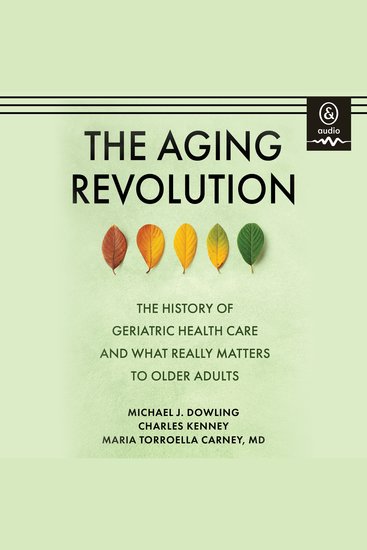
  • The Aging Revolution - The History of Geriatric Health Care and What Really Matters to Older Adults - cover

    The Aging Revolution - The...

    Michael J. Dowling, Charles...

    • 0
    • 0
    • 0
    A history of aging in the United States and an innovative blueprint for revolutionizing care for older adults from Northwell Health, New York’s largest health care system. The New York Times described Dr. Robert Butler as “the man who saw old age anew.” In his 1975 book Why Survive: Being Old in America, Butler argued that for far too many people old age was “a period of quiet despair . . . and muted rage” and he set out to mitigate it. Nearly five decades since he penned his book, a devoted band of brilliant physicians and others in the healthcare field have realized at least a portion of Butler’s dream: to recognize and alleviate suffering among the aging. 
    The Aging Revolution is the story of Butler and his disciples: women and men who saw older distressed adults in hospitals and homes, and worse: being ignored by most of the medical establishment. These revolutionaries could not ignore the suffering, and they set out—individually and collectively—to create entirely new ways of caring for aging adults to ease their suffering and improve their quality and length of life. 
    This revelatory book tells a story never-before told in its entirety, recounting the one of the most significant periods of improvement in American medical history. Readers will learn about pioneering individuals, concepts, and ideas that have improved the lives of millions, including: the women who placed the spotlight on delirium and falls—major issues for older adults; the campaign to build and spread Geriatric and Palliative Care; the small bands of doctors who worked the halls of Congress to create a new program that provides primary care along with home visits from healthcare professionals; and the New York-based foundation that has devoted its mission and millions exclusively to improving care and quality of life for aging adults. 
    Today, as a result, chronic conditions that almost always accompany old age are far more manageable. Older people enjoy more options for work and professional development, for education, for leisure and travel, for sports and maintaining physical strength and mobility. For increasing numbers of Americans, life is healthier and richer in the experiences that matter most. 
    Yet, aging in America can still be a challenge and, too often, particularly for the poor, a painful struggle. The range of mental and physical well-being has almost infinite variations: ninety-year-olds running marathons; sixty-five-year-olds incapacitated by stroke. While this book celebrates the incredible progress and strides made in this field, it also highlights areas that need improvement. The authors lay out specific steps that, if implemented, could ignite the aging revolution and diminish the total volume of older adults suffering in America.
    Voir livre
  • The Wireless World - Global Histories of International Radio Broadcasting - cover

    The Wireless World - Global...

    Friederike Kind-Kovacs, Andrea...

    • 0
    • 0
    • 0
    The Wireless World sets out a new research agenda for the history of international broadcasting, and for radio history more generally. It examines global and transnational histories of long-distance wireless broadcasting, combining perspectives from international history, media and cultural history, the history of technology, and sound studies. It is a cowritten book, the result of more than five years of collaboration. Bringing together their knowledge of a wide range of different countries, languages, and archives, the coauthors show how broadcasters and states deployed international broadcasting as a tool of international communication and persuasion. 


    Exploring the idea of a "wireless world," a globe connected, both in imagination and reality, by radio, The Wireless World sheds new light on the transnational connections created by international broadcasting. Bringing together all periods of international broadcasting within a single analytical frame, the study reveals key continuities and transformations. It looks at how wireless was shaped by internationalist ideas about the use of broadcasting to promote world peace and understanding, at how empires used broadcasting to perpetuate colonialism, and at how anti-colonial movements harnessed radio as a weapon of decolonization.
    Voir livre
  • AI Development Unleashed - Innovations and Techniques for Today's AI Solutions - cover

    AI Development Unleashed -...

    Harper Mitchell

    • 0
    • 0
    • 0
    With a thorough synthesis of theoretical knowledge and real-world applications, "AI Development Unleashed: Innovations and Techniques for Today's AI Solutions" delves into the ever-changing field of artificial intelligence. The book, written by eminent AI specialists, explores the most recent developments and approaches fostering AI innovation across a range of fields. 
    The book starts with basic ideas and moves through important AI methods, including machine learning, neural networks, and natural language processing while providing concise explanations and practical examples. It highlights the significance of strong data methods and effective algorithm design, giving programmers the resources they need to take on challenging AI problems. 
    The book covers important facets of AI implementation and scalability in contemporary applications, going beyond simple theory. It offers a comprehensive understanding of the AI development lifecycle by covering subjects including edge computing, cloud-based AI solutions, and ethical issues in AI development. 
    Additionally, "AI Development Unleashed" covers new developments in deep learning, reinforcement learning, and AI-driven automation that are influencing the direction of AI. The ways in which these technologies are changing sectors, including healthcare, banking, and autonomous systems, are demonstrated through case studies and real-world use cases. 
    This book is an excellent resource for learning about the state-of-the-art concepts and methodologies that underpin today's AI solutions, regardless of whether you're an enthusiast for AI, an experienced developer, or a business leader investigating AI integration. It gives readers the tools they need to properly and successfully use AI's transformative potential in their own activities.
    Voir livre
  • Philosophy - Exploring Life's Big Questions and Timeless Wisdom - cover

    Philosophy - Exploring Life's...

    Coral Nunez

    • 0
    • 0
    • 0
    Philosophy, at its core, is the study of fundamental questions about existence, knowledge, values, reason, and the human condition. It is not merely an academic subject but a way of thinking, questioning, and understanding the world. The term "philosophy" comes from the Greek words "philo" (love) and "sophia" (wisdom), meaning "the love of wisdom." This pursuit of wisdom has been a defining aspect of human civilization for thousands of years, shaping our perspectives on reality, morality, and truth. 
    One of the key aspects of philosophy is its role in fostering critical thinking. Philosophers do not accept ideas at face value but engage in rational inquiry, examining beliefs and assumptions. This is why philosophy often begins with questions rather than answers. What is real? How do we know what we know? What is the purpose of life? These questions are not easily answered, yet they push us to think deeply about our existence. 
    Philosophy is divided into several branches, each focusing on different aspects of human thought. Metaphysics explores the nature of reality, asking questions about existence, time, and the universe. Epistemology deals with the nature and limits of knowledge—how we acquire it and whether absolute truth exists. Ethics examines the principles of right and wrong, guiding moral behavior. Logic studies the structure of reasoning, ensuring that arguments are sound and rational. Political philosophy and aesthetics, while sometimes considered separate disciplines, also fall under the broader philosophical umbrella, dealing with justice, governance, and beauty.
    Voir livre