Rejoignez-nous pour un voyage dans le monde des livres!
Ajouter ce livre à l'électronique
Grey
Ecrivez un nouveau commentaire Default profile 50px
Grey
Abonnez-vous pour lire le livre complet ou lisez les premières pages gratuitement!
All characters reduced
Python Web Development with Sanic - An in-depth guide for Python web developers to improve the speed and scalability of web applications - cover

Python Web Development with Sanic - An in-depth guide for Python web developers to improve the speed and scalability of web applications

Adam Hopkins

Maison d'édition: Packt Publishing

  • 0
  • 0
  • 0

Synopsis

Today’s developers need something more powerful and customizable when it comes to web app development. They require effective tools to build something unique to meet their specific needs, and not simply glue a bunch of things together built by others. This is where Sanic comes into the picture. Built to be unopinionated and scalable, Sanic is a next-generation Python framework and server tuned for high performance.This Sanic guide starts by helping you understand Sanic’s purpose, significance, and use cases. You’ll learn how to spot different issues when building web applications, and how to choose, create, and adapt the right solution to meet your requirements. As you progress, you’ll understand how to use listeners, middleware, and background tasks to customize your application. The book will also take you through real-world examples, so you will walk away with practical knowledge and not just code snippets.By the end of this web development book, you’ll have gained the knowledge you need to design, build, and deploy high-performance, scalable, and maintainable web applications with the Sanic framework.
Disponible depuis: 28/03/2022.
Longueur d'impression: 504 pages.


D'autres livres qui pourraient vous intéresser

  • String Theory - Exploring the Fundamental Building Blocks of the Universe - cover

    String Theory - Exploring the...

    Mark Hedges

    • 0
    • 0
    • 0
    String theory is one of the most profound and ambitious areas of modern physics, proposing that the fundamental building blocks of the universe are not point particles, as traditionally believed, but rather tiny, vibrating strings. These strings, though incredibly small, can exist in multiple forms, each corresponding to a different type of particle. String theory has the potential to unify the four known fundamental forces of nature—gravity, electromagnetism, the weak nuclear force, and the strong nuclear force—into a single, coherent framework. This vision of a unified theory of everything is one of the most exciting prospects in theoretical physics. 
    The roots of string theory date back to the late 1960s, when theoretical physicists began exploring the idea that the strong nuclear force, which binds quarks together in protons and neutrons, might be mediated by a one-dimensional object, a string, rather than a point-like particle. Initially, this idea was pursued primarily as a means of explaining certain aspects of quantum mechanics and particle interactions. However, as the theory evolved, it began to offer potential solutions to some of the most vexing problems in physics, including the unification of forces and the nature of gravity. 
    One of the key features of string theory is the concept of extra dimensions. In classical physics, we live in a universe of three spatial dimensions and one time dimension. However, string theory suggests that the universe may have many more dimensions, hidden from our everyday perception. These extra dimensions are compactified, meaning they are curled up so small that they are effectively invisible at macroscopic scales. The number of extra dimensions in string theory varies depending on the specific version of the theory, but the most popular form, known as superstring theory, suggests the existence of ten dimensions.
    Voir livre
  • Fire Eaters - The People and Aircraft Combatting Wildfires Over the Last Century - cover

    Fire Eaters - The People and...

    Peter Pigott

    • 0
    • 0
    • 0
    Throughout history, when threatened by wildfires our only defense was to pray for rain and run—until aircraft changed the way we fight fires. Beginning with the Canadian "H-Boats" in 1924, aircraft have become indispensable in detecting and extinguishing wildfires. Fire Eaters tells the incredible stories of the Ontario Provincial Air Service, the first government aerial fire suppression organization in history; one of its pilots, Carl Crossley, who invented the water scoop-up and drop-off system; and the Canadair CL-215, the first purpose-built water bomber. 


    Today, helicopters with "Bambi Buckets" and snorkels can dump water while hovering directly over the flames, and Air Tractors and Dash 8-400AT air tankers not only perform a crucial role in saving communities but also protect our ecosystem. Satellites—unmanned aircraft able to fly for sixteen hours, even overnight when manned aircraft do not—and artificial intelligence already play a decisive role in fire management. 


    But it is the men and women of the aerial fire service who have really changed the way we fight fire around the world. Their bravery and dedication mean that response times are fast, fires can be contained sooner, and people have the chance to save rather than lose everything.
    Voir livre
  • Reluctant Conquest - American Wealth Power and Science in the Arctic - cover

    Reluctant Conquest - American...

    Kathryn C. Lavelle

    • 0
    • 0
    • 0
    What drives American foreign relations in the Arctic? It is difficult to give a unified answer to this question because most histories of the region are divided between the Atlantic and Pacific coasts, Asian and European strategic interests, or federal government and Indigenous peoples' concerns, making it difficult to understand the connections among the environmental challenges, scientific understandings, strategic calculations, and governance relationships. Most Americans do not think of their country as an Arctic power, yet it is a region where the United States has had important ties throughout its history.In this sweeping study, from the founding of the country through the acquisition of Alaska to the present, Kathryn C. Lavelle considers American relations across the circumpolar North, incorporating discussions of economics, national security, and science that are conventionally separated. Lavelle argues that it is impossible to understand United States policy without a knowledge of American political development and of how scientific understandings have grown alongside studies of climate and other environmental issues. This history has important implications for future American policy regarding traditional national security and political economy, in addition to climate change and environmental cooperation.
    Voir livre
  • Mastering Spring Reactive Programming for High Performance Web Apps - Revolutionize Your Asynchronous Application Development in Spring with Reactive Programming Principles Spring WebFlux and Reactor - cover

    Mastering Spring Reactive...

    Shubham Srivastava

    • 0
    • 0
    • 0
    Master Reactive Programming: Build Solutions with Reactive Spring
    Book Description
    Mastering Spring Reactive Programming for High Performance Web Apps is a comprehensive guide designed for developers looking to master reactive programming with Spring WebFlux and Reactor. Whether you're a beginner seeking to understand the fundamentals or an experienced developer aiming to enhance your asynchronous programming skills, this book delivers a clear, step-by-step approach to take you from basic concepts to advanced real-world applications. 
    Focused on practical, real-world implementations, the book teaches you how to build, optimize, and maintain efficient reactive systems. It guides you through creating scalable, event-driven applications, handling complex asynchronous tasks, and managing distributed systems using WebFlux libraries and the Reactor framework. By addressing real-world challenges, this book equips readers to improve system performance and resource management, ensuring applications are built for high scalability and resilience. 
    Table of Contents
    
    1. Introduction to Spring Framework
    2. Fundamentals of Reactor Framework
    3. Reactive Streams and Implementations
    4. Asynchronous Programming Using Spring WebFlux
    5. Developing Reactive Web Applications Using WebClient
    6. Reactive Repositories
    7. Messaging Using Reactive Streams
    8. Spring Cloud and Reactive Framework
    9. Testing and Debugging
    10. Release and Monitoring
    11. Hands-On Exercises
    12. Interview Questions
    Index
    Voir livre
  • Creatures That Eat People - Why Wild Animals Might Eat You - cover

    Creatures That Eat People - Why...

    Richard Freeman

    • 0
    • 0
    • 0
    Wild Animals Might Eat You—Learn Which Ones 


    Avoid getting eaten! Do you find yourself wondering: Do bears eat humans? Do birds eat people? Do kangaroos? Could I survive people eating predators of any kind? Perfect for anyone with a fun or morbid interest in wildlife or survivalism, Creatures That Eat People is full of stories of strange animals that eat humans and the situations that lead to it. 


    Learn which wild animals might eat you—from an expert. Cryptozoologist, former zookeeper, current zoological director, bestselling author, and animal enthusiast Richard Freeman examines all the cool man eaters in the animal kingdom—so you can be prepared on your next adventure. 


    You'll find: tips for visiting different types of areas with apex predators in them; bears, sharks, birds, kangaroos, squids, lions, raptors, and all of the other other weird, wild animals that eat people; and real-life, thrilling stories of animals eating people—and some survive and some don't. 


    If you liked How To Survive A Freakin' Bear Attack, Plants That Kill, Surviving the Wild, or In Search of Real Monsters, and if you enjoyed shows like Tiger King or Human Prey, you'll love Creatures That Eat People.
    Voir livre
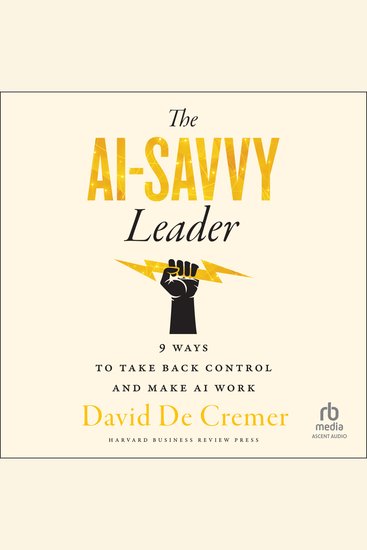
  • The AI-Savvy Leader - Nine Ways to Take Back Control and Make AI Work - cover

    The AI-Savvy Leader - Nine Ways...

    David De Cremer

    • 0
    • 0
    • 0
    Leaders, don't let AI get the best of you. 


    AI is coming fast and will affect every part of a business, including the role of the leader. And up until now, leaders have largely ceded their role in the transformation—pushing determination of strategy out to tech teams and leaving investment decisions with groups that don't have a full view of the organization. Just when responsible leadership is more imperative than ever, leaders are not stepping up to understand and execute in the new world of human-machine collaboration. A generation of AI transformation failures awaits if leaders don't connect their use of AI to their strategies. 


    This book helps leaders retake control of the wildly rapid deployment of AI across organizations. It outlines cleanly and concisely nine actions leaders need to take to successfully steward a transition to a more AI-centric future that will lead to growth for all—companies and workers—and avoid the kinds of mistakes that author David De Cremer has seen many early adopters already make. This is not a book about AI technology itself or the latest developments in machine learning but rather a clarion call for leaders to take their rightful place at the front of the AI revolution and lead their organization into the new world.
    Voir livre