Rejoignez-nous pour un voyage dans le monde des livres!
Ajouter ce livre à l'électronique
Grey
Ecrivez un nouveau commentaire Default profile 50px
Grey
Abonnez-vous pour lire le livre complet ou lisez les premières pages gratuitement!
All characters reduced
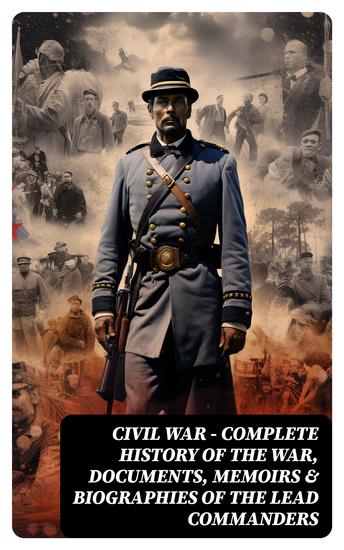
CIVIL WAR – Complete History of the War Documents Memoirs & Biographies of the Lead Commanders - cover

CIVIL WAR – Complete History of the War Documents Memoirs & Biographies of the Lead Commanders

Abraham Lincoln, Ulysses S. Grant, John Esten Cooke, William T. Sherman, James Ford Rhodes, Frank H. Alfriend

Maison d'édition: DigiCat

  • 0
  • 0
  • 0

Synopsis

In 'CIVIL WAR – Complete History of the War, Documents, Memoirs & Biographies of the Lead Commanders,' readers are invited to explore an expansive tapestry of narratives and reflections from the Civil War era. This anthology brings together a diverse range of literary styles, including official documents, personal memoirs, and detailed biographies that collectively illuminate the complexities of this tumultuous period in American history. Through its varied contents, the collection captures both the grand strategies and human intricacies of the war, offering standout pieces that provide invaluable insights into the minds of those who shaped the course of the conflict. The collection draws its power from the combined insights of esteemed contributors such as John Esten Cooke, Abraham Lincoln, and Ulysses S. Grant, each offering unique perspectives rooted in their experiences and roles. These authors, along with William T. Sherman and others, contribute to a multifaceted narrative that intersects with major cultural and historical movements of the time. Their works reflect diverse backgrounds and motivations, presenting a layered understanding of the Civil War that highlights the complexities of leadership, morality, and national identity during this era. A necessary addition to any history enthusiast's library, this anthology offers a compelling window into the Civil War's multidimensional legacy. Readers will find themselves engaged in a comprehensive exploration of the period, enhanced by the editors' skillful curation of authoritative voices. It serves as both an educational resource and a thought-provoking dialogue that bridges past and present, urging readers to consider the enduring impact of the Civil War on modern America. With this rich compilation, the anthology provides an unparalleled opportunity to engage with a pivotal chapter in American history.
Disponible depuis: 12/12/2023.
Longueur d'impression: 3541 pages.

D'autres livres qui pourraient vous intéresser

  • Julian - Rome's Last Pagan Emperor - cover

    Julian - Rome's Last Pagan Emperor

    Philip Freeman

    • 0
    • 0
    • 0
    "When we think of ancient Rome, it's impossible not to think of Christianity, one of its most notable exports—but what if it hadn't been? This is the question provoked by classicist Philip Freeman in Julian, an appealing new entry in Yale's Ancient Lives series, which tells the story of the old faith's last imperial torchbearer."—Anna Heyward, New York Times Book Review 


    Flavius Claudius Julianus, or Julian the Apostate, ruled Rome as sole emperor for just a year and a half, from 361 to 363, but during that time he turned the world upside down. Although a nephew of Constantine the Great, the first Christian emperor of Rome, Julian fought to return Rome to the old gods who had led his ancestors to build their vast empire. 


    As emperor, Julian set about reforming the administration, conquering new territories, and reviving ancient religions. He was scorned in his time for repudiating Christianity and demonized as an apostate for willfully rejecting Christ. Through the centuries, Julian has been viewed by many as a tragic figure who sought to save Rome from its enemies and the corrupting influence of Christianity. Christian writers and historians have seen Julian much differently: as a traitor to God and violent oppressor of Christians. Had Julian not been killed by a random Persian spear, he might well have changed all of history.
    Voir livre
  • Joan of Arc - The Historical Heroine of France during the French Revolution - cover

    Joan of Arc - The Historical...

    Kelly Mass

    • 0
    • 0
    • 0
    The painting of her on the battlefield with only one breast covered and holding a flag is probably one of the most famous paintings from European history. Many people have heard of Joan of Arc, but only few know what she did or how her life was. 
    Joan of Arc (French: Jeanne d' Arc) is a French heroine who was venerated as a saint for her role in the Lancastrian part of the Hundred Years' War. She was born in Domrémy, in the Vosges area of northeast France, to Jacques d' Arc and Isabelle Romée, a peasant family. Joan said she saw visions of the archangel Michael, Saint Margaret, and Saint Catherine of Alexandria telling her to support Charles VII and free France from English supremacy late in the Hundred Years' War. Joan was sent out as part of a relief army to the siege of Orléans by the as-yet-unanointed King Charles VII. After the siege was raised only 9 days later, she rose to fame. 
    She ended up being a sign of the Catholic League in the 16th century, and Napoleon Bonaparte called her a nationwide sign of France in 1803. 
    In 1909, she was beatified, and in 1920, she was canonized. One of France's 9 secondary tutelary saint is Joan of Arc. 
    Since her death, Joan of Arc has stayed a popular character in literature, painting, sculpture, and other cultural works, with many popular authors, playwrights, filmmakers, artists, and composers creating and continuing to produce cultural representations of her.
    Voir livre
  • Bohemian Club The: The History of One of America’s Most Secretive and Controversial Private Clubs - cover

    Bohemian Club The: The History...

    Editors Charles River

    • 0
    • 0
    • 0
    Conspiracy theories, and particularly the belief that elements of the world are secretly controlled by individuals or groups, have been around for as long as people have lived in groups. Perhaps that’s inevitable - after all, those who are excluded from power are very likely to be inclined to see their position not as an outcome of their own choices or situation but because of the secret machinations of shadowy groups.  
    One topic that has been a constant in Internet debates is the group known as the Bohemian Club. Founded in 1872 in San Francisco, this began as a club for journalists with an interest in the arts, but over the subsequent 150 years, it appears to have changed into a vehicle for the annual conclave of some of the most wealthy and powerful men on the planet. Each year, hundreds of men gather in a luxurious camp known as Bohemian Grove in a remote forest in California to do something.  
    	Just what it is they do is a secret, which has inevitably led to some intense speculation. Is it no more than a fun-filled frolic where the super-rich and powerful can go to escape their cares for a few days, or is it something more sinister, a cabal in which secret decisions are made that affect everybody else? Finding out about the Bohemian Club and the annual gatherings at Bohemian Grove isn’t easy. Most of those invited to join this exclusive club remain members until they die, meaning there are no disaffected former members willing to talk about what goes on there. Current members are unwilling to talk about the club or its activities.  
    	It’s this secrecy that has led to some bizarre speculation about just what it is that happens in Bohemian Grove every summer. Coming up with answers is no easy feat, as the group takes its secrecy seriously and members have the wealth and power to make sure the club’s business stays secret.
    Voir livre
  • Talleyrand: The Life and Legacy of France’s Most Influential Diplomat - cover

    Talleyrand: The Life and Legacy...

    Editors Charles River

    • 0
    • 0
    • 0
    “Politics is the systematic cultivation of hatred.” - Talleyrand 
    	While Metternich is most associated with the Congress of Vienna, France, despite its turbulence, had its own influential representative there: Charles Maurice de Talleyrand-Périgord. Known simply as Talleyrand, his name ultimately became associated with crafty, manipulative personal and political maneuvering, even in a country that suffered no shortage of such diplomats and ministers in its history. 
    	As an adult, Talleyrand lived through the most tumultuous years of French history. In a period of little more than 40 years, France passed through five very different periods of rule, but despite the chaos these rapid changes brought, Talleyrand served in important roles in each successive new regime and, through a combination of charm, guile, intelligence, ability, and duplicity, played a leading role in undermining and destroying each. 
    	Under the Ancien Régime, the social and political system by which France had been ruled since the Middle Ages, Talleyrand became a bishop. When the French Revolution tore the nation apart, Talleyrand betrayed both the church and the French Monarchy and became Foreign Minister for the Directory, the governing committee of the French First Republic. In 1799, he betrayed the Republic by helping to organize the coup d'état that would see Napoleon Bonaparte become the absolute dictator of France. 
    	Talleyrand became extremely rich and very powerful under Napoleon, until he wearied of his new leader and betrayed him by selling secrets to his enemies. Talleyrand was one of the key people involved in the plot to remove Napoleon from power and pave the way for the Bourbon Restoration that brought Louis XVIII to the French throne in 1814. He was also a significant factor in the undermining of that regime and its replacement in 1830 during another revolution by a new constitutional monarchy.
    Voir livre
  • Bloody Verrières - The I SS-Panzerkorps Defence of the Verrières-Bourguebus Ridges: Volume 2: The Defeat of Operation Spring and the Battles of Tilly-La-Campagne 23 July – 5 August 1944 - cover

    Bloody Verrières - The I...

    Arthur W. Gullachsen, Douglas E....

    • 0
    • 0
    • 0
    South of the Norman city of Caen, Verrières Ridge was seen a key stepping-stone for the British Second Army if it was to break out of the Normandy bridgehead in late July 1944. Imposing in height and containing perfect terrain for armored operations, the Germans viewed it as the lynchpin to their defenses south of the city of Caen and east of the Orne river. 


    Following the failure of British Operation Goodwood on 18–20 July and the containment of the Canadian Operation Atlantic, further Allied attacks to seize the ridge would have to defeat arguably the strongest German armored formation in Normandy: The I. SS-Panzerkorps 'Leibstandarte.' The fighting of 23 July–3 August is chronicled in detail, specifically the premier Anglo-Canadian operation to capture Verrières Ridge, Operation Spring on 25 July. Designed as an attack to seize the ridge and exploit south with armor, this battle saw the 2nd Canadian Corps attack savaged again by German armored reserves brought in specifically to defeat another Goodwood. 


    Not satisfied with this defensive victory, German armored forces would then seek to restore an earlier defensive line further north, attacking to destroy the 2nd Canadian Infantry Division. Largely unknown, these were some of the strongest and most successful German armored operations to take place in the Normandy campaign.
    Voir livre
  • And Still We March: The touching memoir telling the story of feminism and the fight for women’s rights then and now through the true story of a family - cover

    And Still We March: The touching...

    Marisa Bate

    • 0
    • 0
    • 0
    Retracing my mother’s footsteps in search of women’s freedom 
    1974. A 22-year-old Jacqui French stands for a photograph in Omaha, Nebraska, thousands of miles from home.  
    In 2022, the US Supreme Court voted to overturn Roe v. Wade, restricting access to abortion across America. The decision mirrored a global trend towards a devastating unravelling of women’s freedoms; a reversal of hard-won progress, and a battle that continues to be fought on both sides of the Atlantic. 
    Following in the footsteps of her mother fifty years before her, Marisa Bate is galvanised to journey across America, meeting the women on the ground, and telling the stories behind the headlines. Examining half a century of feminist struggle in the UK and the US, she also finds herself tracing the roots of her own family, seamlessly interweaving the personal with the political. 
    Lyrical, poignant, and bursting with defiant hope, And Still We March is an urgent and perceptive dissection of female autonomy, motherhood, and a woman’s right to choose. 
    A ‘beguiling feminist memoir’ Lindsey Hilsum 
    In this top-rated autobiography, Marisa Bate delves into the history of women's rights, intertwining it with her mother's personal journey. The narrative is a testament to the resilience of women, even in the face of discrimination and social challenges. 
    For fans of Richard Osman (Richard Osman's House of Games), Laura Bates (Fix the System, Not the Women), Lucy Jones (Matrescence), Donna Lancaster (Wise Words for Women), and Bre Graham (Table for Two). 
    HarperCollins 2023
    Voir livre