Begleiten Sie uns auf eine literarische Weltreise!
Buch zum Bücherregal hinzufügen
Grey
Einen neuen Kommentar schreiben Default profile 50px
Grey
Jetzt das ganze Buch im Abo oder die ersten Seiten gratis lesen!
All characters reduced
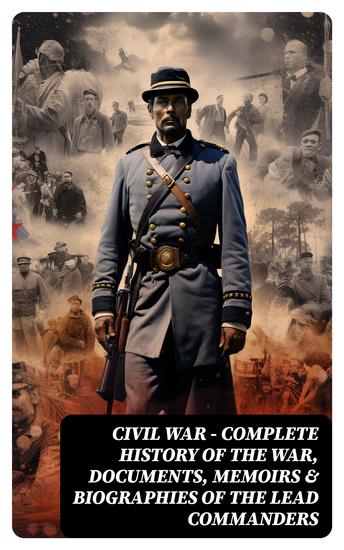
CIVIL WAR – Complete History of the War Documents Memoirs & Biographies of the Lead Commanders - cover

CIVIL WAR – Complete History of the War Documents Memoirs & Biographies of the Lead Commanders

Abraham Lincoln, Ulysses S. Grant, John Esten Cooke, William T. Sherman, James Ford Rhodes, Frank H. Alfriend

Verlag: DigiCat

  • 0
  • 0
  • 0

Beschreibung

In 'CIVIL WAR – Complete History of the War, Documents, Memoirs & Biographies of the Lead Commanders,' readers are invited to explore an expansive tapestry of narratives and reflections from the Civil War era. This anthology brings together a diverse range of literary styles, including official documents, personal memoirs, and detailed biographies that collectively illuminate the complexities of this tumultuous period in American history. Through its varied contents, the collection captures both the grand strategies and human intricacies of the war, offering standout pieces that provide invaluable insights into the minds of those who shaped the course of the conflict. The collection draws its power from the combined insights of esteemed contributors such as John Esten Cooke, Abraham Lincoln, and Ulysses S. Grant, each offering unique perspectives rooted in their experiences and roles. These authors, along with William T. Sherman and others, contribute to a multifaceted narrative that intersects with major cultural and historical movements of the time. Their works reflect diverse backgrounds and motivations, presenting a layered understanding of the Civil War that highlights the complexities of leadership, morality, and national identity during this era. A necessary addition to any history enthusiast's library, this anthology offers a compelling window into the Civil War's multidimensional legacy. Readers will find themselves engaged in a comprehensive exploration of the period, enhanced by the editors' skillful curation of authoritative voices. It serves as both an educational resource and a thought-provoking dialogue that bridges past and present, urging readers to consider the enduring impact of the Civil War on modern America. With this rich compilation, the anthology provides an unparalleled opportunity to engage with a pivotal chapter in American history.
Verfügbar seit: 12.12.2023.
Drucklänge: 3541 Seiten.
Weitere Bücher, die Sie mögen werden

  • After the Flames - A Burn Victim's Battle With Celebrity - cover

    After the Flames - A Burn...

    Jonathan R. Rose

    • 0
    • 0
    • 0
    "A fast-paced, compelling narrative that goes far beyond the headlines." —KEVIN DONOVAN, author of The Billionaire Murders 


    For Joey Philion, surviving the fire was only the beginning. 


    On the morning of March 10th, 1988, in Orillia, Ontario, a house fire engulfed fourteen-year-old Joey Philion in flames. He suffered third degree burns on ninety-five percent of his body. Doctors didn't think he would make it through the night. 


    After the Flames is about one of the world's most famous burn victims: his incredible survival, his nightmarish path to recovery that helped revolutionize medical treatment for burn victims worldwide, the fame thrust upon him after he was declared a hero from the media, and the tumultuous years that followed, most of which were spent under the microscope of an unforgiving public eye. 


    The story also follows Joey's family, including his mother Linda, stepfather Mike, and younger brother Danny, all of whom endured their own tremendous hardships in the wake of a fire that changed their lives forever.
    Zum Buch
  • Joan of Arc - The Historical Heroine of France during the French Revolution - cover

    Joan of Arc - The Historical...

    Kelly Mass

    • 0
    • 0
    • 0
    The painting of her on the battlefield with only one breast covered and holding a flag is probably one of the most famous paintings from European history. Many people have heard of Joan of Arc, but only few know what she did or how her life was. 
    Joan of Arc (French: Jeanne d' Arc) is a French heroine who was venerated as a saint for her role in the Lancastrian part of the Hundred Years' War. She was born in Domrémy, in the Vosges area of northeast France, to Jacques d' Arc and Isabelle Romée, a peasant family. Joan said she saw visions of the archangel Michael, Saint Margaret, and Saint Catherine of Alexandria telling her to support Charles VII and free France from English supremacy late in the Hundred Years' War. Joan was sent out as part of a relief army to the siege of Orléans by the as-yet-unanointed King Charles VII. After the siege was raised only 9 days later, she rose to fame. 
    She ended up being a sign of the Catholic League in the 16th century, and Napoleon Bonaparte called her a nationwide sign of France in 1803. 
    In 1909, she was beatified, and in 1920, she was canonized. One of France's 9 secondary tutelary saint is Joan of Arc. 
    Since her death, Joan of Arc has stayed a popular character in literature, painting, sculpture, and other cultural works, with many popular authors, playwrights, filmmakers, artists, and composers creating and continuing to produce cultural representations of her.
    Zum Buch
  • Great Escapes of World War I The: The History of the Most Famous Prisoner Breakouts during the Great War - cover

    Great Escapes of World War I...

    Editors Charles River

    • 0
    • 0
    • 0
    In the first half of the 20th century, war was fought on a global and industrial scale. Millions of men were flung into the grinder of World War I and World War II, leading to commensurately huge numbers of prisoners of war (POWs). Camps were built to hold thousands of captives, with their own barracks blocks, parade grounds, and even farms. In World War I, there were several fronts in the war - Britain, France, Belgium, and Germany faced each other on the Western Front, fought mostly in northeast France and Belgium, while Germany and Austria Hungary faced Russia on the Eastern Front, where much of the war was fought in East Prussia and what is now Poland. The Italians and Austrians fought in the region of northeast Italy, and the Austrians and Bulgarians faced Serbia and then later an Allied army based in Salonica in the Balkans. The Ottomans faced Russia in northeast Anatolia, the British and Allied forces in the Mesopotamian campaign (mainly in today’s Iraq), the British in Palestine, and the Allies at Gallipoli.  
    	Regardless of rank, throughout the war, many of these men did not sit idle. Many spent their time preparing elaborate escape plans in the hopes of returning to their home nations and back to the fight. Following World War I, several books were published giving romantic accounts of successful escapes. For example, the wildly popular film The Great Escape (1963), has been a main factor in how the public views prisoners of war, and while that film was based on a book that details a mass escape of British and Allied prisoners from a World War II German prison camp for aviators, Stalag Luft III, a real escape from a German prisoner camp in World War I inspired the 1944 great escape from Stalag Luft III. 
    Zum Buch
  • Talleyrand: The Life and Legacy of France’s Most Influential Diplomat - cover

    Talleyrand: The Life and Legacy...

    Editors Charles River

    • 0
    • 0
    • 0
    “Politics is the systematic cultivation of hatred.” - Talleyrand 
    	While Metternich is most associated with the Congress of Vienna, France, despite its turbulence, had its own influential representative there: Charles Maurice de Talleyrand-Périgord. Known simply as Talleyrand, his name ultimately became associated with crafty, manipulative personal and political maneuvering, even in a country that suffered no shortage of such diplomats and ministers in its history. 
    	As an adult, Talleyrand lived through the most tumultuous years of French history. In a period of little more than 40 years, France passed through five very different periods of rule, but despite the chaos these rapid changes brought, Talleyrand served in important roles in each successive new regime and, through a combination of charm, guile, intelligence, ability, and duplicity, played a leading role in undermining and destroying each. 
    	Under the Ancien Régime, the social and political system by which France had been ruled since the Middle Ages, Talleyrand became a bishop. When the French Revolution tore the nation apart, Talleyrand betrayed both the church and the French Monarchy and became Foreign Minister for the Directory, the governing committee of the French First Republic. In 1799, he betrayed the Republic by helping to organize the coup d'état that would see Napoleon Bonaparte become the absolute dictator of France. 
    	Talleyrand became extremely rich and very powerful under Napoleon, until he wearied of his new leader and betrayed him by selling secrets to his enemies. Talleyrand was one of the key people involved in the plot to remove Napoleon from power and pave the way for the Bourbon Restoration that brought Louis XVIII to the French throne in 1814. He was also a significant factor in the undermining of that regime and its replacement in 1830 during another revolution by a new constitutional monarchy.
    Zum Buch
  • Bloody Verrières - The I SS-Panzerkorps Defence of the Verrières-Bourguebus Ridges: Volume 2: The Defeat of Operation Spring and the Battles of Tilly-La-Campagne 23 July – 5 August 1944 - cover

    Bloody Verrières - The I...

    Arthur W. Gullachsen, Douglas E....

    • 0
    • 0
    • 0
    South of the Norman city of Caen, Verrières Ridge was seen a key stepping-stone for the British Second Army if it was to break out of the Normandy bridgehead in late July 1944. Imposing in height and containing perfect terrain for armored operations, the Germans viewed it as the lynchpin to their defenses south of the city of Caen and east of the Orne river. 


    Following the failure of British Operation Goodwood on 18–20 July and the containment of the Canadian Operation Atlantic, further Allied attacks to seize the ridge would have to defeat arguably the strongest German armored formation in Normandy: The I. SS-Panzerkorps 'Leibstandarte.' The fighting of 23 July–3 August is chronicled in detail, specifically the premier Anglo-Canadian operation to capture Verrières Ridge, Operation Spring on 25 July. Designed as an attack to seize the ridge and exploit south with armor, this battle saw the 2nd Canadian Corps attack savaged again by German armored reserves brought in specifically to defeat another Goodwood. 


    Not satisfied with this defensive victory, German armored forces would then seek to restore an earlier defensive line further north, attacking to destroy the 2nd Canadian Infantry Division. Largely unknown, these were some of the strongest and most successful German armored operations to take place in the Normandy campaign.
    Zum Buch
  • Chief Energy Officer- the #newCEO - How High-Performing Leaders Manage People Pressure and Profit to Build Thriving Organizations - cover

    Chief Energy Officer- the...

    Suzy Siegle

    • 0
    • 0
    • 0
    What is leadership energy? How important is energy for leaders? 
    The role of the #newCEO is less about being an executive and more about being the organization's Chief Energy Officer. 
    This book explains why energy is the secret sauce for leaders, and how the right type of energy elevates culture, communication and organizational success. 
    And the best part? You don't have to be in the "C-Suite" to be your organization's Chief Energy Officer!
    Zum Buch