Begleiten Sie uns auf eine literarische Weltreise!
Buch zum Bücherregal hinzufügen
Grey
Einen neuen Kommentar schreiben Default profile 50px
Grey
Jetzt das ganze Buch im Abo oder die ersten Seiten gratis lesen!
All characters reduced
Micro Democracy - The Democracy Revolution of the Information Era - cover

Micro Democracy - The Democracy Revolution of the Information Era

Aaron Ran

Verlag: Aaron Ran

  • 0
  • 1
  • 0

Beschreibung

Micro democracy is a scientific, revolutionary and executable total solution to implement true democracy which maximizes social utility and social justice. Theories, system designs, action plans, roadmap are all in this book, for people to build a new world. It originated from the idea of direct democracy, and deeply optimized and reformed with the help of information technology. It achieves a perfect balance between social justice, decision-making efficiency, and quality. On this basis, a complete superstructure is established, including human rights, laws, and government. With it, people will be able to overthrow the existing political system entirely and create a governance platform that enables the self-evolution and peaceful development of civilization. In addition to theoretical analysis, this book also provides actionable implementation plans and roadmaps so that people can immediately begin to practice and create this new political system. Also, the book proposed a general quantitative model for the assessment of the democratic level of states and regimes, helping people to study the political characteristics of various countries objectively.
Verfügbar seit: 04.07.2020.

Weitere Bücher, die Sie mögen werden

  • Beyond Rage - Mastering Anger Management for a Calmer Life - cover

    Beyond Rage - Mastering Anger...

    Emmanuel Gray

    • 0
    • 0
    • 0
    Beyond Rage: Mastering Anger Management for a Calmer LifeWelcome to 'Beyond Rage: Mastering Anger Management for a Calmer Life,' your comprehensive guide to understanding and harnessing the power of your emotions. In this audiobook, we embark on a transformative journey to help you navigate the turbulent waters of anger and find your way to a more tranquil and fulfilling life.Explore the complexities of anger, its triggers, and its impact on your mental and physical well-being. With expert insights and practical techniques, you'll learn to identify, manage, and ultimately transcend your anger, transforming it into a source of personal growth and emotional resilience.This audiobook isn't just about controlling anger; it's about mastering it and using it as a catalyst for positive change. Through mindfulness, communication strategies, and self-awareness, 'Beyond Rage' empowers you to forge healthier relationships, enhance your emotional intelligence, and cultivate inner peace.Whether you're seeking to manage everyday frustrations or deeper-rooted anger issues, this audiobook provides the tools and wisdom needed to regain control and chart a course toward a calmer, more satisfying life. Join us on this transformative journey beyond rage, and discover the path to emotional mastery and lasting serenity.
    Zum Buch
  • Can we make truth great again? - cover

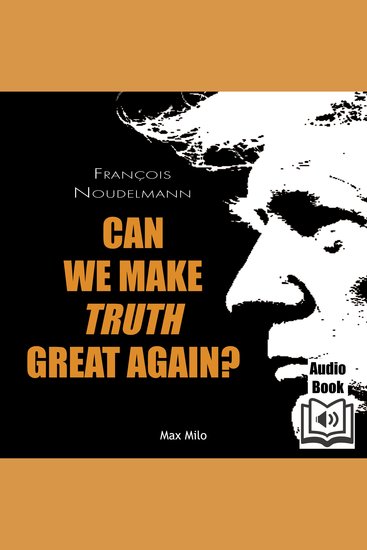
    Can we make truth great again?

    François Noudelmann

    • 0
    • 0
    • 0
    During the 2024 US presidential campaign, the proliferation of lies reached an unprecedented level. This confirms that we have entered the era of post-truth and alternative facts. Beyond true and false, anyone can claim their interpretation and narrative. Is there a way to prevent fake news and political manipulation that threaten democracy?
    This essay traces the path that has led to this relativism over the last forty years on both sides of the ideological spectrum: the reign of storytelling, the empire of emotion, identity politics, victimization, autofiction, cancelation, philosophical deconstruction, the virtualization of the world by artificial intelligence… have all decimated universal reason. To save truth and the positivity of facts, François Noudelmann explores other resources, such as indignation in the face of lies and the alliance of doubt and revolt, which allow us to still believe in a common language.
    Zum Buch
  • A Rare Recording of Henry Cabot Lodge - cover

    A Rare Recording of Henry Cabot...

    Henry Cabot Lodge

    • 0
    • 0
    • 0
    Henry Cabot Lodge (May 12, 1850 - November 9, 1924) was an American Republican politician, historian, and statesman from Massachusetts. He served in the United States Senate from 1893 to 1924 and is best known for his positions on foreign policy. The following recording documents his successful crusade against Woodrow Wilson's Treaty of Versailles and ensured that the United States never joined the League of Nations and his reservations against that treaty influenced the structure of the modern United Nations.
    Zum Buch
  • The Prince - cover

    The Prince

    Niccolò Machiavelli

    • 0
    • 0
    • 0
    Power is never given freely—it is taken, protected, and mastered.
    Written for rulers navigating danger and ambition, The Prince strips leadership down to its hard realities. Machiavelli explores how power is gained, maintained, and lost, arguing that effectiveness often matters more than virtue. With bold clarity, he examines deception, authority, fear, loyalty, and the price of control in a world ruled by uncertainty.
    
    Regarded as "the most influential political treatise ever written," this classic has shaped leaders, thinkers, and strategists for centuries. Its insights remain unsettling, provocative, and strikingly relevant in modern politics, business, and leadership.
    
    If you want to understand how power truly works—and why appearances can matter more than intentions—this book is essential reading.
    
    Open the book—and confront the realities behind leadership and power.
    Zum Buch
  • The Man that Corrupted Hadleyburg and Other Stories - cover

    The Man that Corrupted...

    Mark Twain

    • 0
    • 0
    • 0
    Delve into the world of moral ambiguity, human frailty, and humor with 'The Man that Corrupted Hadleyburg and Other Stories' by Mark Twain. This audiobook presents a collection of Twain's short stories that are as insightful as they are entertaining. With a keen eye for the complexities of human nature, Twain weaves tales that challenge our notions of honesty and integrity. From the enigmatic stranger who brings corruption to a seemingly virtuous town to humorous narratives that explore the human condition, Twain's storytelling prowess shines in this audiobook.
    Zum Buch
  • Modern Discovery of Australia and New Zealand The: The History of the Indigenous Natives and the Initial European Expeditions and Settlements - cover

    Modern Discovery of Australia...

    Editors Charles River

    • 0
    • 0
    • 0
    A land of almost 3 million square miles has lain since time immemorial on the southern flank of the planet, so isolated that it remained entirely outside of European knowledge until 1770. However, the first human footprints on this vast territory were felt 70,000 years earlier, as people began to cross the periodic land bridges and the short sea crossings from Southeast Asia. 
    By the mid-17th century, the existence of a land in the south referred to as Terra Australis was generally known and understood by the Europeans, and incrementally, its shores were observed and mapped. Van Diemen’s Land, an island off the south coast of Australia now called Tasmania, was identified in 1642 by Dutch mariner Abel Tasman, and a few months later, the intrepid Dutchman would add New Zealand to the map of the known world. 
    At the time, the English were the greatest naval power in Europe, but they arrived on the scene rather later. The first to appear was William Dampier, captain of the HMS Roebuck, in 1699, after he had been granted a Royal Commission by King William III to explore the east coast of New Holland. By then, the general global balance of power was shifting, and with the English gaining a solid foothold in India, their supremacy in the Indian Ocean trade zone began. The Dutch, once predominant in the region, began slowly to lose ground, slipping out of contention as a major global trading power. So too were the Portuguese, also once dominant in the region. It was now just the French and the English who were facing one another down in a quest to dominate the world, but their imperial interests were focused mainly in India and the East Indies, as well as the Caribbean and the Americas. As a result, the potential of a vast, practically uninhabited great southern continent did not yet hold much interest. By then the world was largely mapped, with just regions such as the Arctic Archipelago and the two poles remaining terra incognita.
    Zum Buch