Begleiten Sie uns auf eine literarische Weltreise!
Buch zum Bücherregal hinzufügen
Grey
Einen neuen Kommentar schreiben Default profile 50px
Grey
Jetzt das ganze Buch im Abo oder die ersten Seiten gratis lesen!
All characters reduced
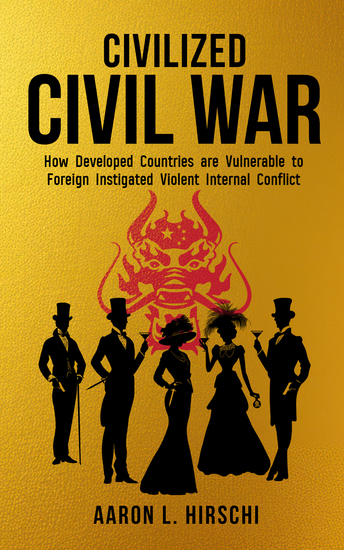
Civilized Civil War - How Developed Countries Are Vulnerable to Foreign Instigated Violent Internal Conflict - cover

Civilized Civil War - How Developed Countries Are Vulnerable to Foreign Instigated Violent Internal Conflict

Aaron L. Hirschi

Verlag: Defiance Press and Publishing

  • 0
  • 0
  • 0

Beschreibung

"Civilized Civil War" is a chilling exploration of the vulnerabilities lurking within modern Western democracies. Drawing on his extensive background in military intelligence and national security, Aaron Hirschi presents a meticulously crafted scenario of how a foreign power – implicitly China – could orchestrate internal conflict in a developed nation without firing a single shot.
 
This groundbreaking analysis delves deep into the strategies and tactics of both the foreign-backed elites (FBE) seeking to subvert democracy and the national resistance forces (NRF) fighting to preserve it. Hirschi's unique insight brings to life the shadowy world of 5th Gradient Warfare, where battles are fought through information manipulation, economic sabotage, and social engineering rather than traditional military confrontation.
 
But "Civilized Civil War" is more than just a hypothetical war game. It serves as a stark wake-up call, highlighting real-world vulnerabilities in our energy policies, education systems, and media landscapes that could be exploited by adversaries. Hirschi challenges readers to reconsider long-held assumptions about governance, international cooperation, and the very nature of modern conflict.
 
As tensions between China and the West continue to escalate, this book provides crucial insight into the potential battlegrounds of the future. It is essential reading for policymakers, military strategists, and concerned citizens alike – anyone who seeks to understand and defend against the invisible threats to our democratic way of life.
Verfügbar seit: 04.09.2025.
Drucklänge: 236 Seiten.


Weitere Bücher, die Sie mögen werden

  • From Pulpit to Podium to Policy - cover

    From Pulpit to Podium to Policy

    Dr. Richard Tobias PhD

    • 0
    • 0
    • 0
    Today, many fundamentalist Christian members of Congress find it simpler and more comforting to disregard complexity and science when creating US law and, instead, wield faith like a righteous sword. In the making of new legislation, these Congressmen go so far as to cite biblical events, claiming, for instance, that the Great Flood was an example of climate change, although, “…that certainly wasn’t because mankind had overdeveloped hydrocarbon energy.” These Christian lawmakers even make frequent allusions to being ‘led by’ or ‘inspired by’ God when deciding legal policies and ignore scientific findings that contradict their faith in favor of legislation that benefits powerful corporations. 
    "Congress shall make no law respecting an establishment of religion..." Thus reads the First Amendment of the Constitution of the United States. Yet, as Dr. Richard Tobias argues in From Pulpit to Podium Policy, decisions by the Supreme Court and repeated opposition by strong religious Congressional members against the separation of church and state put the longstanding ideals of democracy in danger. 
    Zum Buch
  • The Abolitionist’s Journal - Memories of an American Antislavery Family - cover

    The Abolitionist’s Journal -...

    James D. Richardson

    • 0
    • 0
    • 0
    Over the course of more than twenty years, James D. Richardson and his wife, Lori, retraced the steps of his ancestor, George Richardson (1824–1911), across nine states, uncovering letters, diaries, and more memoirs hidden away. Their journey brought them to the brink of the racial divide in America, revealing how his great-great-grandfather Richardson played a role in the Underground Railroad, served as a chaplain to a Black Union regiment in the Civil War, and founded a college in Texas for the formerly enslaved. 


    In narrating this compelling life, The Abolitionist's Journal explores the weight of the past as well as the pull of one's ancestral history. The author raises questions about why this fervent commitment to the emancipation of African Americans was nearly forgotten by his family, exploring the racial attitudes in the author's upbringing and the ingrained racism that still plagues our nation today. 


    As America confronts a generational reckoning on race, these important perspectives add a layer to our larger national story.
    Zum Buch
  • The 19th-Century Famines in Finland - Economic and Environmental Impacts - cover

    The 19th-Century Famines in...

    Sarah Willards

    • 0
    • 0
    • 0
    In the 19th century, Finland was a region undergoing profound political, social, and economic transformation. Following centuries of Swedish rule, Finland was ceded to the Russian Empire in 1809, becoming an autonomous Grand Duchy under the Russian crown. This shift in governance marked a significant turning point in the nation's development, as it introduced new administrative structures and a degree of self-rule, yet still tied Finland’s fate closely to the broader political currents of imperial Russia. Despite this autonomy, many rural communities remained deeply influenced by traditional practices rooted in earlier Swedish governance and local customs. 
    Agriculture formed the backbone of the Finnish economy during this period, with the vast majority of the population engaged in farming or forestry. The rural landscape was dominated by small farms and tenant holdings, where subsistence farming was the norm. Crops such as rye, barley, and oats were staples, but yields were highly susceptible to environmental fluctuations. There was limited access to modern tools, techniques, or fertilizers, and storage methods were often inadequate, leaving communities vulnerable to failed harvests. The lack of agricultural diversity and technological stagnation only exacerbated the risks, particularly during years of poor weather or early frosts. 
    Economically, Finland was still in the early stages of development, with only a few urban centers and a limited industrial base. Trade remained modest, and most commerce was localized. The transportation infrastructure, particularly in the countryside, was underdeveloped, which made the movement of goods—especially food—slow and unreliable. The country’s dependence on its immediate environment for food and income meant that any disruption, whether climatic or political, could have devastating consequences. This fragility was compounded by population growth, which put increasing pressure on available land and resources.
    Zum Buch
  • Xia Dynasty - The Myth and Mystery of China's First Dynasty - cover

    Xia Dynasty - The Myth and...

    Rolf Hedger

    • 0
    • 0
    • 0
    The Xia Dynasty is often considered the first dynasty of China, marking the transition from a prehistoric era dominated by tribal alliances to a structured monarchy. However, much of what is known about the Xia comes from ancient texts written centuries later, blurring the line between history and legend. At the heart of this foundation myth is Yu the Great, a figure credited with taming the catastrophic floods that once plagued the Yellow River region. 
    According to traditional accounts, China before the Xia was ruled by the Five Emperors, semi-mythical sages who brought order and knowledge to early societies. The final ruler of this period, Emperor Shun, recognized Yu for his brilliance and appointed him to control the devastating floods that had threatened agricultural settlements for generations. Unlike his predecessors, who attempted to block or divert the waters, Yu devised a system of dredging and canal-building that allowed the floodwaters to drain naturally into rivers and the sea. His efforts reportedly took over a decade, during which he traveled across the land, surveying the terrain and directing large-scale labor projects. His selfless dedication won him the admiration of the people, and his success in flood control cemented his reputation as a leader with the Mandate of Heaven. 
    The concept of the Mandate of Heaven, though later fully developed under the Zhou Dynasty, has its roots in the Xia period. It suggested that rulers were chosen by divine will and that their legitimacy depended on their ability to maintain order and prosperity. Yu's ability to tame the floods demonstrated both his virtue and his right to rule. Upon Emperor Shun’s abdication, Yu became the first king of the Xia Dynasty, establishing a hereditary monarchy that would continue for generations.
    Zum Buch
  • Dispossessing the Wilderness - Indian Removal and the Making of the National Parks - cover

    Dispossessing the Wilderness -...

    Mark David Spence

    • 0
    • 0
    • 0
    National parks like Yellowstone, Yosemite, and Glacier preserve some of this country's most cherished wilderness landscapes. While visions of pristine, uninhabited nature led to the creation of these parks, they also inspired policies of Indian removal. By contrasting the native histories of these places with the links between Indian policy developments and preservationist efforts, this work examines the complex origins of the national parks and the troubling consequences of the American wilderness ideal. The first study to place national park history within the context of the early reservation era, it details the ways that national parks developed into one of the most important arenas of contention between native peoples and non-Indians in the twentieth century.
    Zum Buch
  • Buddhism in Daily Life And Other Essays - cover

    Buddhism in Daily Life And Other...

    M. O’ C. Walshe

    • 0
    • 0
    • 0
    This is an audiobook of Bodhi Leaves No. 85 by M. O’ C. Walshe, Buddhism in Daily Life And Other Essays narrated by Jayashree Tata Nagaraj. The print edition can be found in the Pariyatti Edition of Collected Bodhi Leaves Vol. 3. The eBook of Bodhi Leaves No. 85 can be downloaded from the BPS website.
     
    The essays included are:
    
    Buddhism in Daily Life
    Self-Deliverance
    How to Meditate without Meditating
    Axolotls
    
     
    Excerpt:
     
    To be a “Buddhist” without making any attempt to put the principles into practice is nonsensical. Buddhism is essentially something to do rather than something to believe. The attainment of the higher wisdom will, for most people at least, be a long task which may not be fully achieved in this lifetime. But those who are sincerely treading the path will stand out. They will have something about them which subtly marks them out. They will be mindful, compassionate, considerate to others. While they will not rush round offering good advice to all and sundry unasked, they may well be the kind of people whom those in need of advice and help will instinctively turn to. They will be good citizens of the world, for the very reason that they are not too much caught up in its meretricious attractions.
    Zum Buch