Begleiten Sie uns auf eine literarische Weltreise!
Buch zum Bücherregal hinzufügen
Grey
Einen neuen Kommentar schreiben Default profile 50px
Grey
Jetzt das ganze Buch im Abo oder die ersten Seiten gratis lesen!
All characters reduced
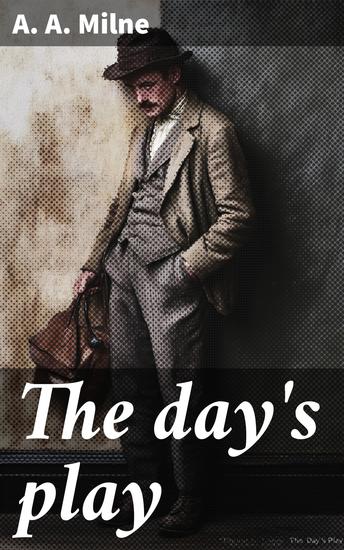
The day's play - cover

The day's play

A. A. Milne

Verlag: Good Press

  • 0
  • 0
  • 0

Beschreibung

In "The Day's Play," A. A. Milne presents a captivating collection of one-act plays that reflect his nuanced understanding of human emotion and social interaction. Written in the early 20th century, Milne's literary style is marked by its wit, charm, and intricate character development, capturing the essence of Edwardian society. Through a series of engaging dialogues and thought-provoking scenarios, the playwright navigates themes of love, friendship, and the complexities of everyday life, allowing readers to glimpse the struggles and joys of his contemporaries while maintaining a light-hearted tone. A. A. Milne, best known for his beloved children's character Winnie-the-Pooh, was also a playwright and novelist whose experiences during World War I and his keen observations of social dynamics informed his work. Born in London in 1882, Milne's diverse literary background—ranging from journalism to children's literature—allowed him to cultivate a deep understanding of human psychology, which shines through in the varied personalities and situations presented in this collection. "The Day's Play" is a must-read for anyone interested in early 20th-century literature or the interplay of humor and poignancy in human interactions. Whether you seek a delightful escape into the world of theatre or a deeper understanding of the intricacies of social relationships, Milne's thoughtful writing promises to illuminate and entertain.
Verfügbar seit: 02.03.2025.
Drucklänge: 200 Seiten.
Weitere Bücher, die Sie mögen werden

  • The Mark on the Wall - cover

    The Mark on the Wall

    Anonym

    • 0
    • 0
    • 0
    What is the mark on the wall? A shadow? A nail? Or something deeper?
    
    The Mark on the Wall is one of Virginia Woolf's most celebrated early short stories, a perfect, brief plunge into the Modernist style she would perfect in novels like Mrs. Dalloway and To the Lighthouse.
    
    From a comfortable chair by the fire, the narrator's eye catches a mysterious dark mark. What follows is a mesmerizing journey of the mind, a stream-of-consciousness exploration that moves fluidly from speculation about the mark's origin to meditations on history, gender roles, life's impermanence, and the nature of thought itself.
    
    This story is a masterclass in:
    
    Psychological Depth: The inner world of the narrator becomes the landscape of the story.
    
    Philosophical Inquiry: Questioning the rigid structures of society and logic.
    
    Modernist Innovation: A concise, groundbreaking example of breaking traditional narrative forms.
    
    If you appreciate literary fiction, psychological depth, and the intricate beauty of language, this short story is an essential read from one of the 20th century's greatest writers.
    
    Discover the mystery that lies beyond the surface. Click "Buy Now" and begin your journey into the mind.
    Zum Buch
  • A Room of One's Own - cover

    A Room of One's Own

    Virginia Woolf

    • 0
    • 0
    • 0
    Discover the Essential Manifesto for Female Creativity.
    
    In A Room of One's Own, Virginia Woolf delivers a powerful and enduring argument for the necessity of intellectual and financial independence for women. Based on a series of lectures given at Cambridge University, Woolf explores the historical and social barriers that have silenced women's voices for centuries.
    
    Through the brilliant fictional creation of Judith Shakespeare—the imagined talented sister of William—Woolf illustrates how genius is often stifled by poverty and lack of opportunity. Her famous conclusion that "a woman must have money and a room of her own if she is to write fiction" remains a cornerstone of feminist literature and a rallying cry for creators everywhere.
    
    This definitive edition presents one of the most important works of the 20th century. A masterpiece of modernist prose and literary criticism, Woolf's essay is a witty, profound, and essential exploration of gender, class, and the creative spirit.
    
    Claim your space in literary history. Buy "A Room of One's Own" today.
    Zum Buch
  • The Wound Dresser - cover

    The Wound Dresser

    Walt Whitman

    • 0
    • 0
    • 0
    Walter Whitman was an American poet, essayist and journalist. A humanist, he was a part of the transition between transcendentalism and realism, incorporating both views in his works. Whitman is among the most influential poets in the American canon, often called the father of free verse. His work was controversial in its time, particularly his 1855 poetry collection Leaves of Grass, which was described as obscene for its overt sensuality. Whitman's own life came under scrutiny for his presumed homosexuality.Born in Huntington on Long Island, as a child and through much of his career, he resided in Brooklyn. At age 11, he left formal schooling to go to work. Later, Whitman worked as a journalist, a teacher, and a government clerk. Whitman's major poetry collection, Leaves of Grass, was first published in 1855 with his own money and became well known. The work was an attempt at reaching out to the common person with an American epic. He continued expanding and revising it until his death in 1892. During the American Civil War, he went to Washington, D.C. and worked in hospitals caring for the wounded. His poetry often focused on both loss and healing. On the death of Abraham Lincoln, whom Whitman greatly admired, he wrote his well-known poems, "O Captain! My Captain!" and "When Lilacs Last in the Dooryard Bloom'd", and gave a series of lectures. After a stroke towards the end of his life, Whitman moved to Camden, New Jersey, where his health further declined. When he died at age 72, his funeral was a public event.Whitman's influence on poetry remains strong. Mary Whitall Smith Costelloe argued: "You cannot really understand America without Walt Whitman, without Leaves of Grass ... He has expressed that civilization, 'up to date,' as he would say, and no student of the philosophy of history can do without him." Modernist poet Ezra Pound called Whitman "America's poet ... He is America.
    Zum Buch
  • The Black Cat - cover

    The Black Cat

    Edgar Allen Poe

    • 0
    • 0
    • 0
    A love for all things, with age, turns into a sour resentment and leads a man to the gallows!
    Zum Buch
  • Ghost of Art The (Unabridged) - cover

    Ghost of Art The (Unabridged)

    Charles Dickens

    • 0
    • 0
    • 0
    Charles Dickens was a writer and social critic who created some of the world's best-known fictional characters and is regarded as the greatest novelist of the Victorian era. His works enjoyed unprecedented popularity during his lifetime, and by the twentieth century critics and scholars had recognised him as a literary genius. His novels and short stories enjoy lasting popularity.
    THE GHOST OF ART: I AM a bachelor, residing in rather a dreary set of chambers in the Temple. They are situated in a square court of high houses, which would be a complete well, but for the want of water and the absence of a bucket. I live at the top of the house, among the tiles and sparrows. Like the little man in the nursery-story, I live by myself, and all the bread and cheese I get-which is not much-I put upon a shelf. I need scarcely add, perhaps, that I am in love, and that the father of my charming Julia objects to our union.
    Zum Buch
  • Haunted House The (Unabridged) - cover

    Haunted House The (Unabridged)

    Charles Dickens

    • 0
    • 0
    • 0
    "The Haunted House" is a story series published in 1859 for the weekly periodical All the Year Round. It was "Conducted by Charles Dickens", with Charles Dickens writing the opening and closing stories, framing stories by Dickens himself and five other authors.
    The story appeared in the Extra Christmas Number on 13 December 1859. Dickens began a tradition of Christmas publications with A Christmas Carol in 1843 and his Christmas stories soon became a national institution. The Haunted House was his 1859 offering.
    In Dickens's opening story, The Mortals in the House, the narrator's ("John") health "required a temporary residence in the country." Knowing this, a friend of the narrator had chanced to drive by the house-situated close to a railroad stop mid-way between Northern England and London-and had written to the narrator suggesting he travel down from the North and look the place over. It was a large mid-eighteenth-century manor house on two square acres with a "sadly neglected garden," recently cheaply repaired, and "much too closely and heavily shadowed by trees." The house itself is "stiff ... cold ... [and] formal" and "in as bad taste, as could possibly be desired by the most loyal admirer of the whole quartet of [King] Georges." It was "ill-placed, ill-built, ill-planned, and ill-fitted." It was "damp ... not free from dry rot" and redolent with the "flavour of rats."
    Zum Buch