Unisciti a noi in un viaggio nel mondo dei libri!
Aggiungi questo libro allo scaffale
Grey
Scrivi un nuovo commento Default profile 50px
Grey
Iscriviti per leggere l'intero libro o leggi le prime pagine gratuitamente!
All characters reduced
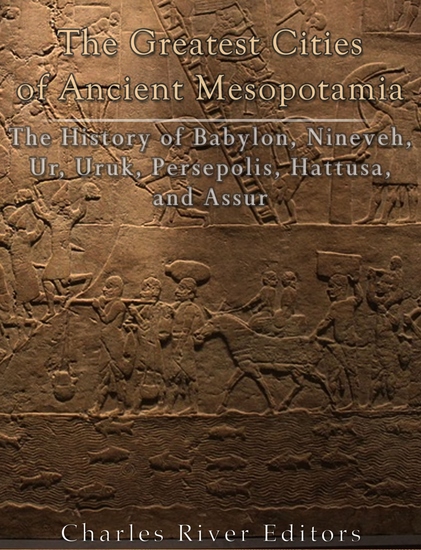
The Greatest Cities of Ancient Mesopotamia - The History of Babylon Nineveh Ur Uruk Persepolis Hattusa and Assur - cover

The Greatest Cities of Ancient Mesopotamia - The History of Babylon Nineveh Ur Uruk Persepolis Hattusa and Assur

Editors Charles River

Casa editrice: Charles River Editors

  • 0
  • 0
  • 0

Sinossi

In southern Iraq, a crushing silence hangs over the dunes. For nearly 5,000 years, the sands of the Iraqi desert have held the remains of the oldest known civilization: the Sumerians. When American archaeologists discovered a collection of cuneiform tablets in Iraq in the late 19th century, they were confronted with a language and a people who were at the time only scarcely known to even the most knowledgeable scholars of ancient Mesopotamia. The exploits and achievements of other Mesopotamian peoples, such as the Assyrians and Babylonians, were already known to a large segment of the population through the Old Testament and the nascent field of Near Eastern studies had unraveled the enigma of the Akkadian language that was widely used throughout the region in ancient times, but the discovery of the Sumerian tablets brought to light the existence of the Sumerian culture, which was the oldest of all the Mesopotamian cultures.
 
Although the Sumerians continue to get second or even third billing compared to the Babylonians and Assyrians, perhaps because they never built an empire as great as the Assyrians or established a city as enduring and great as Babylon, they were the people who provided the template of civilization that all later Mesopotamians built upon. The Sumerians are credited with being the first people to invent writing, libraries, cities, and schools in Mesopotamia (Ziskind 1972, 34), and many would argue that they were the first people to create and do those things anywhere in world.
 
For a people so great it is unfortunate that their accomplishments and contributions, not only to Mesopotamian civilization but to civilization in general, largely go unnoticed by the majority of the public. Perhaps the Sumerians were victims of their own success; they gradually entered the historical record, established a fine civilization, and then slowly submerged into the cultural patchwork of their surroundings. They also never suffered a great and sudden collapse like other peoples of the ancient Near East, such as the Hittites, Assyrians and Neo-Babylonians did. A close examination of Sumerian culture and chronology reveals that the Sumerians set the cultural tone in Mesopotamia for several centuries in the realms of politics/governments, arts, literature, and religion. The Sumerians were truly a great people whose legacy continued long after they were gone.
 
Even today, the world owes the Sumerians a tremendous amount. When Western Europe was still in the Stone Age, it was the Sumerians who invented writing and the wheel, divided time into minutes and seconds, tamed nature, and built gigantic cities. They embraced culture and the arts, and their caravans crossed the desert, opening up the first trade routes. Their myths and legends inspired various origin stories, and their memory lives on in the Old Testament. They wrote the history of the birth of mankind. The heritage of the Sumerian civilization and their successors is everywhere.
Disponibile da: 01/05/2025.
Lunghezza di stampa: 349 pagine.


Altri libri che potrebbero interessarti

  • Love Learn Play - A Simple Formula for a Happier More Meaningful Life - cover

    Love Learn Play - A Simple...

    Akhil Gupta

    • 0
    • 0
    • 0
    In a world that equates success with happiness, many high-achievers still feel unfulfilled. In Love, Learn, Play, Akhil Gupta offers a transformative mindset that reframes how we think about purpose, peace, and flourishing.
    Mostra libro
  • Rethinking Fandom - How to Beat the Sports-Industrial Complex at Its Own Game - cover

    Rethinking Fandom - How to Beat...

    Craig Calcaterra

    • 0
    • 0
    • 0
    “Modern fandom is rubbish, and Calcaterra explains why, but in so doing, also shows us the way out of our desensitized, corporate, laundry-hugging ways.” —Keith Law, The Athletic   Sports fandom isn’t what it used to be. Owners and executives increasingly count on the blind loyalty of their fans and too often act against the team’s best interest. Sports fans are left deliberating not only mismanagement, but also political, health, and ethical issues.   In Rethinking Fandom, sportswriter (and lifelong sports fan) Craig Calcaterra outlines endemic problems with what he calls the Sports-Industrial Complex, such as intentionally tanking a season to get a high draft pick, scamming local governments to build cushy new stadiums, actively subverting the players, bad stadium deals, racism, concussions, and more. But he doesn’t give up on professional sports. In the second half of the book, he proposes strategies to reclaim joy in fandom: rooting for players instead of teams, being a fair-weather fan, becoming an activist, and other clever solutions.   With his characteristic wit and piercing commentary, Calcaterra argues that fans have more power than they realize to change how their teams behave.  “If you’re like me and love sports but have become increasingly dismayed by the ‘sports-industrial complex,’ Calcaterra’s book will prove a balm that allows you to hold onto that fandom without turning a blind eye to the myriad problems and sources of exploitation on the field.” —John Warner, The Chicago Tribune  “Rather than simply criticizing, Calcaterra provides positive solutions to help us form a healthier and more thoughtful relationship with the sports we love. A vital book for any sports fan in the 21st century.” —Mike Duncan, New York Times–bestselling author
    Mostra libro
  • History of the Jews - A Concise Guide to the Diaspora Gathering and Persecution of the Jews - cover

    History of the Jews - A Concise...

    Kelly Mass

    • 0
    • 0
    • 0
    Jewish history is a rich tapestry woven over millennia, shaped by the development of a people, their religion, and their culture as they interacted with various civilizations, faiths, and cultures. The earliest reference to Israel can be found on the Merneptah Stele, dated to between 1213–1203 BCE, marking the first historical mention of the ancient Israelite people. However, the religious and cultural narrative of the Jews stretches far earlier. Jewish tradition traces its origins to at least 1500 BCE, with religious texts such as the Torah recounting the story of the Israelites, beginning with the patriarchs Abraham, Isaac, and Jacob. This historical foundation laid the groundwork for the development of Judaism, which began to emerge as a distinct religion during the Hellenistic period, particularly around 323–31 BCE, as Greek scholars began documenting Jewish practices and beliefs. 
    The trajectory of Jewish history has been marked by a series of dispersals and captivities, with the first significant one being the Assyrian exile of the ten northern tribes in 722 BCE. This event set the stage for a larger dispersion that was solidified with the Babylonian captivity in 586 BCE, when the Jewish elite were taken into exile. Following the Babylonian conquest, Jews began to settle throughout the ancient Near East, which would later become a defining characteristic of Jewish existence. The Jewish people continued to spread across the Mediterranean world, particularly within the vast expanse of the Roman Empire, where they maintained distinct cultural and religious practices even as they interacted with surrounding civilizations. This trend persisted throughout Byzantine rule in the eastern Mediterranean, although the influence of Jewish communities diminished in these regions after the Byzantine Empire lost control of the Levant to the Arab Islamic Empire in 638 CE.
    Mostra libro
  • A Constitution for the Common Good - Strengthening Scottish Democracy After 2014 - cover

    A Constitution for the Common...

    W Elliot Bulmer

    • 0
    • 0
    • 0
    If Scotland has voted YES on 18 September, how can a written Constitution be good for the people of Scotland?
    
    If Scotland has voted NO, how could a new Constitution protect and enhance Scottish democracy within a restructured UK?
    
    Whether YES or NO, a reconstituted Scotland is possible and good for all its citizens.
    
    
    Nearly every democracy in the world is built upon a written constitution, and constitutions have been at the core of citizens' demands for better governance in places as disparate as Kenya, Tunisia and Ukraine. With the Scottish National Party promising a written constitution in the event of a YES vote and other parties suggesting other possible options for constitutional change in the event of a NO vote, constitutional change looks certain to remain central to the political agenda in Scotland for some time to come.


    But what is a constitution for? Is it a defensive charter to protect the basic structures of democratic government, or is it a transformative covenant for a better society? How can the Constitution sustain democracy and promote ethical politics while at the same time recognising and accommodating differences in society? What difference would a good Constitution make to the poor? How can the Constitution help ensure that the common good of the citizenry prevails over private vested interests?


    In addressing these questions, this book sets out a vision for how Scotland could reconstitute itself. It emphasises the connection between the constitution, democracy and the common good, arguing that democratic self-government is the true prize, regardless of the relationship of Scotland to the rest of the UK.


    This book not only makes a vital contribution to Scotland's current and on-going constitutional debate, whatever the outcome in September 2014, but also engages with fundamental questions of constitutionalism and democracy that are of enduring relevance to both citizens and scholars around the world.
    Mostra libro
  • Seduction - Influencing Someone through Charm or Persuasion - cover

    Seduction - Influencing Someone...

    Cito Harder

    • 0
    • 0
    • 0
    Seduction is often perceived as an art form, one that blends charm, charisma, and influence. However, behind its allure lies a deep psychological foundation that shapes how and why individuals are drawn to one another. The psychology of seduction is rooted in our basic emotional and social needs, particularly the desire for connection, validation, and attraction. Understanding these underlying psychological mechanisms can shed light on how seduction functions both consciously and subconsciously in human interactions. 
    At its core, seduction taps into the psychological principle of attraction, which is influenced by a combination of innate and learned factors. Human beings are social creatures, and our brains are wired to respond to others in ways that promote bonding and intimacy. This attraction is not purely physical but can also be emotional, intellectual, and even social. For example, people often find others more attractive when they share similar interests, values, or experiences, which creates a sense of commonality and trust. This bond of similarity is a psychological catalyst in seduction, where individuals may use shared interests to create a sense of connection and mutual understanding. 
    Another psychological aspect of seduction lies in the concept of power dynamics. Seduction often involves a delicate balance of influence and control. The person who is seducing may use charm or persuasion to gain an upper hand, while the target of the seduction may either knowingly or unknowingly submit to the allure. Power, in this context, does not always have to be overt or manipulative. Sometimes, it can be subtle—through small gestures, compliments, or actions that invoke a sense of attraction or desire.
    Mostra libro
  • Bipolar General - My Forever War with Mental Illness - cover

    Bipolar General - My Forever War...

    USA (Ret) Maj. Gen Gregg F....

    • 0
    • 0
    • 0
    Maj. Gen. Gregg Martin cut a striking figure in the Army: athletic, quick witted, devout, and studious, he was a natural leader. Thanks to his engineering and leadership knowhow, Martin was chosen to lead the thousands of combat engineers who paved the way for 100,000 Army troops to battle their way to Baghdad in 2003. Only years later would he learn how the pressure of organizing dozens of simultaneous life-or-death missions each day altered the biochemistry of his brain. The Iraq War triggered what military and Veterans Administration psychiatrists ultimately diagnosed as late-onset bipolar disorder, a chemical imbalance that sends sufferers whipsawing between grandiose imaginings and suicidal depressions. His increasing erratic behavior led to his forced resignation as president of the National Defense University and ended his military career. 


    Bipolar General offers a candid account of Martin's personal journey with undiagnosed mental illness as he rose through the ranks of the United States Army. He discusses why his condition went undiagnosed for so long and explores what can be done both within and outside the armed forces to diagnose and treat mental illness. Bipolar General should be of value to those with mental illness and to the communities of family, friends, and caregivers surrounding them.
    Mostra libro