Unisciti a noi in un viaggio nel mondo dei libri!
Aggiungi questo libro allo scaffale
Grey
Scrivi un nuovo commento Default profile 50px
Grey
Iscriviti per leggere l'intero libro o leggi le prime pagine gratuitamente!
All characters reduced
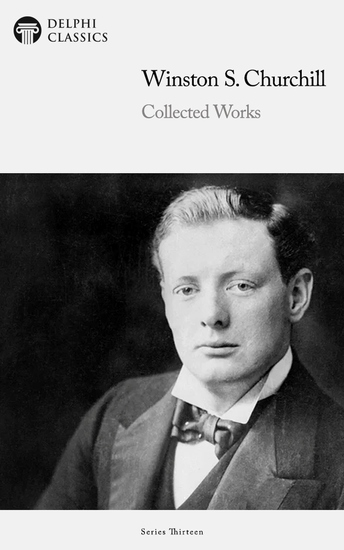
Delphi Collected Works of Winston S Churchill Illustrated - cover

Delphi Collected Works of Winston S Churchill Illustrated

Winston S. Churchill

Casa editrice: Delphi Publishing Ltd

  • 0
  • 0
  • 0

Sinossi

The British statesman, orator and author Winston Churchill served as prime minister twice, achieving legendary status for rallying the British people during World War II and leading the country from the brink of defeat to victory. In addition to his careers of soldier and politician, Churchill was a prolific writer, starting with war journalism charting his adventures in British India, at the Siege of Malakand, at Sudan during the Mahdist War and in Africa in the Second Boer War. He excelled as a writer of history, producing multi-volume studies of grand subjects to critical acclaim. Many of his speeches and parliamentary answers were also published in pamphlets and collected editions. In 1953 Churchill was awarded the Nobel Prize in Literature ‘for his mastery of historical and biographical description as well as for brilliant oratory’. This eBook presents Churchill’s collected works, with numerous illustrations, rare texts, informative introductions and the usual Delphi bonus material. (Version 1)
 
* Beautifully illustrated with images relating to Churchill’s life and works* Concise introductions to the major texts* Churchill’s novel ‘Savrola’ and the rare short stories* Images of how the books were first published, giving your eReader a taste of the original texts* Excellent formatting of the texts* Many non-fiction works and speech collections * Special chronological and alphabetical contents tables for the speeches* Includes the famous WWII speeches* Easily locate the works you want to read* Features a bonus biography – discover Churchill’s incredible life* Ordering of texts into chronological order and genres
 
Please note: due to US copyright restrictions, some non-fiction works cannot appear in this edition. When new texts become available, they will be added to the eBook as a free update.
 
CONTENTS:
 
The NovelSavrola (1900)
 
The Shorter FictionMan Overboard (1898)If Lee Had Not Won the Battle of Gettysburg (1931)The Dream (1966)
 
The Non-FictionThe Story of the Malakand Field Force (1898)The River War (1899)London to Ladysmith via Pretoria (1900)Ian Hamilton’s March (1900)Lord Randolph Churchill (1906)My African Journey (1908)The World Crisis I: 1911-1914 (1923)The World Crisis II: 1915 (1923)The World Crisis III: 1916-1918 (1927)Great Contemporaries (1937)Painting as a Pastime (1948)
 
The SpeechesIntroduction to Churchill the OratorMr Brodrick’s Army (1903)For Free Trade (1906)Liberalism and the Social Problem (1909)The People’s Rights (1910)India (1931)Arms and the Covenant (1938)Into Battle (1941)The Unrelenting Struggle (1942)The End of the Beginning (1943)Onwards to Victory (1944)The Sinews of Peace (1948)Europe Unite (1950)In the Balance (1951)Stemming the Tide (1953)The Unwritten Alliance (1961)
 
Index of SpeechesList of Speeches in Chronological OrderList of Speeches in Alphabetical Order
 
The BiographyMr. Churchill: A Portrait (1942) by Philip Guedalla
Disponibile da: 21/05/2023.
Lunghezza di stampa: 1014 pagine.
Altri libri che potrebbero interessarti

  • The Capital Dilemma - Balancing Growth and Fairness in the Free Market - cover

    The Capital Dilemma - Balancing...

    Arlo Holders

    • 0
    • 0
    • 0
    The free market and capitalism have long been foundational principles of economic systems around the world. At their core, they represent the idea that economic decisions, such as production, investment, and distribution, should be guided by the forces of supply and demand with minimal government intervention. In a truly free market, goods and services are exchanged in a competitive environment where prices are determined by the collective actions of consumers and producers rather than by central planning or state control. 
    Capitalism, as an economic system, emerged during the early stages of the Industrial Revolution in the 18th and 19th centuries. Its roots trace back even further to mercantilist policies that prioritized trade and accumulation of wealth through colonial ventures. Over time, capitalism has evolved from simple trade systems to complex global markets, driven by the desire for profit and the expansion of economic activities. The central tenet of capitalism is the pursuit of self-interest, where individuals or organizations are motivated to create wealth by competing in open markets. 
    This system offers several advantages, such as fostering innovation, encouraging efficiency, and enabling individuals to accumulate wealth. By allowing businesses and entrepreneurs to operate freely, capitalism encourages the creation of new products, services, and technologies, which in turn leads to economic growth and increased standards of living. Moreover, the competitive nature of free markets ensures that resources are allocated efficiently, as businesses strive to meet consumer demands at the lowest cost.
    Mostra libro
  • The Great Famine of 1315-1317 - Europe's Darkest Hour - cover

    The Great Famine of 1315-1317 -...

    Sarah Willards

    • 0
    • 0
    • 0
    The Great Famine of 1315-1317 stands as one of the darkest periods in European history, marking a time of immense suffering, social upheaval, and devastation. It was not a single event but rather a prolonged crisis, which compounded existing vulnerabilities within medieval European society. The origins of the famine can be traced back to a confluence of environmental, social, and economic factors, all of which led to one of the worst food shortages ever experienced on the continent. 
    The famine’s roots can be found in the dramatic climatic changes of the early 14th century. The period known as the Little Ice Age brought cooler temperatures, and the years leading up to the famine saw unusual weather patterns. Prolonged rain, particularly during the summer months of 1315, led to flooding and crop failure, especially in regions dependent on staple grains like wheat, oats, and barley. The disastrous harvests were compounded by already strained food supplies and a growing population. 
    The impact of the famine was felt most acutely by the poorer classes, whose subsistence farming could not sustain them through such harsh conditions. The majority of the population in rural areas relied on farming for food and income, and with crops failing, their livelihoods were destroyed. Urban centers, though slightly better equipped to withstand hardship, faced sharp increases in food prices, making it difficult for even the wealthier classes to procure sustenance. Starvation, malnutrition, and poverty became widespread, leading to mass suffering across the continent.
    Mostra libro
  • History of Christianity for Kids: A Captivating Guide to Church History Starting from Jesus to the Present - cover

    History of Christianity for...

    Captivating History

    • 0
    • 0
    • 0
    Discover the Exciting History of Christianity—A Kid-Friendly Adventure! 
    Parents, are you looking for a fun and educational way to introduce your child to the fascinating world of history? Look no further! This captivating audiobook takes young listeners on a thrilling journey through the history of Christianity, all told in easy-to-understand language. 
    Why This Audiobook is a Must-Have for Your Child Learning About History 
    Understanding the past helps kids make sense of the world today. This audiobook offers a kid-friendly exploration of how Christianity has shaped our culture and values over the centuries. 
    Engaging and Educational 
    The audiobook includes exciting stories and interesting facts, making history come alive. Your child will be eager to learn about important events and figures, like saints, the Reformation, and the Crusades. 
    Simple and Clear Language 
    Created specifically for young listeners, this audiobook breaks down complex ideas into simple, relatable explanations. 
    What Your Child Will Discover:Who was Jesus? Learn about the life and teachings of one of history’s most influential figures.What is a saint? Discover the fascinating stories of people who have been called saints and why they are important.The Reformation and the Church of England: Find out how one big change led to the creation of a whole new church.The Crusades: Understand why people went to war for their beliefs and how it changed the world.Protestantism and the pope: Learn about different branches of Christianity and the role of the pope in the church. 
    Scroll up and click the “add to cart” button to give your child the gift of knowledge and curiosity today!
    Mostra libro
  • What Path to Salvation? - cover

    What Path to Salvation?

    Dr. B. R. Ambedkar

    • 0
    • 0
    • 0
    Though I was born a Hindu, I solemnly assure you that I will not die as a Hindu. - Dr. B. R. AmbedkarHaving made this statement - Dr. Ambedkar gave this speech Mukti Kon Pathe (What Path to Salvation) in Marathi to his community to impress upon them the need to convert, if they were to break free from the shackles of Untouchability.This audiobook presents that speech along with a preface that will help the modern day audience get the most out of the speech and understand why it is important and pertinent even in this day and age.
    Mostra libro
  • Integrity - The Foundation of Trust: Upholding Your Principles in Every Situation - cover

    Integrity - The Foundation of...

    Esther Jameson

    • 0
    • 0
    • 0
    Integrity is the cornerstone of trust, and trust is essential in every aspect of our lives. Whether in personal relationships, the workplace, or society as a whole, integrity is what binds us together and ensures that we can rely on one another. Without integrity, trust is compromised, and relationships become fragile, leading to misunderstandings, broken bonds, and lost opportunities. It is the foundation upon which all other virtues are built, and it is a key element that defines who we are as individuals and how we are perceived by others. 
    At its core, integrity is about being true to one’s principles and values, regardless of the circumstances. It means doing the right thing, even when no one is watching, and maintaining consistency between one’s beliefs, actions, and words. Integrity is not about perfection; rather, it is about being honest, transparent, and committed to doing what is right, even when it’s difficult or inconvenient. 
    One of the most powerful aspects of integrity is its ability to build trust. When we demonstrate integrity, others come to rely on our word and actions. Trust is built over time through repeated demonstrations of honesty, consistency, and reliability. Integrity fosters an environment where people feel safe, respected, and valued. It is the glue that holds relationships together, whether in families, friendships, or workplaces. People with integrity are seen as dependable, ethical, and authentic, making them natural leaders and role models.
    Mostra libro
  • The Constitution of Liberty - The Definitive Edition - cover

    The Constitution of Liberty -...

    F.A. A. Hayek

    • 0
    • 0
    • 0
    “One of the great political works of our time . . . The twentieth-century successor to John Stuart Mill’s essay ‘On Liberty.’” —NewsweekConservatives and concerned citizens alike have grown increasingly fearful of big government. Enter Nobel Prize–winning economist and political theorist F. A. Hayek, whose passionate warning against empowering states with greater economic control, The Road to Serfdom, became an overnight sensation.The latest entry in the University of Chicago Press’s series of newly edited editions of Hayek’s works, The Constitution of Liberty is, like Serfdom, just as relevant to our present moment. The book is considered Hayek’s classic statement on the ideals of freedom and liberty, ideals that he believes have guided—and must continue to guide—the growth of Western civilization. Here Hayek defends the principles of a free society, casting a skeptical eye on the growth of the welfare state and examining the challenges to freedom posed by an ever expanding government—as well as its corrosive effect on the creation, preservation, and utilization of knowledge. In opposition to those who call for the state to play a greater role in society, Hayek puts forward a nuanced argument for prudence. Guided by this quality, he elegantly demonstrates that a free market system in a democratic polity—under the rule of law and with strong constitutional protections of individual rights—represents the best chance for the continuing existence of liberty.Striking a balance between skepticism and hope, Hayek’s profound insights are timelier and more welcome than ever before. This definitive edition of The Constitution of Liberty will give a new generation the opportunity to learn from his enduring wisdom.
    Mostra libro