Rejoignez-nous pour un voyage dans le monde des livres!
Ajouter ce livre à l'électronique
Grey
Ecrivez un nouveau commentaire Default profile 50px
Grey
Abonnez-vous pour lire le livre complet ou lisez les premières pages gratuitement!
All characters reduced
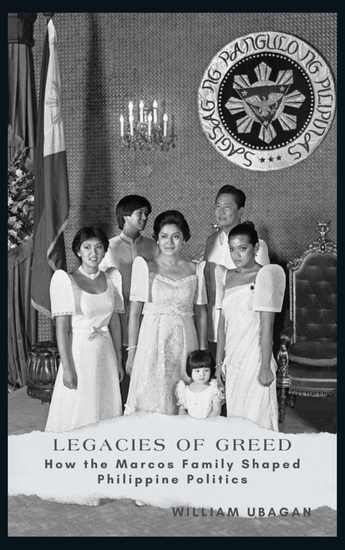
Legacies of Greed - How the Marcos Family Shaped Philippine Politics - cover

Legacies of Greed - How the Marcos Family Shaped Philippine Politics

William Ubagan

Maison d'édition: ZRK Book Shop

  • 0
  • 0
  • 0

Synopsis

Legacies of Greed: How the Marcos Family Shaped Philippine Politics by William Ubagan is a compelling exploration of one of the most influential and controversial dynasties in Philippine history. From Ferdinand Marcos' rise to power and declaration of Martial Law to the family's return to prominence in modern politics, this book examines how their pursuit of wealth and influence has left an indelible mark on the nation's political landscape.
 
Through meticulous research and critical analysis, Ubagan delves into the mechanisms of power, the culture of corruption, and the enduring impact of authoritarianism. The book also highlights the resilience of the Filipino people and their struggle for justice and accountability amidst decades of political turbulence.
 
Whether you are a student of history, a political observer, or simply a concerned citizen, Legacies of Greed provides valuable insights into the dynamics of power, the consequences of unchecked ambition, and the lessons we must learn to safeguard democracy.
 
Eye-opening, thought-provoking, and deeply relevant, this book challenges readers to confront the past and consider the future of Philippine politics.
Disponible depuis: 18/11/2024.
Longueur d'impression: 100 pages.

D'autres livres qui pourraient vous intéresser

  • Human Freedom - The Struggle for Individual Rights and Liberty Across the Globe (2 in 1) - cover

    Human Freedom - The Struggle for...

    Marcus Kline

    • 0
    • 0
    • 0
    This bundle contains the following titles: 
    Freedom of Speech: Freedom of speech is a cornerstone of democratic societies, integral to the exercise of individual autonomy and the pursuit of truth. At its core, it is the right to express ideas, opinions, and beliefs without fear of government reprisal or censorship. This principle is enshrined in numerous legal documents, most notably the First Amendment to the U.S. Constitution, which guarantees "the freedom of speech, or of the press," protecting the individual’s right to speak openly in the public sphere. 
    Children’s Rights: Children represent the future of our societies, yet they remain among the most vulnerable and marginalized populations worldwide. The protection of children's rights has become one of the most critical global issues in the 21st century, demanding urgent attention and action. While significant progress has been made in raising awareness of children's rights, millions of children still suffer from abuse, neglect, exploitation, and deprivation. This complex and multifaceted issue requires an in-depth understanding of the challenges children face, as well as the actions needed to safeguard their well-being.
    Voir livre
  • Beyond States - Powers Peoples and Global Order - cover

    Beyond States - Powers Peoples...

    Anthony Pagden

    • 0
    • 0
    • 0
    Today, the majority of the peoples of the planet live in nation-states, based upon the idea, if never the reality, of a single people, a single culture, a single rule of law, and a single source of sovereign authority. But will they continue to do so in the future? 


    None of the major challenges that confront humanity today—from climate change to disease, from terrorism to mass migration—can be handled effectively by single nation-states, no matter how powerful. The world is no longer made up only of states but also of an ever-increasing multitude of interstate networks and organizations which recognize no borders. We are beginning to be able to imagine the very real possibility of a new global civil society. But what political form should this take? 


    By examining the history of the evolution of human society from the world's first empires to today's world of interstate networks, this book argues that there now exists the possibility of the emergence of a new political form, a global 'federation of federations', that will bring the species closer to the possibility of a more harmonious, equitable, and secure future.
    Voir livre
  • Liberal White Supremacy - How Progressives Silence Racial and Class Oppression - cover

    Liberal White Supremacy - How...

    Angie Beeman

    • 0
    • 0
    • 0
    In Liberal White Supremacy, Angie Beeman argues that white supremacy is maintained not only by right-wing conservatives or stereotypically uneducated working-class racial bigots but also by progressives who operate from a liberal ideology of color-blindness, racism-evasiveness, and class elitism. This distinction provides insight on divisions among progressives at the local level, in community organizations, and at the national level, in the Democratic Party. By distinguishing between liberal and radical approaches to racism, class oppression, capitalism, and social movement tactics, Beeman shows how progressives continue to be limited by liberal ideology and perpetuate rather than dismantle white supremacy, all while claiming to be antiracist. 


    She conceptualizes this self-serving process as "liberal white supremacy," the tendency for liberal European Americans to constantly place themselves in the superior moral position in a way that reinforces inequality. Beeman advances what she calls action-oriented and racism-centered intersectional approaches as alternatives to progressive organizational strategies that either downplay racism in favor of a class-centered approach or take a talk-centered approach to racism without developing explicit actions to challenge it.
    Voir livre
  • Au Revoir Britannia - cover

    Au Revoir Britannia

    Sylvie Bermann

    • 0
    • 0
    • 0
    From her unique perspective as former French ambassador to the UK, Sylvie Bermann examines the mistruths told by politicians surrounding the fateful 2016 Brexit referendum. Au Revoir Britannia asks the question 'How did this happen?' and exposes what she sees as the 'unrepenting' and 'inveterate' lies of the now pm, Boris Johnson. This first English edition includes a new preface exploring the future of post-Brexit Europe and Britain, and the uncertain implications of the Russian invasion of Ukraine.
    Voir livre
  • The City of The Sun - cover

    The City of The Sun

    Tommaso Campanella

    • 0
    • 0
    • 0
    The City of the Sun is a philosophical work by the Italian Dominican philosopher Tommaso Campanella. It is an important early utopian work. The work was written in Italian in 1602, shortly after Campanella's imprisonment for heresy and sedition. A Latin version was written in 1613–1614 and published in Frankfurt in 1623. 
    The book is presented as a dialogue between "a Grandmaster of the Knights Hospitaller and a Genoese Sea-Captain". Inspired by Plato's Republic and the description of Atlantis in Timaeus, it describes a theocratic society where goods, women and children are held in common. It also resembles the City of Adocentyn in the Picatrix, an Arabic grimoire of astrological magic. In the final part of the work, Campanella prophesies—in the veiled language of astrology—that the Spanish kings, in alliance with the Pope, are destined to be the instruments of a Divine Plan: the final victory of the True Faith and its diffusion in the whole world. While one could argue that Campanella was simply thinking of the conquest of the New World, it seems that this prophecy should be interpreted in the light of a work written shortly before The City of the Sun, The Monarchy in Spain, in which Campanella exposes his vision of a unified, peaceful world governed by a theocratic monarchy.
    Voir livre
  • The Cultural Revolution - A Decade of Upheaval - cover

    The Cultural Revolution - A...

    Jun Liu

    • 0
    • 0
    • 0
    The Cultural Revolution, which lasted from 1966 to 1976, was a decade of intense political and social upheaval in China. It was initiated by Mao Zedong, the Chairman of the Chinese Communist Party, as a means to reassert his ideological dominance and eliminate perceived threats within the party and society. The roots of the Cultural Revolution can be traced back to the aftermath of the Great Leap Forward, growing political divisions, and Mao’s desire to reshape China’s ideological landscape. 
    One of the key factors that led to the Cultural Revolution was Mao’s declining influence following the disastrous Great Leap Forward (1958–1962). This economic and social campaign, aimed at transforming China into a communist utopia through rapid industrialization and collectivization, resulted in widespread famine and the deaths of millions. The failures of the Great Leap Forward weakened Mao’s credibility, and he was forced to step back from day-to-day governance, allowing more pragmatic leaders such as Liu Shaoqi and Deng Xiaoping to implement economic reforms. These leaders promoted policies that prioritized economic stability over radical communist ideology, which Mao saw as a betrayal of the revolution’s goals. 
    In response to his diminished authority, Mao sought to reassert control by launching an ideological campaign against those he deemed “capitalist roaders” within the party. By the early 1960s, internal power struggles intensified as Mao and his radical supporters, including Lin Biao and Jiang Qing, clashed with moderate leaders advocating for a more pragmatic approach to governance. Mao viewed the growing influence of his rivals as a direct threat to his vision for China. To counter their policies, he began promoting the idea of a new revolutionary movement that would purify Chinese society and eliminate counterrevolutionary elements.
    Voir livre