Rejoignez-nous pour un voyage dans le monde des livres!
Ajouter ce livre à l'électronique
Grey
Ecrivez un nouveau commentaire Default profile 50px
Grey
Abonnez-vous pour lire le livre complet ou lisez les premières pages gratuitement!
All characters reduced
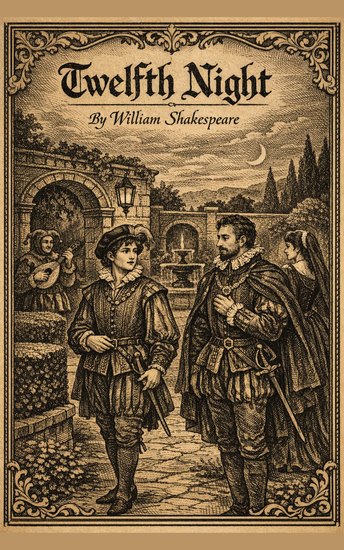
Twelfth Night - cover

Twelfth Night

William Shakespeare

Maison d'édition: CLXBX

  • 0
  • 0
  • 0

Synopsis

A sparkling comedy of mistaken identity, romantic entanglements, and playful deception, Twelfth Night is one of William Shakespeare's most delightful and enduring works. Set in the imagined land of Illyria, this lively play blends humor, music, and heartfelt emotion in a story that celebrates love in all its unpredictable forms.

The tale begins with a shipwreck that separates twins Viola and Sebastian. Believing her brother lost at sea, Viola disguises herself as a young man named Cesario in order to serve Duke Orsino. The Duke, consumed by his unreturned affection for the Countess Olivia, sends Cesario to plead his case on his behalf. But the situation quickly grows complicated: Olivia falls in love with Cesario, unaware that he is actually Viola in disguise, while Viola herself secretly develops feelings for Orsino.

As identities blur and affections tangle, the play unfolds in a whirlwind of comic misunderstandings. Alongside the central love triangle, a spirited subplot features the pompous steward Malvolio, who becomes the target of a mischievous prank that tests his vanity and ambition. Through these intersecting stories, Shakespeare creates a vibrant world filled with wit, longing, and joyful chaos.

At its heart, Twelfth Night explores themes of identity, gender roles, desire, and the transformative power of love. The play challenges rigid boundaries between appearance and reality, showing how disguise can both conceal and reveal the truth. Its festive spirit reflects the holiday season for which it is named—a time when conventions are overturned and laughter reigns.

With memorable characters, lyrical dialogue, and sparkling humor, Twelfth Night remains one of Shakespeare's most beloved comedies. It balances lighthearted romance with deeper reflections on longing and self-discovery, offering a timeless celebration of the human heart.

Charming, witty, and endlessly entertaining, Twelfth Night invites readers and audiences alike to lose themselves in a world where love triumphs over confusion and joy emerges from delightful disorder.
Disponible depuis: 20/02/2026.
Longueur d'impression: 73 pages.
D'autres livres qui pourraient vous intéresser

  • Witchcraft - From their pens to your ears genius in every story - cover

    Witchcraft - From their pens to...

    Arthur Machen

    • 0
    • 0
    • 0
    Arthur Llewelyn Jones was born in Caerleon, Monmouthshire on the 3rd March 1863. 
    Machen came from a long line of clergymen, and when he was two, his father became vicar of a small parish about five miles north of Caerleon, and Machen was brought up at the rectory there. 
    In his early years he received an excellent classical education, but family poverty ruled out university, and he was sent to London to sit exams to attend medical school but failed the exams.  He did show literary promise with the publication of the poem ‘Eleusinia’ in 1821.  But life in London was difficult and it was only in 1884 that he published again and was taken on to translate several French works which thereafter became the standard editions for many years. 
    In 1887, his father died.  That same year he married Amelia Hogg, a maverick music teacher with a passion for the theatre.  He also began to receive legacies from Scottish relatives which allowed him to devote more time to writing. 
    After publishing in literary magazines in 1894 he published his first book ‘The Great God Pan’.  Its sexual and horrific content very much helped sales. 
    Over the next decade or so he wrote some of his best work but was unable to find a publisher mainly due to the collapse of the decadent market over Oscar Wilde’s scandalous trial. 
    In 1899, his wife died and during his long recovery he took up acting and travelled around the country as part of a travelling company.  Three years later he was publishing again and had remarried. 
    Re-publishing of earlier works helped anchor both his reputation and his income.  By the time the Great War opened Europe’s wounds he returned to the public eye with ‘The Bowmen’ helped by the publicity around the ‘Angel of Mons’ episode. 
    However, by the late 20’s new works had dried up and his back catalogue was no longer a source of regular income. 
    In 1932 he received a Civil List pension of ₤100 per annum but other work was not forthcoming.  His finances finally stabilised with a literary appeal in 1943 for his eightieth birthday and allowed him to live his remaining years in relative comfort. 
    Arthur Machen died on 15th December 1947 in Beaconsfield. He was 84.
    Voir livre
  • Alice's Adventures in Wonderland - Audiobook - cover

    Alice's Adventures in Wonderland...

    Lewis Carroll, Classic...

    • 0
    • 0
    • 0
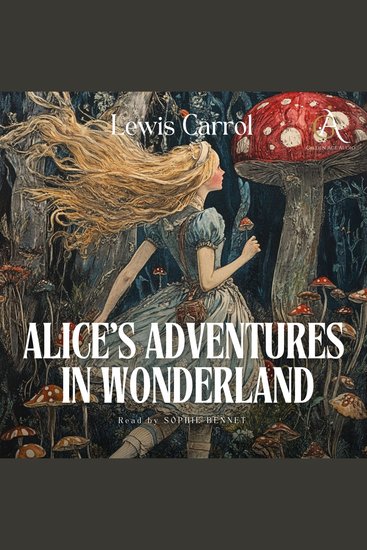
    Lewis Carroll's Alice's Adventures in Wonderland is a timeless journey into the world of imagination, where logic bends and the ordinary becomes extraordinary. The story follows young Alice as she tumbles down a rabbit hole and discovers a land of peculiar creatures, talking animals, and nonsensical rules. From the grinning Cheshire Cat to the frantic White Rabbit and the tyrannical Queen of Hearts, every encounter challenges Alice's understanding of reality.This novel is more than a children's tale—it is a playful yet thought-provoking exploration of identity, curiosity, and the limits of reason. Written with wit, wordplay, and satire, Carroll's masterpiece invites readers of all ages to step into a dreamlike realm where the impossible feels possible, and where every page offers a new puzzle to unlock.
    Voir livre
  • Gooseberries - From their pens to your ears genius in every story - cover

    Gooseberries - From their pens...

    Anton Chekhov

    • 0
    • 0
    • 0
    Anton Pavlovich Chekhov was born on 29th January 1860 in Taganrog, on the south coast of Russia.  
    His family life was difficult; his father was strict and over-bearing but his mother was a passionate story-teller, a subject Chekhov warmed to. As he later said; ‘our talents we got from our father, but our soul from our mother’.  
    At school Chekhov was distinctly average. At 16 his father mis-managed his finances and was declared bankrupt. His family fled to Moscow. Chekhov remained and eked out a living by various means, including writing and selling short sketches to newspapers, to finish his schooling. That completed and with a scholarship to Moscow University obtained he rejoined his family. 
    He was able to help support them by selling satirical sketches and vignettes of Russian lifestyles and gradually obtained further commissions. In 1884, he qualified as a physician and, although it earned him little, he often treated the poor for free, he was fond of saying ‘Medicine is my lawful wife, and literature is my mistress.’ 
    His own health was now an issue as he began to cough up blood, a symptom of tuberculosis.  Despite this his writing success enabled him to move the family into more comfortable accommodation.  
    Chekhov wrote over 500 short stories which included many, many classics including ‘The Kiss’ and ‘The Lady with a Dog’.  His collection ‘At Dusk’ won him the coveted Pushkin Prize when was only 26.  
    He was also a major playwright beginning with the huge success of ‘Ivanov’ in 1887.   
    In 1892 Chekhov bought a country estate north of Moscow. Here his medical skills and money helped the peasants tackle outbreaks of cholera and bouts of famine. He also built three schools, a fire station and a clinic.  It left him with less time for writing but the interactions with real people gained him detailed knowledge about the peasantry and their living conditions for his stories.  
    His most famous work, ‘The Seagull’ was received disastrously at its premiere in St Petersburg. It was later restaged in Moscow to highlight its psychological aspects and was a huge success. It led to ‘Uncle Vanya’, ‘The Three Sisters’ and ‘The Cherry Orchard’.  
    Chekhov suffered a major lung hemorrhage in 1897 while visiting Moscow. A formal diagnosis confirmed tuberculosis and the doctors ordered changes to his lifestyle.  
    Despite a dread of weddings the elusive literary bachelor quietly married the actress Olga Knipper, whom he had met at rehearsals for ‘The Seagull’, on 25th May 1901. 
    By May 1904 with his tuberculosis worsening and death imminent he set off for the German town of Badenweiler writing cheerful, witty letters to his family and assuring them his health was improving.  
    On 15th July 1904 Anton Chekhov died at Badenweiler.  He was 44.
    Voir livre
  • The Idiot - cover

    The Idiot

    Fyodor Dostoevsky

    • 0
    • 0
    • 0
    A young man returns to Russia from a Swiss sanatorium with no money, no guile and an incurable habit of telling the truth, and Petersburg society decides what to do with him. Dostoevsky set out to portray a perfectly good man and admitted the task frightened him; he wrote the novel abroad, in debt, and considered it a failure. It is now the book his admirers defend most fiercely.
    Voir livre
  • A Society - From their pens to your ears genius in every story - cover

    A Society - From their pens to...

    Virginia Woolf

    • 0
    • 0
    • 0
    Adeline Virginia Woolf was born on the 25th January 1882 in South Kensington in London. 
    Although lauded as a founder of modernist writing with such classics as ‘Orlando’, ‘Mrs Dalloway’ and ‘To the Lighthouse’ and, of course, many classic short stories, her background is filled with elements of tragedy that she somehow overcame to become such a revered writer.   Her mother died when she was 13, her half-sister Stella two years later and with it her first of several nervous breakdowns.  Appallingly it was later found that three of her half-brothers had sexually abused her so darkness must have seemed ever present.   
    She began writing professionally at age 20 but her father’s death two years later brought a complete mental collapse and she was briefly institutionalised.  Somehow she found within herself a literary career and with it great innovations in writing; she was a pioneer of “stream of consciousness”.    
    Her tight circle of friends were the founders of the Bloomsbury Group, a movement whose legacy still influences across the arts and society in many way to this day.   
    Whilst the dark periods continued to interrupt her emotional state her rate of work never ceased.  Until, on 28th March 1941, Woolf put on her overcoat, filled up its pockets with stones, and walked into the River Ouse, in Lewes, East Sussex and drowned herself.  Her body was not recovered until the 18th April.  She was 59. 
    She left behind a note which read in part “Dearest, I feel certain that I am going mad again.  I feel we can't go through another of those terrible times.  And I shan't recover this time.  I begin to hear voices, and I can't concentrate.  So I am doing what seems the best thing to do”.
    Voir livre
  • Grim Tales - A pioneering volume of macabre supernatural tales - cover

    Grim Tales - A pioneering volume...

    Edith Nesbit

    • 0
    • 0
    • 0
    Edith Nesbit was born on the 15th August 1858 in Kennington, then part of Surrey.   
     
    Due to the health issues and tuberculosis of her sister Mary, Nesbit’s early life was one of constant changes of house both in England and on the continent. 
     
    At age 17, Nesbit met Hubert Bland and they married three years later―whilst she was 7 months pregnant.  Bland also kept his affair with another woman going throughout their marriage and the two children of that relationship were raised by Nesbit as well as her own three with Bland. 
     
    Together they were founder members of the Fabian Society in 1884 naming their son Fabian in its honour.  They also edited the Society's journal; ‘Today’.  Nesbit was an active lecturer and prolific writer on socialism during those years but gradually her work for them dwindled as her career as a children’s writer grew.  Her most famous success was ‘The Railway Children’ but she was also very prolific and greatly accomplished in poetry, short stories―especially her macabre ghost and supernatural stories―and novels for adults.  
     
    In February 1917, some three years after the death of Bland she married Thomas ‘the Skipper’ Tucker in Woolwich, where he was a ship's engineer on the Woolwich Ferry. 
     
    Edith Nesbit died from lung cancer on the 4th May 1924 at her house ‘The Long Boat’ at Jesson, St Mary's Bay, New Romney in Kent.  She was 65.
    Voir livre