¡Acompáñanos a viajar por el mundo de los libros!
Añadir este libro a la estantería
Grey
Escribe un nuevo comentario Default profile 50px
Grey
Suscríbete para leer el libro completo o lee las primeras páginas gratis.
All characters reduced
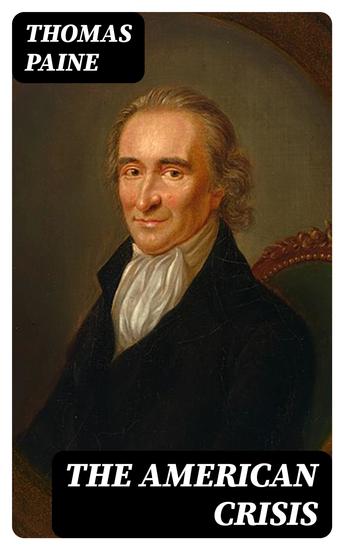
The American Crisis - cover

The American Crisis

Thomas Paine

Editorial: DigiCat

  • 0
  • 0
  • 0

Sinopsis

In "The American Crisis," Thomas Paine crafts a series of powerful pamphlets that served as a rallying cry for American independence during the Revolutionary War. Written in a passionate and accessible style, Paine's arguments not only illuminate the trials faced by patriots but also emphasize the philosophical underpinnings of freedom, democracy, and the rights of man. With its eloquent prose and persuasive rhetoric, this work emerged in a tumultuous literary context, standing as a direct response to the challenges besetting the young nation and fostering a sense of unity among its people in the face of adversity. Paine, a political activist and philosopher, was deeply influenced by Enlightenment ideals, which manifested in his belief in rational thought and human rights. His early life in England, combined with his experiences in America, shaped his understanding of oppression and fueled his quest for justice. "The American Crisis" was pivotal during the war, not only stoking the fires of rebellion but also enhancing Paine's role as a leading thinker of his time, making it clear why he remains a significant figure in American history. This compelling collection is highly recommended for readers intrigued by the ideological battles that forged the United States. Paine's incisive insights and unwavering commitment to liberty provide not only historical context but also timeless lessons on individual rights and civic duty, resonating deeply even in contemporary debates about freedom and governance.
Disponible desde: 11/10/2022.
Longitud de impresión: 928 páginas.

Otros libros que te pueden interesar

  • Canaanites - The Ancient History of the People Who Inhabited Israel - cover

    Canaanites - The Ancient History...

    Kelly Mass

    • 0
    • 0
    • 0
    During the late 2nd millennium BC, Canaan was a Semitic-speaking civilization located in the Ancient Near East. The region held significant geopolitical importance, especially during the Late Bronze Age Amarna Period in the 14th century BC, when it became a crossroads for major empires. The Egyptian, Hittite, Mitanni, and Assyrian Empires all had areas of interest that converged or overlapped in Canaan, making it a key territory for trade, warfare, and cultural exchange. Much of our understanding of Canaan comes from archaeological excavations at sites such as Tel Hazor, Tel Megiddo, En Esur, and Gezer, where remnants of ancient Canaanite life have been uncovered. 
    In biblical texts, the term "Canaan" frequently appears to refer to the broader geographical region known as the Levant, particularly the Southern Levant. This area includes several territories that are central to the Bible’s narrative, such as the Land of Israel, Philistia, and Phoenicia. The Canaanites were the indigenous peoples of this region, and their diverse societies included both settled agricultural communities and nomadic-pastoral groups.
    Ver libro
  • 20 Myths about Religion and Politics in America - cover

    20 Myths about Religion and...

    Ryan P. Burge

    • 0
    • 0
    • 0
    The way most people think about religion and politics is only loosely linked to empirical reality, argues Ryan P. Burge in 20 Myths about Religion and Politics in America. Instead, our thinking is based on anecdotes, a quick scan of news headlines, or worse, flat-out lies told by voices trying to push a religious or political agenda on a distracted public. 


    Burge sees this fundamentally flawed understanding of the world around us and our misperceptions about where we fit into the larger fabric of society as caustic for the future of American politics and religion. Without an accurate picture of our society, when we subscribe to only caricatures of what our country looks like, we never really address the problems facing us. 


    Striving to be an impartial referee, Burge describes with accessible and engaging prose what the data says. Step by step, he debunks twenty myths, using rigorous data analysis and straightforward explanations. He gives listeners the resources to adopt an empirical view of the world that can help all of us, religious and nonreligious alike, get past at least some of the unsupported beliefs that divide us.
    Ver libro
  • Past Imperfect - French Intellectuals 1944-1956 - cover

    Past Imperfect - French...

    Tony Judt

    • 0
    • 1
    • 0
    A “marvelously readable” critique of Sartre, Camus, de Beauvoir, and other French postwar intellectuals that “consistently entertains and provokes” (The Washington Post).   The uniquely prominent role of French intellectuals in European cultural and political life following World War II is the focus of this book by the acclaimed author of Postwar: A History of Europe Since 1945. Tony Judt analyzes this intellectual community’s most divisive conflicts: how to respond to the promise and the betrayal of Communism and how to sustain a commitment to radical ideals when confronting the hypocrisy in Stalin’s Soviet Union, in the new Eastern European Communist states, and in France itself. Judt shows why this was an all-consuming moral dilemma to a generation of French men and women, how their responses were conditioned by war and occupation, and how postwar political choices have come to sit uneasily on the conscience of later generations of French intellectuals. Judt’s analysis extends beyond the writings of fashionable “existentialist” personalities such as Jean-Paul Sartre, Albert Camus, and Simone de Beauvoir to include a wide intellectual community of Catholic philosophers, non-aligned journalists, literary critics and poets, Communist and non-Communist alike—and asserts that what he calls the “moral irresponsibility” of those years damaged France’s cultural standing, and reflected the nation’s larger difficulty in confronting its own ambivalent past.   “A forthright and uncommonly damning study of those intellectually volatile years . . . indicts these intellectuals for their inhumanity in failing to test their political thought against political reality.” —The New York Times Book Review   “Brilliant . . . splendidly written.” —Foreign Affairs
    Ver libro
  • Summary of Scott W Atlas's A Plague Upon Our House - cover

    Summary of Scott W Atlas's A...

    Falcon Press

    • 0
    • 0
    • 0
    Buy now to get the main key ideas from Scott W. Atlas's A Plague Upon Our House 
    The COVID-19 pandemic created panic all around the world, but was it what we were made to believe, or was there a political agenda hidden behind all the restrictions? 
    In A Plague Upon Our House, Dr. Scott W. Atlas details his couple months as a member of the White House Coronavirus Task Force. Politics had taken over science long before Atlas got there, and while he tried to bring back logic and critical thinking into decision-making, he had little impact. He discusses his views of the science behind the lockdowns and mask mandates - the science medical professionals on his team refused to believe. He sheds light on the politics behind every strategy implemented, and the utter chaos that ensued due to the contradictions in the media.
    Ver libro
  • Last One Walking - The Life of Cherokee Community Leader Charlie Soap - cover

    Last One Walking - The Life of...

    Greg Shaw, Wilma Mankiller,...

    • 0
    • 0
    • 0
    You probably know the story of the late Wilma Mankiller, the first woman to serve as principal chief of the Cherokee Nation. You might not recognize the name of her husband, Charlie Soap, yet his role as a Native community organizer is no less significant. Last One Walking charts for the first time the life and work of this influential Cherokee. 


    Author and former journalist Greg Shaw gives voice to his sources. He draws on his many travels and interviews with Soap and on previously unpublished writings. Shaw offers a rich profile of Soap's singular career—particularly as a champion of water rights. 


    In managing public infrastructure projects, housing assistance, and water development in the Cherokee Nation, Soap has exemplified ga-du-gi, the Cherokee word for community members working together for the collective good. 


    Charlie Soap's name in Cherokee, Ohni ai, translates as "the last one walking." In the Cherokee wolf clan, this is the member who trails the rest of the pack to watch for danger and opportunity. 


    The Native American fight for land has been well chronicled, but the fight for water has not. Last One Walking helps to fill that void with a narrative that is also deeply moving.
    Ver libro
  • Badass Living - cover

    Badass Living

    Victor Waid

    • 0
    • 0
    • 0
    Feeling stuck in life? BADASS LIVING is your no-nonsense guide to rediscovering your energy, redefining your goals, and reigniting your passion for living. Step onto the path to personal transformation and take back control of your journey.
    Ver libro