Unisciti a noi in un viaggio nel mondo dei libri!
Aggiungi questo libro allo scaffale
Grey
Scrivi un nuovo commento Default profile 50px
Grey
Iscriviti per leggere l'intero libro o leggi le prime pagine gratuitamente!
All characters reduced
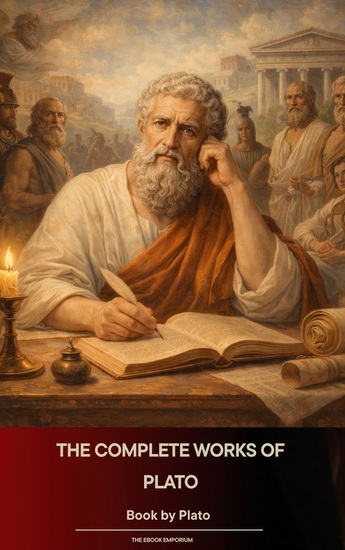
The Complete Works of Plato - cover

The Complete Works of Plato

Plato

Traduttore Benjamin Jowett

Casa editrice: The Ebook Emporium

  • 0
  • 0
  • 0

Sinossi

What questions define a good life—and a just society?

The Complete Works of Plato brings together the essential dialogues of one of the most influential philosophers in human history. Writing through vivid conversations led by Socrates, Plato explored the deepest questions of ethics, politics, reality, beauty, and the nature of knowledge—ideas that continue to shape Western thought.

This comprehensive collection includes Plato's major dialogues, from reflections on virtue and justice to profound inquiries into metaphysics, love, education, and the ideal state. Through clear reasoning and dramatic dialogue, Plato transformed philosophy into a living conversation rather than abstract theory.

His works laid the foundations of philosophy, political theory, and ethics, influencing thinkers from Aristotle to modern philosophy.

Inside this eBook, you'll explore:

All major Platonic dialogues in one complete collection

Core texts such as The Republic, Symposium, and Phaedo

Timeless explorations of justice, truth, love, and knowledge

A cornerstone of classical philosophy and world literature

Studied for over two millennia and still debated today, Plato's works remain essential reading for anyone seeking intellectual depth and enduring wisdom.

Enter the dialogue that shaped civilization. Buy now and experience the complete works of Plato.
Disponibile da: 29/01/2026.
Lunghezza di stampa: 547 pagine.
Altri libri che potrebbero interessarti

  • Energy Politics in the Mena Region - From Hydrocarbons to Renewables? - cover

    Energy Politics in the Mena...

    Valeria Talbot

    • 0
    • 0
    • 0
    The war in Ukraine has highlighted Europe's urgency to diversify its energy supplies and reduce dependence on Russia. While, in such context, energy security has become a top political priority for Europe, energy resources from the Middle East and North Africa (MENA) region have drawn European countries' renewed attention. Boasting abundant oil and gas reserves, the MENA region will likely play a
    leading role in Europe's current energy crisis. While MENA exporters' ability to increase their supply is limited in the short-term, more resources are likely to be available in a longer-term perspective.
    As Europeans are scrambling for alternatives, this Report analyses the different implications for a number of MENA exporters of fossil fuels. As these countries have become even more central to Europe's energy security, assessing their prospects is of paramount importance, including not only their short-term role as suppliers of fossil fuels, but also their opportunity to accelerate along the path of the green
    transition.
    How is the current energy crisis affecting the role of MENA hydrocarbons producers as Europe's energy suppliers? How will Europe's needs in additional resources redefine energy geopolitics in the Middle East and North Africa? Which new prospects for their green transition?
    Mostra libro
  • American Political Parties - Why They Formed How They Function and Where They're Headed - cover

    American Political Parties - Why...

    John Kenneth White, Matthew R....

    • 0
    • 0
    • 0
    American Political Parties is a core textbook on political parties in the United States that places the US party system into a framework designed around the disagreements between Alexander Hamilton and Thomas Jefferson. White and Kerbel argue that the two-party system in the United States began with a common agreement on the key values of freedom, individual rights, and equality of opportunity but that Hamilton and Jefferson disagreed—often vehemently—over how to translate these ideals into an acceptable form of governance. 


    While Hamilton wanted to marry freedom to a strong, active federal government with an energetic president who would act on behalf of all citizens, Jefferson believed that freedom should be allied to local civic virtue, with governmental responsibilities placed primarily at the local level. Today, Hamiltonian nationalism finds its home in the Democratic Party, while Republicans have espoused Jeffersonian localism since 1964. Using this historical framework, American Political Parties examines a range of topics including marketing and social media, campaign finance, reforms in the presidential nominating process, political demography, and third parties. In this new edition, the authors describe four possible futures in the wake of the 2020 election and why Americans believed it was "the most important" election in their lifetimes.
    Mostra libro
  • The US Congress - A Very Short Introduction - cover

    The US Congress - A Very Short...

    Donald A. Ritchie

    • 0
    • 0
    • 0
    Donald A. Ritchie, a congressional historian for forty years, takes listeners on a fascinating, behind-the-scenes tour of Capitol Hill, pointing out the key players, explaining their behavior, and translating parliamentary language into plain English. He also explores the essential necessity of compromise to accomplish anything significant in the legislative arena. However, recent events show that political polarization has hardened and produced gridlock. The 2020 election also produced a more diverse membership in terms of gender, ethnicity, religion, and ideology, with primary elections resulting in the defeat of moderate candidates, making bipartisan compromise harder to achieve. 


    Among the most significant events, the Senate ignored President Obama's last nomination to the Supreme Court and then adopted a "nuclear option" to streamline future Supreme Court confirmations. The House also twice impeached President Trump, processes that starkly expose the differences between the majority-rule requirements of the House and the super-majority requirements of the Senate. This new edition explains how the parties have changed in light of the unprecedented politics of the past four years, culminating in the mob attack on the U.S. Capitol on January 6, 2021, and how this development has affected both the House and the Senate.
    Mostra libro
  • How to Slay a Dragon - Building a New Russia After Putin - cover

    How to Slay a Dragon - Building...

    Mikhail Khodorkovsky

    • 0
    • 0
    • 0
    Mikhail Khodorkovsky is one of the most astute observers of today's Russia. Imprisoned for a decade in Russia's prisons on politically motivated charges, he knows all too well the best and the worst of his country. He now lives in exile and, like many Russians who live abroad, he longs for the day when he can return to a free and democratic Russia. 


    This book is Khodorkovsky's account of what is happening in Russia today and what could happen in the future. Putin will not last forever: sooner or later, there will be a post-Putin era. But Russia's history has been deeply shaped by an autocratic trap: a revolution against an autocracy has produced another autocracy, followed by another revolution and another autocracy, and so on. If Russia is to find its place as a constructive partner in a global community of civilized nations, then it has to escape this vicious cycle. 


    How to Slay a Dragon is Khodorkovsky's account of his own journey and of how the vicious cycle of Russian history can be broken. He charts a pathway towards a parliamentary federal republic which would enable Russia to become a free and democratic society, living in peace and without dragons.
    Mostra libro
  • Commander in Chief - Partisanship Nationalism and the Reconstruction of Congressional War Powers - cover

    Commander in Chief -...

    Casey B. K. Dominguez

    • 0
    • 0
    • 0
    The constitutional balance of war powers has shifted from Congress to the president over time. Today, presidents broadly define their constitutional authority as commander in chief. In the nineteenth century, however, Congress was the institution that claimed and defended expansive war powers authority. This discrepancy raises important questions: How, specifically, did Congress define the boundaries between presidential and congressional war powers in the early republic? Did that definition change? 


    Casey Dominguez's Commander in Chief systematically analyzes the authority that members of Congress ascribe to the president as commander in chief and the boundaries they put around that authority. 


    Dominguez shows that for more than a century members of Congress defined the commander in chief's authority narrowly. But in a wave of nationalism during the Spanish-American War, members of Congress began to argue that Congress owed deference to the commander in chief. They also tended to argue that a president of their own party should have broad war powers, while the powers of a president in the other party should be defined narrowly. Together, these two dynamics suggest that the conditions for presidentially dominated modern constitutional war powers were set at the turn of the twentieth century, far earlier than is often acknowledged.
    Mostra libro
  • Day of Reckoning - How the Far Right Declared War on Democracy - cover

    Day of Reckoning - How the Far...

    Mike Wendling

    • 0
    • 0
    • 0
    The United States has become an almost unrecognizable country—with millions in thrall to conspiracy theories, toxic populism, and the far right edging closer to total power—a dire threat to civil society and democratic institutions. While the MAGA movement was in remission due to Donald Trump's defeat in 2020, the fascist fringes have not just survived but have continued to thrive and burrow into the mainstream. The January 6th Capitol Riot prosecutions have done little to curb their enthusiasm for mayhem. 


    Trump's base in the Republican Party is committed to their candidate like never before. The institutionalization of racist voter suppression and the outdated logic behind the Electoral College means he could take back the White House. Apocalyptic messaging ensures the alt-right, anti-government, anti-LGBT, and white nationalist groups see the next election as a life-or-death struggle and are uniting to back the one person they can all agree on—guaranteeing another chaotic election. 


    In this chilling exposé, Wendling encounters Capital rioters, Covid deniers, QAnon supporters, and Proud Boys and uncovers the roots of a movement that threatens to shatter the foundations of democracy.
    Mostra libro