Unisciti a noi in un viaggio nel mondo dei libri!
Aggiungi questo libro allo scaffale
Grey
Scrivi un nuovo commento Default profile 50px
Grey
Iscriviti per leggere l'intero libro o leggi le prime pagine gratuitamente!
All characters reduced
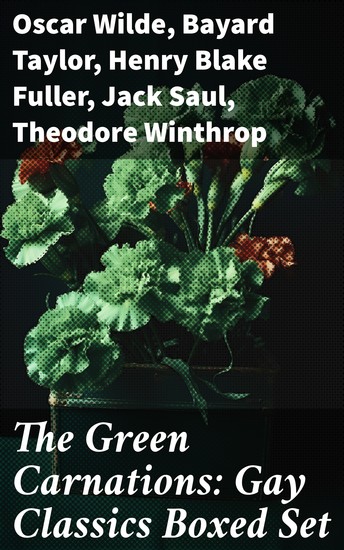
The Green Carnations: Gay Classics Boxed Set - The Picture of Dorian Gray Joseph and His Friend Cecil Dreeme The Sins of the Cities of the Plain… - cover

The Green Carnations: Gay Classics Boxed Set - The Picture of Dorian Gray Joseph and His Friend Cecil Dreeme The Sins of the Cities of the Plain…

Oscar Wilde, Bayard Taylor, Henry Blake Fuller, Petronius, Theodore Winthrop, Jack Saul, Harlan Cozad McIntosh

Casa editrice: Good Press

  • 0
  • 0
  • 0

Sinossi

The Green Carnations: Gay Classics Boxed Set offers readers an intricate tapestry of narratives, essays, and reflections that delve deeply into LGBTQ+ themes throughout literary history. This collection brings together a rich array of voices, exploring diverse literary styles ranging from the incisive satire of Oscar Wilde to the classical narrative complexities found in Petronius. Each piece resonates with its own interpretation of identity, queer culture, and societal critique, contributing significantly to the anthology'Äôs overarching themes of self-discovery, love in its many forms, and the courage of living one's truth. With contributions from revered authors like Bayard Taylor, Henry Blake Fuller, Jack Saul, and more, the collection embodies the spirit of literary movements that have commented on and shaped queer identity over centuries. The editors have curated a selection that not only pays homage to the historical struggles and triumphs of the LGBTQ+ community but also aligns with pivotal cultural and literary discourses, such as the aesthetic movement and early modernism. These authors offer a blend of perspectives that span different cultural contexts, creating a mosaic that enhances the reader's appreciation of the thematic depths underpinning queer literature. This anthology is an essential read for those seeking to explore the multiplicity of LGBTQ+ narratives through the lens of various literary traditions. It presents an invaluable opportunity for readers to encounter a plethora of voices and styles within a single volume, providing educational insight and fostering meaningful dialogue. Whether for academic study or personal enlightenment, The Green Carnations aims to broaden the understanding of queer themes and their impact on both literature and society at large.
Disponibile da: 21/12/2023.
Lunghezza di stampa: 1888 pagine.


Altri libri che potrebbero interessarti

  • Body Language - Writers on Identity Physicality and Making Space for Ourselves - cover

    Body Language - Writers on...

    Nicole Chung, Matt Ortile

    • 0
    • 0
    • 0
    Bodies are serious, irreverent, sexy, fragile, strong, political, and inseparable from our experiences and identities as human beings. Pushing the dialogue and confronting monolithic myths, this collection of essays tackles topics like weight, disability, desire, fertility, illness, and the embodied experience of race in deep, challenging ways. 


    Selected from the archives of Catapult magazine, the essays in Body Language affirm and challenge the personal and political conversations around human bodies from the perspectives of thirty writers diverse in race, age, gender, size, sexuality, health, ability, geography, and class—a brilliant group probing and speaking their own truths about their bodies and identities, refusing to submit to others' expectations about how their bodies should look, function, and behave. 


    Covering a wide range of experiences—from art modeling as a Black woman to nostalgia for a brutalizing high school sport, from the frightening upheaval of cancer diagnoses to the small beauties of funeral sex—this collection is intelligent, sensitive, and unflinchingly candid. Through the power of personal narratives, as told by writers at all stages of their careers, Body Language reflects the many ways in which we understand and inhabit our bodies.
    Mostra libro
  • The Master of Drums - Gene Krupa and the Music He Gave the World - cover

    The Master of Drums - Gene Krupa...

    Elizabeth J. Rosenthal

    • 0
    • 0
    • 0
    From the early 1930s onward, Gene Krupa was a drum-centric rarity in the jazz world. Never before had a drummer been in the forefront as a solo artist. His galvanizing, unrestrained passion for percussion demanded it. Rocking the rafters, Gene thrilled audiences in ballrooms, nightclubs, and movies. 


    Seemingly born jazz-drum crazy in 1909 to a Polish-immigrant working-class family in South Chicago, Gene was a professional by the age of thirteen and soon made his first recordings. By the early 1930s, he was New York City's most in-demand drummer, and in 1934, joined brilliant clarinetist Benny Goodman's band, helped inaugurate the Swing Era, and played the first-ever swing concert at Carnegie Hall. He formed his own band and shattered racial boundaries by sharing the spotlight with the African-American trumpeter Roy Eldridge. But after a skyrocketing ride to the top, Gene experienced a rollercoaster ride of good and bad luck, emotional highs, and devastating depths. 


    In The Master of Drums, biographer Elizabeth J. Rosenthal crafts a celebratory, honest, and exhaustively researched portrait of a twentieth-century music legend. When he died, Gene Krupa may have left behind a world of grieving friends, colleagues, fans, students, and progeny, but as The Master of Drums proves, his dynamic musical and cultural influences live on.
    Mostra libro
  • White Duck in a Black Pond A: Race Identity and Privilege - cover

    White Duck in a Black Pond A:...

    Dane Wycoff

    • 0
    • 0
    • 0
    A White Duck in a Black Pond is a compelling memoir as engrossing, relevant, and timely today as decades ago. Being the son of a White mother and an African American father during the 1950s presented challenges on its own, but the bane of Dane Wycoff's existence wasn’t that he was mixed; it was because he believed himself one hundred percent Black despite his white skin. His chosen identity led to an endless wave of rejection, violence, and torment. Dane was a Black boy somatically entrapped in white pigmentation, rejected by Black and White peers alike.
    Mostra libro
  • A Legend of Old Egypt - From their pens to your ears genius in every story - cover

    A Legend of Old Egypt - From...

    Boleslaw Prus

    • 0
    • 0
    • 0
    Aleksander Głowacki who wrote under the nom de plume Boleslaw Prus was born on 20th August 1847 at Hrubieszów in the Kingdom of Poland, at that time, controlled by the Russian Empire. 
    At three his mother died and then at nine his father.  Female relatives helped raise him but at 15 he joined the Polish uprising against the might of Imperial Russia.  Wounded on the battlefield, arrested and imprisoned, he was later released into the care of a relative and resumed secondary school and then Warsaw University but poverty forced him to leave after two years.  At some point he developed agoraphobia which often caused problems. 
    In 1869, he enrolled in the Forestry Department at Puławy but was soon sacked and so he began a system of self-education that led to work as a newspaper columnist on a wide-ranging series of topics that eventually became the ‘Weekly Chronicles’ and spanned 40 years. 
    With his finances now stabilized he married and then adopted his late brother-in-law’s son.  
    It seems he had doubts as to the scale of his talents and early on adopted the name ‘Boleslaw Prus’ for both his journalistic and literary offerings. 
    His work as a short-story writer met with much acclaim. He wrote several dozen of them, originally published in newspapers and ranging in length from micro-story to novella. His keen observation of everyday life and sense of humor are evident in them.  
    During his career he also wrote novels. After ‘Pharoah’, in 1895, he embarked on a four-month journey taking in Berlin, Dresden, Nuremberg, Rapperswil in Switzerland, where he stayed for two months, and his final destination, Paris.  Here his agoraphobia was so bad he couldn’t cross the Seine.  
    However, his writing continued and in 1911 his novel ‘Changes’, though uncompleted, began to be serialised.  It was never finished. 
    Boleslaw Prus died on 19th May 1912, at his Warsaw apartment.  He was 64.  A National Hero, thousands attended both his funeral service and interment.
    Mostra libro
  • Oasis: What's The Story?: Life on tour with Liam and Noel Gallagher - cover

    Oasis: What's The Story?: Life...

    Iain Robertson

    • 0
    • 0
    • 0
    *THE MUST-LISTEN BOOK FOR THE OASIS REUNION TOUR*'Deserves to stay on the bestseller lists for a long time to come' - Caitlin Moran'Brilliant' - NMEOasis were a band like bands used to be. Hard-drinking and substance abusing. If they liked you, they loved you. If they didn't, you had to be prepared for confrontation. Iain Robertson is used to tough jobs - after retiring from the Parachute Regiment, he took on jobs guarding George Harrison, Gary Moore and Johnny Rotten. But keeping Oasis on the rails after debut album Definitely Maybe ignited their rise toward global superstardom would be the toughest gig of them all. Oasis would explode into public consciousness and have the world at their feet in the wake of their epic first album and a huge world tour. Iain was side-by-side as their road manager and minder, twenty-four hours a day, eight days a week, as they took on the world and won. No one was closer. Now updated with new unpublished material to celebrate the thirty year anniversary of Definitely Maybe and ahead of their upcoming reunion tour, this story is the defining chronicle of life on tour with Oasis.
    Mostra libro
  • After the Funeral - From their pens to your ears genius in every story - cover

    After the Funeral - From their...

    Mary Butts

    • 0
    • 0
    • 0
    Mary Frances Butts was born on 13th December 1890 in Poole, Dorset. 
    Her early years were spent at Salterns, an 18th-century house overlooking Poole Harbour.  Sadly in 1905 her father died, and she was sent for boarding at St Leonard's school for girls in St Andrews. 
    Her mother remarried and, from 1909, Mary studied at Westfield College in London, and here, first became aware of her bisexual feelings.  She was sent down for organising a trip to Epsom races and only completed her degree in 1914 when she graduated from the London School of Economics.  By then Mary had become an admirer of the occultist Aleister Crowley and she was given a co-authorship credit on his ‘Magick (Book 4)’. 
    In 1916, she began the diary which would now detail her future life and be a constant reference point for her observations and her absorbing experiences. 
    During World War I, she was doing social work for the London County Council in Hackney Wick, and involved in a lesbian relationship.  Life changed after meeting the modernist poet, John Rodker and they married in 1918. 
    In 1921 she spent 3 months at Aleister Crowley's Abbey of Thelema in Sicily; she found the practices dreadful and also acquired a drug habit.  Mary now spent time writing in Dorset, including her celebrated book of short stories ‘Speed the Plough’ which saw fully develop her unique Modernist prose style. 
    Europe now beckoned and several years were spent in Paris befriending many artists and writing further extraordinary stories.   
    She was continually sought after by literary magazines and also published several short story collections as books. Although a Modernist writer she worked in other genres but is essentially only known for her short stories.  Mary was deeply committed to nature conservation and wrote several pamphlets attacking the growing pollution of the countryside. 
    In 1927, she divorced and the following year her novel ‘Armed with Madness’ was published.  A further marriage followed in 1930 and time was spent attempting to settle in London and Newcastle before setting up home on the western tip of Cornwall.  By 1934 the marriage had failed. 
    Mary Butts died on 5th March 1937, at the West Cornwall Hospital, Penzance, after an operation for a perforated gastric ulcer. She was 46.
    Mostra libro