Join us on a literary world trip!
Add this book to bookshelf
Grey
Write a new comment Default profile 50px
Grey
Subscribe to read the full book or read the first pages for free!
All characters reduced
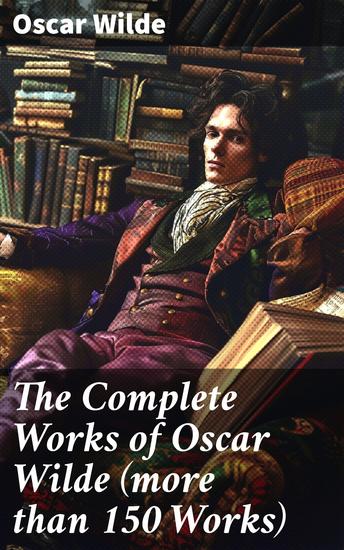
The Complete Works of Oscar Wilde (more than 150 Works) - Captivating Wit and Social Commentary: A Literary Collection by a Victorian Icon - cover

The Complete Works of Oscar Wilde (more than 150 Works) - Captivating Wit and Social Commentary: A Literary Collection by a Victorian Icon

Oscar Wilde

Publisher: Good Press

  • 0
  • 0
  • 0

Summary

The Complete Works of Oscar Wilde is a compendium that showcases the multifaceted genius of one of the most celebrated playwrights and literary figures of the late 19th century. This extensive compilation encompasses Wilde's poetry, plays, tales, and critical essays, crafted with his quintessential wit and poignant social commentary. The distinctive style of Wilde's writing, marked by his epigrammatic brilliance and engaging prose, invites readers to explore themes of aestheticism, identity, and morality against the backdrop of Victorian societal norms, revealing the paradoxes and contradictions of human nature. Oscar Wilde, an Irish novelist, poet, and playwright, emerged from the aesthetic movement which valued art for art's sake. Known for his flamboyant personality and keen insights into society, Wilde's experiences with love, loss, and scandal permeate his works. His own life of defiance against societal conventions informs the spirited critiques found within his writings, making his works not only a reflection of his time but also a timeless exploration of the human experience. Readers are encouraged to immerse themselves in The Complete Works of Oscar Wilde for a profound literary experience that exemplifies both the brilliance and the tragedy of one of literature'Äôs most iconic figures. This collection promises to enrich your understanding of the complexities of contemporary society and the enduring nature of art and individualism.
Available since: 12/18/2023.
Print length: 2121 pages.

Other books that might interest you

  • In Search of a Boy Named Chester - A gift to my father for his 100th birthday - cover

    In Search of a Boy Named Chester...

    Ford S. Worthy

    • 0
    • 0
    • 0
    Shortly after the end of World War II, a 21-year-old Navy officer – just back after a year at war in the Pacific – was eager to return to his small hometown in eastern North Carolina for a brief home leave. At the San Francisco airport, a mother travelling to Omaha offered him her seat – a patriotic gesture of gratitude, he believed. There was one condition: the sailor would need to accompany her 10-year-old son and see him safely to his grandmother in Omaha. 
    The boy’s name was Chester. The sailor never forgot him. 
    Nearly 80 years later, the sailor’s son sets out to give his father a special 100th birthday gift: to discover what became of that precocious boy. 
    The book blends memoir, investigative nonfiction, and family history into a poignant and suspenseful journey. Through letters, military records, census and newspaper archives and outreach to strangers-turned-allies, the author pieces together the life of a boy nearly lost to time. Along the way, the story explores themes of memory, intergenerational connection, and the lasting impact of wartime experiences. Rich in historical detail and emotional resonance, the book will appeal to readers of narrative nonfiction, World War II history, and family sagas, and to genealogical sleuths drawn to real-life mysteries. In Search of a Boy Named Chester is a story that shows us how even the most fleeting encounters can reveal who we are and who we may become.
    Show book
  • Cannon Hall Farm - Past Present & Future - cover

    Cannon Hall Farm - Past Present...

    The Nicholson Family

    • 0
    • 0
    • 0
    As seen on Channel 5’s hit shows, Springtime on the Farm, This Week on the Farm and Cannon Hall: A Yorkshire Farm 
     
     
    Packed with fresh anecdotes and astonishing new detail, this emotional journey to the foothills of the Pennines brings the Cannon Hall Farm story bang up to date. 
     
    In their own words, the very personal story of the ups and downs of the Nicholson family at Cannon Hall farm spanning almost 70 years. 
     
     
    From the death of Roger’s beloved dad Charlie to the daily struggle for survival amid farming’s rapidly changing landscape, the Nicholsons have weathered storm after storm. 
     
     
    They came perilously close to losing it all as a lifetime of farming tradition seemed to slip through their fingers. 
    But in a daring last roll of the dice, they bet the farm – and won – creating against all odds one of Britain’s best-loved tourist attractions. 
     
     
    Here, Roger and wife Cynthia, along with their sons Richard, Robert and David, take turns reflecting on some of the dizzy highs and crushing lows that have made them who they are today: champion livestock breeders, TV stars and – above all – devoted farmers.
    Show book
  • Andrew Fuller - Evangelical Hero - cover

    Andrew Fuller - Evangelical Hero

    Joel R. Beeke, Douglas Bond

    • 0
    • 0
    • 0
    What do George Whitefield, Elisabeth Elliot, and J. Gresham Machen have in common? They were all Evangelical Heroes. In the Evangelical Heroes series, Joel Beeke and Douglas Bond present thirty biographical sketches of faithful evangelical leaders from the eighteenth, nineteenth, and twentieth centuries. From George Whitfield to Charles Spurgeon to R.C. Sproul, these men and women held firm to the authority of Scripture and the reality of Christ's death and resurrection in the face of rising liberalism in the Church. These inspiring volumes introduce us to faithful Christians from the past and encourage us to stand firm today!
    Show book
  • Body Language - Writers on Identity Physicality and Making Space for Ourselves - cover

    Body Language - Writers on...

    Nicole Chung, Matt Ortile

    • 0
    • 0
    • 0
    Bodies are serious, irreverent, sexy, fragile, strong, political, and inseparable from our experiences and identities as human beings. Pushing the dialogue and confronting monolithic myths, this collection of essays tackles topics like weight, disability, desire, fertility, illness, and the embodied experience of race in deep, challenging ways. 


    Selected from the archives of Catapult magazine, the essays in Body Language affirm and challenge the personal and political conversations around human bodies from the perspectives of thirty writers diverse in race, age, gender, size, sexuality, health, ability, geography, and class—a brilliant group probing and speaking their own truths about their bodies and identities, refusing to submit to others' expectations about how their bodies should look, function, and behave. 


    Covering a wide range of experiences—from art modeling as a Black woman to nostalgia for a brutalizing high school sport, from the frightening upheaval of cancer diagnoses to the small beauties of funeral sex—this collection is intelligent, sensitive, and unflinchingly candid. Through the power of personal narratives, as told by writers at all stages of their careers, Body Language reflects the many ways in which we understand and inhabit our bodies.
    Show book
  • Old Fashioned Landowners - Gogols story of an aging couple who must confont the harsh lessons of mortality - cover

    Old Fashioned Landowners -...

    Nikolai Gogol

    • 0
    • 0
    • 0
    Nikolai Vasilievich Gogol was born on 1st April 1809 to a father, descended from Ukrainian Cossacks and a mother with a military background in the Ukrainian town of Sorochyntsi, then part of the Russian Empire and rich in Cossack traditions and folklore.   
     
    His father wrote poetry and plays which the young Gogol helped stage at his uncle’s home theatre.  This helped ignite in him a love of literature and blossomed when he attended, what is now, the Nizhyn Gogol State University at the age of 12.  Here he participated in school theatre productions and refined his mastery of his native Ukrainian and also the Russian of his Imperial masters. 
     
    In 1828 he went to St Petersburg and unsuccessfully tried to begin a career as an actor after finding that with no money and no connections the civil service was barred to him. 
     
    Embezzling money from his mother he embarked on a trip to Germany. When the money ran out, he returned to St Petersburg but the experiences were used in a series of stories he contributed to periodicals.  These tales were steeped in his childhood memories of the Ukrainian landscape and peasantry enlivened with the supernatural of its folklore woven with realistic events of the day.  He wrote in Russian in a whimsical, colloquial style with a smattering of Ukrainian words and phrases that provided an authenticity.  Eight stories were published as ‘Evenings on a Farm near Dikanka’.  Seemingly all at once fame and fortune arrived. Gogol was hailed by his contemporaries, including Pushkin, as a pre-eminent writer of Russian literature.   
     
    His success continued with his brilliant plays ‘The Inspector General’ and the comedy ‘The Marriage for the Theatre’, both being highly acclaimed.   
     
    In 1834 he became Professor of Medieval History at the University of St. Petersburg but with little academic or teacher training, failed to adequately fulfil many of his duties and soon resigned this post.  With no obligations and using his earnings from his writing, which now included the impressionistic and immortal ‘Dead Souls’, Gogol travelled around Europe, spending the most time in Rome where he studied art, read Italian literature and developed a passion for opera.  
     
    In the 1840s Gogol became preoccupied with a need to purify his soul and embarked on a pilgrimage to Jerusalem. In tandem he fell under the influence of a strict and austere spiritual ascetic who persuaded him to observe strict fasts that, allied with his depression and deteriorating health, contributed to his death on 21st April 1852 at the age of only 43. 
     
    In ‘Old Fashioned Land Owners’ Gogol describes a peaceful setting and a peaceful couple who have grown old together.  But foreboding makes an entrance and life is now a series of cruel twists that breaks everything.
    Show book
  • The Sangamon Story - Selected Readings from Francis Grierson's The Valley of Shadows - cover

    The Sangamon Story - Selected...

    Francis Grierson

    • 0
    • 0
    • 0
    Francis Grierson's, The Valley of Shadows, is truly a lost American classic. Written at the dawn of the twentieth century, the author has remarkably captured his adventures and observations as a child growing up on the prairies of Illinois in the years leading up the Civil War, in a region that was neither North nor South; neither for slavery nor against it; and how their small family farm became an unscheduled stop on the Underground Railroad.Written in an authentic vernacular of the time, and populated by larger than life characters, Grierson has woven a tale of excitement and mystery, set in a second Garden of Eden of wildlife and nature. The prose and dialogue is like Shakespeare of the prairie. It reads like a cross between Tom Sawyer and Uncle Tom's Cabin, and stands out among all of the other books written about that era.What people are saying:“It has a quality not to be found in any other writing about the Civil War;""Its prose is alive, strong, subtle, of warm color, almost overpowering;""No one can read it, without finding new enlightenment about our past.”
    Show book