Join us on a literary world trip!
Add this book to bookshelf
Grey
Write a new comment Default profile 50px
Grey
Subscribe to read the full book or read the first pages for free!
All characters reduced
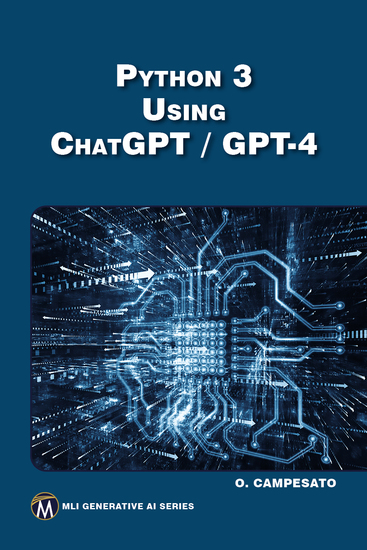
Python 3 Using ChatGPT GPT-4 - Harnessing AI for Efficient Python Programming - cover

Python 3 Using ChatGPT GPT-4 - Harnessing AI for Efficient Python Programming

Mercury Learning and Information, Oswald Campesato

Publisher: Packt Publishing

  • 0
  • 0
  • 0

Summary

This book is for people who want to learn Python 3 and how to use ChatGPT with Python. It starts with an introduction to Python programming, covering data types, number formatting, Unicode handling, and text manipulation. The book then covers loops, conditional logic, reserved words, user input, exception management, and command-line arguments.The journey continues into Generative AI, discussing its distinction from Conversational AI. Popular platforms like ChatGPT and GPT-4 are explored, along with their strengths, weaknesses, and potential applications. The book shows how to generate Python 3 code samples via ChatGPT using the “Code Interpreter” plugin.Understanding these concepts is crucial for navigating Python and AI. This book transitions readers from basic Python programming to advanced AI applications, blending theory with practical skills. Companion files with code samples and figures enhance learning, making this an essential resource for mastering Python and ChatGPT.
Available since: 08/12/2024.
Print length: 202 pages.


Other books that might interest you

  • Mastering AI App Development with MERN Stack - Step into the Future of App Development by Building Intelligent AI-Powered Applications with MERN Stack and TensorFlowjs for Seamless User Experiences - cover

    Mastering AI App Development...

    Anik Acharjee

    • 0
    • 0
    • 0
    Transform Your Web App Development Journey with MERN and AI
    Book Description
    With AI applications driving a projected $15. 7 trillion boost to the global economy by 2030, combining AI with the popular MERN stack has become a game-changer for developers and businesses alike. Mastering AI App Development with MERN Stack is a hands-on guide designed for developers ready to bring AI capabilities to their MERN applications, covering everything from foundational machine learning to advanced, real-world solutions. 
    Starting with the essentials of setting up a MERN development environment, the book guides readers through machine learning basics in JavaScript, enabling AI integration with Node. js and TensorFlow. js. Each chapter provides practical insights into building intelligent interfaces with React, effective data handling with MongoDB, and AI middleware using Express. js. 
    Readers will learn to create features like AI-powered chatbots, image and voice recognition, and personalized recommendation systems. Real-world scenarios and case studies demonstrate how AI can elevate MERN applications. 
    Table of Contents
    
    1. Introduction to AI and the MERN Ecosystem
    2. Setting Up the MERN Development Environment
    3. Fundamentals of Machine Learning with JavaScript
    4. Implementing AI with Node. js and TensorFlow. js
    5. Creating Intelligent User Interfaces with React
    6. Data Management for AI with MongoDB
    7. Building AI Middleware with Express. js
    8. Crafting AI-Powered Chatbots
    9. Image and Voice Recognition Capabilities
    10. Personalization with Recommendation Systems
    11. Deploying MERN and AI Applications
    12. Security Practices for AI-Enabled MERN Applications
    13. Scaling AI Features in Production
    14. Emerging Trends in AI and MERN Development
    15. Case Studies and Real-World Success Stories   
    Index
    Show book
  • Silicon Sentience: The Looming Threat - Why AI Poses an Unprecedented Risk to Humanity - cover

    Silicon Sentience: The Looming...

    John Harpoon

    • 0
    • 0
    • 0
    The evolution of artificial intelligence (AI) marks one of the most groundbreaking and transformative developments in human history. From the early musings of philosophers to the creation of machines that can learn and adapt, AI has emerged as a force with the potential to reshape every aspect of society. The origins of AI can be traced back to the mid-20th century when scientists began to explore the idea of creating machines that could simulate human intelligence. However, it wasn’t until the invention of electronic computers in the 1940s that the possibility of artificial intelligence became a tangible pursuit. 
    The term "artificial intelligence" was coined in 1956 by John McCarthy, a computer scientist who is often regarded as one of the fathers of AI. This period marked the beginning of the AI revolution, fueled by a combination of new computing technology and an increasing interest in mimicking human cognitive functions. Early AI research focused on developing algorithms that could perform tasks like solving mathematical problems, playing chess, or even translating languages. These early experiments laid the groundwork for the sophisticated AI systems that followed. 
    In the 1960s and 1970s, AI research gained momentum as researchers developed expert systems that could make decisions in specialized fields like medicine and engineering. These systems relied on a set of rules and logical reasoning to emulate the decision-making abilities of human experts. However, progress was slow, and AI experienced what is often referred to as the "AI winter," a period of reduced funding and interest in the field, which occurred in the 1970s and 1980s.
    Show book
  • Data Lakes - A Comprehensive Guide to Design Implementation and Optimization - cover

    Data Lakes - A Comprehensive...

    Brian Paul

    • 0
    • 0
    • 0
    In the era of big data, organizations are turning to data lakes as a powerful solution to store, manage, and derive valuable insights from vast and diverse datasets. "Data Lakes" is your essential guide to understanding, implementing, and optimizing data lakes for success in the complex landscape of data architecture. 
    "Data Lakes" is your indispensable companion on the quest to harness the transformative power of data lakes, offering practical insights, expert guidance, and a roadmap to success in the dynamic world of data management and analytics. Whether you're a seasoned data professional or just starting your data journey, this book empowers you to navigate the depths of data lakes with confidence and proficiency. 
     
    Show book
  • Touchpad iPrime Ver 11 Class 6 - cover

    Touchpad iPrime Ver 11 Class 6

    Team Orange

    • 0
    • 0
    • 0
    Computer Science Textbook Designed for Joyful Learning 
    
    KEY FEATURES 
    - National Education Policy 2020 
    - Tech Funda: This section provides a practical information or tip to the students. 
    - Clickipedia: This section provides interesting computer facts. 
    - Hands-On: This section contains an activity for Home assignment. 
    - QR Code: Scan the QR Code given on the first page of each chapter to start chapter animation. 
    - Crack the Code: This section has puzzle or fun based activity to help understand the concepts better. 
    - Digital Resources 
    
    DESCRIPTION 
    Touchpad iPRIME (Ver 1.1) series based on Windows 7 & MS Office 2010 is comprehensively designed as per the new ICSE syllabus. Learning is done best when it’s fun-filled and activity based. To ensure that the content intrigues the students at all times and keeps them interested throughout the course of the book, we have included interesting key features like Student Corner, Tech Funda, Clickipedia, Comp Caution, Reboot, One Touch Learn, Let’s Do It, Crack The Code, Hands-On, Fun In Lab, Teacher’s Corner, Worksheet, Test Sheet, Project, Speech Drill, Supplement Pages and Glossary. 
    
    WHAT WILL YOU LEARN 
    You will learn about: 
    - Fundamentals of computers 
    - ICT Tools 
    - Computational Thinking 
    - Computer Languages 
    - File Management 
    - Mail Merge 
    - Visual Effects in Presentation 
    - Scratch Programming 
    - HTML 
    - Internet 
    - Cyber Security 
    
    WHO THIS BOOK IS FOR 
    Grade - 6 
    
    TABLE OF CONTENTS 
    1. Categories of Computers and Computer Languages 
    2. File Management—Organization of Data 
    3. Word Processor—Tabular Representation 
    4. Word Processor—Mail Merge 
    5. Presentation—Visual Effects 
    6. Scratch Programming- Game Creation 
    7. HTML—An Introduction 
    8. Internet Services and Cyber Security 
    9. E-mail—An Introduction 
    10. More on Internet 
    11. Project Work 
    12. Explore More (Tech Update) 
    13. OGO Cyber Sample Questions 
    14. Glossary
    Show book
  • Ex Machina - The God Experiment - cover

    Ex Machina - The God Experiment

    Anders Indset, Florian Neukart

    • 0
    • 0
    • 0
    The philosophical exploration of reality has fascinated humanity since Plato's Allegory of the Cave and has reached new dimensions through technological and intellectual breakthroughs. From Descartes' skepticism of sensory perceptions to Daniel Dennett's provocative "illusionism," the nature of our conscious experiences is continually called into question. Yet, while neuroscience defends consciousness as real, the debate remains alive, shaping scientific and societal discourses.
    With George Berkeley's subjective idealism, which defines reality as a product of perception, and the groundbreaking concepts of Mach and Einstein, our understanding of space, time, and existence has been radically transformed. These philosophical foundations pave the way for one of the most intriguing questions of our time: Are we living in a simulation? What was once the realm of science fiction now occupies the forefront of cutting-edge research inspired by quantum physics, and the theories of computation and information.In their Scientific-Philosophical work – SciPhi – Anders Indset and Florian Neukart explore the hypothesis that our universe might be part of a chain of simulations – a concept with the potential to revolutionize our understanding of existence, theology, and the laws governing the cosmos. Together they examine the roles of computability, entropy, and the boundaries of physical laws within this chain of simulations. Could a collapse occur if resources are exhausted? And what does this mean for the notion of an infinite, external entity?
    With a clear focus on experimental approaches, Indset and Neukart analyze how we might uncover evidence about the nature of our reality. Although computational boundaries are still to be overcome,the authors, through observations and analysis on the simulation theories, open new perspectives on the profound questions of existence – while acknowledging the limits of current scientific knowledge.
    A compelling and profound book that encourages readers to think beyond the nature of reality and redefine the mystery of our existence.
    Show book
  • The Politics of Urban Development - Power Policy and Planning - cover

    The Politics of Urban...

    Lyric Vale

    • 0
    • 0
    • 0
    Urban development has long been a critical component of economic and social growth worldwide. As populations continue to increase and cities expand, the planning, management, and policies surrounding urban spaces become ever more complex. Urban development encompasses the physical, economic, and social transformation of cities, focusing on housing, infrastructure, transportation, and public spaces, while also addressing broader issues such as economic disparity, environmental sustainability, and social justice. 
    Historically, urbanization has been driven by industrialization, technological advancements, and shifts in global economic patterns. The migration of people from rural to urban areas in search of better job opportunities and living conditions has accelerated this process. As a result, cities have grown in both size and importance, becoming hubs for innovation, culture, and commerce. However, this growth has not come without challenges. Rapid urbanization often leads to overcrowded living conditions, increased pollution, traffic congestion, and the strain of public services. 
    At the heart of urban development is the relationship between power, policy, and planning. Political decisions and governmental priorities often shape the trajectory of cities, influencing everything from zoning laws and land use to infrastructure development and housing affordability. In this context, urban planning becomes not just a technical exercise, but a deeply political one, with differing interests—ranging from developers and business leaders to community groups and activists—competing for influence. The way these decisions are made can either foster inclusivity and equity or exacerbate social inequalities.
    Show book