Unisciti a noi in un viaggio nel mondo dei libri!
Aggiungi questo libro allo scaffale
Grey
Scrivi un nuovo commento Default profile 50px
Grey
Iscriviti per leggere l'intero libro o leggi le prime pagine gratuitamente!
All characters reduced
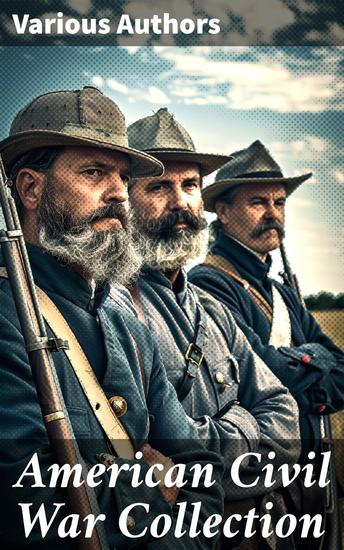
American Civil War Collection - 40+ Novels & Tales of Civil War Including the Rhodes History of the War 1861-1865 - cover

American Civil War Collection - 40+ Novels & Tales of Civil War Including the Rhodes History of the War 1861-1865

Mark Twain, Stephen Crane, Edward Everett Hale, Ambrose Bierce, Joseph A. Altsheler, John Esten Cooke, John William De Forest, Randall Parrish, Mary Johnston, Charles King, G. A. Henty, Robert W. Chambers, Winston Churchill, George Washington Cable, George W. Peck, Ellen Glasgow, Natalie Sumner Lincoln, John McElroy, Byron A. Dunn, John R. Musick, James Ford Rhodes, Jules Verne, Thomas Dixon Jr., B.K. Benson, Charles Carleton Coffin, Lucy Foster Madison, W. H. Shelton, Harry Hazelton, Edward Robins, Henry F. Keenan, María Ruiz de Burton

Casa editrice: Good Press

  • 0
  • 0
  • 0

Sinossi

The 'American Civil War Collection' is a compelling anthology that explores the complexities, struggles, and ideologies of a nation divided. This collection weaves together an array of narratives, ranging from suspenseful tales of battlefield valor to poignant reflections on the human condition during one of America'Äôs most turbulent eras. Each piece within this anthology contributes to a mosaic that reveals the multifaceted experiences of the Civil War, showcasing a diversity of literary styles from realism to romance, historical fiction to speculative glimpses, thereby offering a nuanced perspective on a period that continues to resonate within American cultural memory. Contributing authors such as Jules Verne, Mark Twain, and Ambrose Bierce, among others, bring their unique voice and perspective to the anthology. Their collective works echo the historical, cultural, and social movements of their time, depicting both fictional and realistic interpretations of the war. This convergence of esteemed authors represents a blend of Southern and Northern voices, immigrant and native stories, enriching the tapestry of this turbulent historical period. Together, these writers deepen the reader'Äôs engagement with themes of conflict, survival, and redemption, while also reflecting the broader literary movements of the 19th and early 20th centuries. For readers, the 'American Civil War Collection' offers an unparalleled opportunity to engage with a wide spectrum of literary insights and historical interpretations within a single volume. Its rich compilation of voices serves not only as educational material but also as a catalyst for dialogue and reflection. Whether you're a history buff, a literary enthusiast, or a student of American culture, this anthology provides a profound exploration of the varied American experiences of war, allowing readers to appreciate the depth and diversity of perspectives it holds. It serves as a testament to the enduring power of storytelling in capturing the human experience across divides.
Disponibile da: 28/12/2023.
Lunghezza di stampa: 9581 pagine.

Altri libri che potrebbero interessarti

  • Brightness Falls - From their pens to your ears genius in every story - cover

    Brightness Falls - From their...

    Mary Butts

    • 0
    • 0
    • 0
    Mary Frances Butts was born on 13th December 1890 in Poole, Dorset. 
    Her early years were spent at Salterns, an 18th-century house overlooking Poole Harbour.  Sadly in 1905 her father died, and she was sent for boarding at St Leonard's school for girls in St Andrews. 
    Her mother remarried and, from 1909, Mary studied at Westfield College in London, and here, first became aware of her bisexual feelings.  She was sent down for organising a trip to Epsom races and only completed her degree in 1914 when she graduated from the London School of Economics.  By then Mary had become an admirer of the occultist Aleister Crowley and she was given a co-authorship credit on his ‘Magick (Book 4)’. 
    In 1916, she began the diary which would now detail her future life and be a constant reference point for her observations and her absorbing experiences. 
    During World War I, she was doing social work for the London County Council in Hackney Wick, and involved in a lesbian relationship.  Life changed after meeting the modernist poet, John Rodker and they married in 1918. 
    In 1921 she spent 3 months at Aleister Crowley's Abbey of Thelema in Sicily; she found the practices dreadful and also acquired a drug habit.  Mary now spent time writing in Dorset, including her celebrated book of short stories ‘Speed the Plough’ which saw fully develop her unique Modernist prose style. 
    Europe now beckoned and several years were spent in Paris befriending many artists and writing further extraordinary stories.   
    She was continually sought after by literary magazines and also published several short story collections as books. Although a Modernist writer she worked in other genres but is essentially only known for her short stories.  Mary was deeply committed to nature conservation and wrote several pamphlets attacking the growing pollution of the countryside. 
    In 1927, she divorced and the following year her novel ‘Armed with Madness’ was published.  A further marriage followed in 1930 and time was spent attempting to settle in London and Newcastle before setting up home on the western tip of Cornwall.  By 1934 the marriage had failed. 
    Mary Butts died on 5th March 1937, at the West Cornwall Hospital, Penzance, after an operation for a perforated gastric ulcer. She was 46.
    Mostra libro
  • The Daughter of Lilith - From their pens to your ears genius in every story - cover

    The Daughter of Lilith - From...

    Anatole France

    • 0
    • 0
    • 0
    François-Anatole Thibault was born on the 16th April 1844 in Paris, France, the son of a bookseller and bibliophile. 
    He studied at the Collège Stanislas, a private Catholic school, and after graduating joined his father in the bookstore, which specialised in works on the French Revolution.  Several years later he secured a position as cataloguer at Bacheline-Deflorenne and at Lemerre before being appointed librarian for the French Senate in 1876. 
    His literary career had begun as a journalist and as a poet before publishing his novel ‘Le Crime de Sylvestre Bonnard’ in 1881.  Praised for its elegant prose, it won him a prestigious prize from the Académie Française, which later elected him to its storied ranks. 
    His works were profound and thoughtful and often couched in surreal and outlandish expressions; whether penguins baptized by a near-blind Abbott transformed themselves into humans or of a guardian angel who becomes an atheist, his stories turned established thought into startling literature. 
    His short stories run in the same vein.  The premise may seem plausible but his distinctive style turns them into an individual viewpoint which invokes both discussion and admiration. 
    In his private life his relationships with women were often turbulent.  A Socialist, he was a fervent supporter of the Russian Revolution and the early years of the French Communist party. 
    He was awarded the Nobel Prize in 1921 but the following year his entire canon of works was placed on the prohibited list of the Catholic Church, which he thought of as a credit to his name. 
    Anatole France died on the 12th October 1924 in Tours.  He was 80.
    Mostra libro
  • Anatoliy Golitsyn: The Life and Legacy of the KGB Defector Who Became a CIA Asset - cover

    Anatoliy Golitsyn: The Life and...

    Editors Charles River

    • 0
    • 0
    • 0
    Many people remain fascinated by stories about the Cold War, particularly the espionage that was covertly conducted across the globe by both sides. Indeed, from the beginning of the Cold War, there were hundreds if not thousands of spies positioned in each side’s governments. Some worked as double agents, while others worked to plant pivotal pieces of information or disinformation to persuade government officials within these warring countries. 
    Inevitably, some of the Cold War’s most shadowy actions involved trying to turn Soviet assets, whether for propaganda or intelligence purposes, but the Soviet system constantly had to worry about defections, as evidenced by the construction of the Berlin Wall in the early 1960s. That said, while the whistleblowers may be celebrated if they damage the public relations of an adversary, they can be controversial if they damage one’s own country, as evidenced by the polarizing reputations of individuals like Edward Snowden and Julian Assange. 
    During Congressional testimony concerning President Kennedy’s assassination many years after Anatoliy Golitsyn’s defection, James Jesus Angleton claimed he was “probably without any question the most major defection since World War II as far as Soviet intentions, Soviet organization, and Soviet operations are concerned.” He would later become a voice for the Soviets’ disinformation strategy through his studies and his work as a KGB agent and with the CIA’s Counterintelligence Unit. Golitsyn became disenchanted with Moscow and the Soviet way of life after having spent his life protecting it. 
    Thanks to his schooling and training, Golitsyn had deep inside knowledge of the USSR’s (communist) strategy to rule the world. Angleton, the chief of the CIA’s Counterintelligence Unit, was a huge supporter and believer of Golitsyn’s ideas and theories.
    Mostra libro
  • Life After the White House: Secrets and Reflections From a Political Insider - "Unlock the secrets of political insight! Dive into captivating audio reflections from a seasoned insider" - cover

    Life After the White House:...

    Marek Draven

    • 0
    • 0
    • 0
    'Life After the White House: Secrets and Reflections From a Political Insider' 
    ⭐⭐ Simplified Audio Guide with Explanations ⭐⭐ 
    Are you eager to advance in your career and enhance your expertise by uncovering the hidden truths from a unique insider perspective? 
    Searching for a comprehensive resource that reveals all the essential elements to understand life after the presidency? 
    Your quest ends here! 
    This audiobook serves as your ultimate guide for deepening your insights, applying your knowledge, and engaging with real-world experiences. With this, you're equipped for meaningful understanding. 
    Updated for the latest insights from a political insider. 
    Key features of this enhanced guide: 
    - Invaluable insights about life after serving in the White House 
    - In-depth reflections on political experiences 
    - Effective strategies for navigating the political landscape 
    Our audiobook sets itself apart with thorough coverage, which is vital for your understanding. Concepts aren't simply glossed over; they are explored with care. 
    Please note that this audiobook is an independent resource and not affiliated with any official political entity. 
    With a structured approach and straightforward language, 'Life After the White House' ensures smooth transitions between topics. Bid farewell to convoluted jargon and embrace clear, precise, and insightful content. 
    So, why delay? Click the BUY NOW button, secure your audiobook, and embark on a journey to uncover the secrets of life after the White House!
    Mostra libro
  • Fanny Crosby's Life-Story - cover

    Fanny Crosby's Life-Story

    Fanny Crosby

    • 0
    • 0
    • 0
    Read Her exists to promote books written by Christian women. Women throughout history have written inspiring and insightful books that glorify Christ, and it's time they are read! One way Read Her seeks to make these books more accessible is by producing audiobooks available on all major audiobook distributors. Fanny Crosby’s Life-Story written by herself, are one of those works we want to bring back to the listening ear of the Christian community. 
    Fanny Crosby's hymns have resonated across the world, leaving an enduring impact in the hearts and souls of people for many years. But who is Fanny Crosby as a person? Did her life and character align with the inspiration found in her poetry? Those who knew her well often spoke of her patience, kindness, winsome personality, and unwavering goodness. While most haven't had the privilege of knowing her personally, the desire to learn more about the woman behind the hymns is only natural.
    Mostra libro
  • Nerva-Antonine Dynasty The: The History and Legacy of the Emperors Who Ruled the Roman Empire at Its Peak - cover

    Nerva-Antonine Dynasty The: The...

    Editors Charles River

    • 0
    • 0
    • 0
    “The Five Good Emperors,” a reference to the five emperors who ruled the Roman Empire between 96 and 180 CE (Nerva, Trajan, Hadrian, Antoninus Pius, and Marcus Aurelius), was a term first coined by Machiavelli and later adopted and popularized by historian Edward Gibbon, who said that under these men, the Roman Empire “was governed by absolute power under the guidance of wisdom and virtue.”  
    	This period of 84 years is generally regarded as the high point of the Roman Empire, at least after Augustus, but what is uncertain and a matter of ongoing debate is whether the five emperors were personally responsible for the situation and the accompanying prosperity enjoyed throughout the empire at the time or if they were simply the beneficiaries of the Pax Romana, inaugurated by Augustus in the early part of the 1st century CE. In other words, historians have wondered whether anyone in power during those years would have enjoyed the same rewards.  
    	The description of these rulers as “good” is also a matter of interpretation, with some scholars suggesting they were only “good” in comparison to the preceding emperor (Domitian) and the emperor who followed Marcus Aurelius (Commodus). Both of them were horrible rulers in every aspect, making their near contemporaries look all the better.  
    	Regardless, it is clear that the era of the Five Good Emperors was one of unparalleled success and wealth, and the reasons Rome reached its zenith at this time are worthy of scrutiny. Perhaps most noteworthy is that none of these five emperors were blood relatives - while the final two are often referred to as the Antonines, they were not, in fact, related except by adoption, a practice that may in itself provide at least part of the answer to the question as to why this particular period was so magnificent.
    Mostra libro