Begleiten Sie uns auf eine literarische Weltreise!
Buch zum Bücherregal hinzufügen
Grey
Einen neuen Kommentar schreiben Default profile 50px
Grey
Jetzt das ganze Buch im Abo oder die ersten Seiten gratis lesen!
All characters reduced
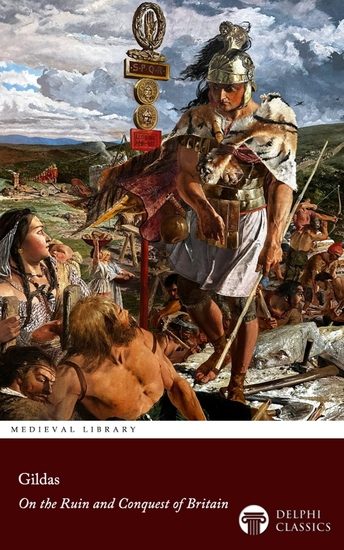
On the Ruin and Conquest of Britain by Gildas Illustrated - cover

On the Ruin and Conquest of Britain by Gildas Illustrated

Gildas Sapiens

Verlag: Delphi Publishing Ltd

  • 0
  • 0
  • 0

Beschreibung

Gildas the Wise was a sixth century British monk best known for his religious polemic ‘De Excidio et Conquestu Britanniae’, recounting the history of the Britons before and during the arrival of the Anglo-Saxons. It is an important work not only for its early medieval information, but also for British history in general, as it is one of the few works written in Britain to survive from this time. Gildas’ text went on to influence the Venerable Bede and other important Saxon historians. Delphi’s Medieval Library provides eReaders with rare and precious works of the Middle Ages, with noted English translations and the original texts.  This eBook presents Gildas’ complete works, with illustrations, an informative introduction and the usual Delphi bonus material. (Version 1)

 
* Beautifully illustrated with images relating to Gildas’ life and works* Features the complete extant works of Gildas, in both English translation and the original Latin* Concise introduction to the text* J. A. Giles’ 1848 translation, with the original hyperlinked footnotes* Excellent formatting * Easily locate the sections you want to read with individual contents tables* Features two biographies of Gildas — including the seminal ninth century account by the Monk of Ruys

 
CONTENTS:

 
The TranslationOn the Ruin and Conquest of Britain (c. 530)

 
The Original TextContents of the Latin Text

 
The BiographiesThe Life of Gildas (c. 800) by the Monk of RuysThe Life of Gildas (c. 1150) by Caradoc of Llancarfan
Verfügbar seit: 13.05.2025.
Drucklänge: 1290 Seiten.

Weitere Bücher, die Sie mögen werden

  • The Fall of Communism - Understanding the Collapse of the Soviet Union and Its Impact - cover

    The Fall of Communism -...

    Arlo Holders

    • 0
    • 0
    • 0
    The origins of communism can be traced back to the mid-19th century, largely shaped by the theories of Karl Marx and Friedrich Engels. Marx's writings, particularly The Communist Manifesto (1848), presented a vision for a classless society where the working class, or proletariat, would overthrow the capitalist bourgeoisie and establish a dictatorship of the proletariat. Marx believed this revolution would lead to the eventual abolition of private property, creating a system where resources and wealth were shared equally among all people. Engels, Marx’s collaborator, helped to spread these ideas, laying the theoretical foundation for communism as a political ideology. 
    In the early 20th century, the ideas of Marxism found fertile ground in Russia, where economic disparity and social unrest were widespread. The Russian Empire, under Tsar Nicholas II, faced increasing pressure from industrialization, a growing working class, and a largely disenfranchised peasantry. The Russian Revolution of 1917, led by the Bolshevik Party under Vladimir Lenin, marked the beginning of communism’s practical implementation. The Bolsheviks sought to establish a socialist state where the working class would control the means of production and dismantle the old Tsarist monarchy. 
    Following the revolution, the Soviet Union was formed in 1922, uniting the Russian Federation and several other Soviet republics under a single communist government. The new government, however, faced significant challenges, including civil war, foreign intervention, and the task of restructuring a country that had been predominantly agrarian into a socialist industrialized state. Lenin’s death in 1924 led to the rise of Joseph Stalin, who consolidated power through brutal purges and policies such as forced collectivization and rapid industrialization.
    Zum Buch
  • Dark Psychology and Manipulation (2 Books in 1) - Learn Dark Psychology Secrets Persuasion Techniques NLP Body Language and Outsmart Everybody Else - cover

    Dark Psychology and Manipulation...

    Leo Sanders

    • 0
    • 0
    • 0
    2 Books Box SetThis book includes: 
    - How to Analyze People with Dark Psychology 
    - Secret Manipulation TechniquesDo you want to learn to defend yourself against Mental Manipulation? 
    Do you want to learn body language basics, detect manipulative and toxic people? 
    Do you often feel people take advantage of you or control you in order to "help you"? 
    What do they think? How do they feel? Are they lying? 
    Have you always wanted to learn about dark psychology, but you never knew where to begin? 
    Dark psychology is the art and science of manipulation and mind control, and through its studies, you will learn to control how other people think as well as how to control their actions and interactions. It may seem like a difficult feat at first, but you will achieve all of that, and much more! 
    Reading this book you’ll learn the most powerful principles in the world of Dark Psychology. Not sure if you'll be able to use them in practice? Don’t worry! Each chapter explains an aspect of Dark Psychology in a way that is easily accessible and readily understandable for all. 
    Here’s just a little of what you’ll discover inside: 
    - Dark Side of the Idea of Human Consciousness 
    - Techniques to Read People 
    - The Psychology of Dreams 
    - Psychology of the Insane 
    - The Benefits of Meeting Our Dark Side 
    - Secret Manipulation Techniques 
    - Neuro-Linguistic Programming 
    - Reverse Psychology 
    - Emotional Intelligence 
    - Body Language 
    - The Psychology of Death 
    - Exploring Yourself with Psychology 
    - Techniques to Control and Influence Minds 
    - Control Your Mind Thoughts 
    - Master Your Emotions 
    - Simple Methods to Avoid Brainwashing 
    - How to Become an Effective Communicator 
    - Dark Psychological Tricks 
    - Gain Control of Your MindAre you ready to delve into the secrets of our minds?
    Zum Buch
  • Roman Society and Culture - A Comprehensive Guide - cover

    Roman Society and Culture - A...

    Rogan Fish

    • 0
    • 0
    • 0
    Roman society, one of the most influential civilizations in human history, was built upon a complex and well-structured foundation that evolved over centuries. The origins of Roman civilization can be traced back to the early settlements along the Tiber River, where communities of farmers and shepherds gradually coalesced into the city-state of Rome. As Rome expanded, both geographically and politically, its social structure grew more intricate, reflecting a blend of indigenous customs and influences from conquered territories. 
    At the heart of Roman society was a rigid social hierarchy, essential to maintaining order and stability. This structure was divided primarily into two main classes: the patricians and the plebeians. The patricians were the elite, consisting of noble families who claimed descent from Rome's founding fathers. They held significant political power and owned vast lands. In contrast, the plebeians represented the common people, including farmers, craftsmen, and laborers. Though initially excluded from many aspects of governance, the plebeians gradually secured political rights through persistent social struggles, leading to the establishment of the office of the Tribune, which protected their interests. 
    Apart from these major classes, Roman society also included a growing number of slaves, who were often prisoners of war or born into servitude. Slavery was integral to the Roman economy, with slaves performing various tasks, from domestic duties to skilled labor in workshops. Despite their lack of freedom, some slaves, particularly those with specialized skills, could earn their emancipation, gaining the status of freedmen and integrating into the lower echelons of society.
    Zum Buch
  • A Year of Mr Lucky - A memoir of submission loss and longing - cover

    A Year of Mr Lucky - A memoir of...

    Meg Weber

    • 0
    • 0
    • 0
    When Meg Weber - a recently divorced, queer, single parent - realizes she's ready to date again, she comes across the profile of Mr. Lucky; a smart dominant with similar interests. But not all goes as planned. In her memoir, A Year Of Mr. Lucky, Meg takes us through her journey of erotic encounters, pain and pleasure, explorations of self-worth, submission, yearning, and healing.
    Zum Buch
  • WHITE TURK vs BLACK TURK - Roots of Political Schism in Turkey - cover

    WHITE TURK vs BLACK TURK - Roots...

    Aydin Nurhan

    • 0
    • 0
    • 0
    White Turk vs Black Turk is a thought-provoking exploration of the complex interplay between clashing lifestyles in Turkey and their impact on the country's political arena. Former Ambassador Nurhan provides a comprehensive understanding of the intricate tapestry that is Turkey's political landscape by skill- fully incorporating human aspirations, and inferiority complexes while navigating through history, religion, cultural shifts, and economic disparities to paint a holistic picture of the dynamics at play.
    Zum Buch
  • Bought & Sold - Scotland Jamaica and Slavery - cover

    Bought & Sold - Scotland Jamaica...

    Kate Phillips

    • 0
    • 0
    • 0
    This book traces the story of how and why thousands of Scots made money from buying and selling humans… a story we need to own. We need to admit that many Scots were enthusiastic participants in slavery.
    Union with England gave Scotland access to both trade and settlement in Jamaica, Britain's richest colony and its major slave trading hub. Tens of thousands from Scotland lived and worked there. The abolition campaign and slave revolts threatened Scottish plantation owners, merchants, traders, bankers and insurance brokers who made their fortunes from slave-farmed sugar in Jamaica and fought hard to preserve the system of slavery. Archives and parliamentary papers in both countries reveal these transatlantic Scots in their own words and allow us to access the lives of their captives. 
    Scotland and Jamaica were closely entwined for over one hundred years. Bought & Sold traces this shared story from its early beginnings in the 1700s to the abolition of slavery in the British Empire and reflects on the meaning of those years for both nations today.
    Zum Buch