Join us on a literary world trip!
Add this book to bookshelf
Grey
Write a new comment Default profile 50px
Grey
Subscribe to read the full book or read the first pages for free!
All characters reduced
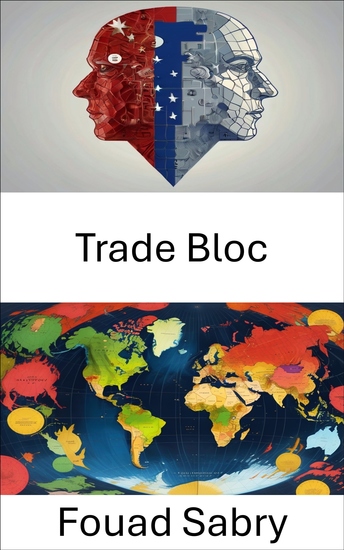
Trade Bloc - Navigating Economic Alliances and Regional Integration - cover

Trade Bloc - Navigating Economic Alliances and Regional Integration

Fouad Sabry

Publisher: One Billion Knowledgeable

  • 0
  • 0
  • 0

Summary

In an era of interconnected global economies, understanding regional trade blocs is crucial. "Trade Bloc," a significant addition to the "Political Science" series, examines the formation, functioning, and impact of these economic entities. This book provides a thorough analysis of trade blocs and their influence on international trade and policy, making it essential for those interested in modern economic integration.
 
1: Trade Bloc: This defines trade blocs and explores their significance in global trade.
 
2: Customs Union: Examine customs unions, focusing on how they harmonize trade policies and streamline trade.
 
3: Free Trade Area: This highlights free trade areas and their role in reducing barriers and fostering growth.
 
4: Single Market: Explore how a single market integrates economies by eliminating barriers to movement.
 
5: World Trade Organization: Gain insights into the WTO's role in international trade agreements and regional blocs.
 
6: ASEAN: Delve into ASEAN's trade policies and its contributions to regional integration.
 
7: Trade Agreement: Cover various trade agreements, their structure, negotiation, and impact on relations.
 
8: ASEAN Free Trade Area: Examine efforts to enhance intra-regional trade and cooperation among ASEAN nations.
 
9: Central European Free Trade Agreement: Understand the CEFTA's role in facilitating trade and regional economic development.
 
10: Eurasian Economic Community: Explore the Community's objectives and its role in economic integration across Eurasia.
 
11: Preferential Trading Area: Analyze preferential trading areas and their economic advantages for members.
 
12: Economic Integration: A look at various forms of economic integration and their trade implications.
 
13: Free Trade Agreement: Explore free trade agreements, focusing on their negotiation and implementation.
 
14: Regional Integration: Understand regional integration's broader impact on neighboring economic and political relations.
 
15: List of Multilateral Free Trade Agreements: A detailed list of significant multilateral agreements and their global trade dynamics.
 
16: African Economic Community: Explore efforts to promote economic integration across the African continent.
 
17: Economic Union: Examine economic unions and their role in creating unified environments.
 
18: List of Bilateral Free Trade Agreements: List and analyze key bilateral agreements and their trade impact.
 
19: Cross-National Cooperation and Agreements: Investigate cooperation forms and their role in enhancing global trade collaboration.
 
20: Commercial Policy: Understand commercial policy's significance in shaping trade practices and blocs.
 
21: Eurasian Economic Union: Conclude with an analysis of the EEU's structure and its regional trade effects.
 
"Trade Bloc" offers profound insights into regional trade agreements and their global economic implications.
Available since: 10/16/2024.
Print length: 222 pages.

Other books that might interest you

  • The Postmodern Predicament - Existential Challenges of the Twenty-First Century - cover

    The Postmodern Predicament -...

    Bruce Ackerman

    • 0
    • 0
    • 0
    Human beings have taken one thing for granted since our earliest days: we are bodily creatures dealing with one another on a face-to-face basis. The internet has shattered this fundamental feature of human existence. We are suddenly living our lives in two worlds at once—shifting endlessly from virtual to physical reality as we reach out to others. 


    Worse yet, we are developing different personal identities in our two worlds. We say and do things in virtual reality that flatly contradict our face-to-face commitments to family, friends, and fellow-workers—and vice versa. The Postmodern Predicament explores these dilemmas at each phase of the life cycle, beginning at the moment a young child picks up a cell phone. 


    The existentialist tradition of the twentieth century provides a precious perspective on our postmodern dilemmas. Thinkers and doers like Simone de Beauvoir and Jean-Paul Sartre considered the fragmentation of modern life as a central source of contemporary anxieties. Like them, Ackerman views the challenges of the internet age as a political, no less than personal, problem—and proposes concrete reforms that that could mobilize broad-based support for democracy against demagogic assaults on its very foundations.
    Show book
  • The Hollow Crown - Shakespeare on How Leaders Rise Rule and Fall - cover

    The Hollow Crown - Shakespeare...

    Eliot A. Cohen

    • 0
    • 0
    • 0
    What Shakespeare's plays can teach us about modern-day politics 


    William Shakespeare understood power: what it is, how it works, how it is gained, and how it is lost. 


    In The Hollow Crown, Eliot A. Cohen reveals how the battling princes of Henry IV and scheming senators of Julius Caesar can teach us to better understand power and politics today. The White House, after all, is a court—with intrigue and conflict rivaling those on the Globe's stage—as is an army, a business, or a university. And each court is full of driven characters, in all their ambition, cruelty, and humanity. Henry V's inspiring speeches reframe John F. Kennedy's appeal, Richard III's wantonness illuminates Vladimir Putin's brutality, and The Tempest's grace offers a window into the presidency of George Washington. 


    An original and incisive perspective, The Hollow Crown shows how Shakespeare's works transform our understanding of the leaders who, for good or ill, make and rule our world.
    Show book
  • The ANC Billionaires - Big Capital's Gambit and the Rise of the Few - cover

    The ANC Billionaires - Big...

    Pieter Du Toit

    • 0
    • 0
    • 0
    'We were talking about the rise of Japan, about Ronald Reagan's Star Wars … globalisation, technology. And they were still banging on about the Freedom Charter.' – Anglo American's Michael Spicer on the ANC in the mid-1980s.
    In 1985, a group of white South African business leaders, led by Gavin Relly, the executive chairperson of Anglo American, travelled to a game lodge in Zambia to meet with the exiled ANC leadership under Oliver Tambo and Thabo Mbeki. This visit set in motion a coordinated and well-resourced plan by big business to influence and direct political change in South Africa.
    In The ANC Billionaires, top-selling author Pieter du Toit draws on first-hand accounts by major roleplayers about the contentious relationship between capital and the ANC before, during and after the country's transition to democracy, and shows how the liberation organisation was completely unprepared to navigate the intersection between business and politics.
    He also ties the rise of the new elite – including Cyril Ramaphosa, Patrice Motsepe and Saki Macozoma – to the ANC, a party of government and patronage.
    Show book
  • Strangers No More - Immigration and the Challenges of Integration in North America and Western Europe - cover

    Strangers No More - Immigration...

    Richard Alba, Nancy Foner

    • 0
    • 0
    • 0
    An up-to-date and comparative look at immigration in Europe, the United States, and CanadaStrangers No More is the first book to compare immigrant integration across key Western countries. Focusing on low-status newcomers and their children, it examines how they are making their way in four critical European countries—France, Germany, Great Britain, and the Netherlands—and, across the Atlantic, in the United States and Canada. This systematic, data-rich comparison reveals their progress and the barriers they face in an array of institutions—from labor markets and neighborhoods to educational and political systems—and considers the controversial questions of religion, race, identity, and intermarriage.Richard Alba and Nancy Foner shed new light on questions at the heart of concerns about immigration. They analyze why immigrant religion is a more significant divide in Western Europe than in the United States, where race is a more severe obstacle. They look at why, despite fears in Europe about the rise of immigrant ghettoes, residential segregation is much less of a problem for immigrant minorities there than in the United States. They explore why everywhere, growing economic inequality and the proliferation of precarious, low-wage jobs pose dilemmas for the second generation. They also evaluate perspectives often proposed to explain the success of immigrant integration in certain countries, including nationally specific models, the political economy, and the histories of Canada and the United States as settler societies.Strangers No More delves into issues of pivotal importance for the present and future of Western societies, where immigrants and their children form ever-larger shares of the population.
    Show book
  • The Secret Listener - An Ingenue in Mao's Court - cover

    The Secret Listener - An Ingenue...

    Yuan-Tsung Chen

    • 0
    • 0
    • 0
    The history of China in the twentieth century is comprised of a long series of shocks: the 1911 revolution, the civil war between the communists and the nationalists, the Japanese invasion, the revolution, the various catastrophic campaigns initiated by Chairman Mao between 1949 and 1976, its great opening to the world under Deng, and the Tiananmen Square Massacre. 


    Yuan-tsung Chen lived through most of it, and at certain points in close proximity to the seat of communist power. Born in Shanghai in 1929, she came to know Zhou En-Lai as a young girl while living in Chongqing, where Chiang Kai-Shek's government had relocated to, during the war against Japan. That connection to Zhou helped her save her husband's life in Cultural Revolution. After the communists took power, she obtained a job in one of the culture ministries. She frequently engaged with the upper echelon of the party and was a first-hand witness to some of the purges that the regime regularly initiated. Eventually, the commissar she worked under was denounced in 1957, and she barely escaped being purged herself. Later, during Cultural Revolution, she and her husband were purged and sent to live in a rough, poor area. They finally moved to Hong Kong, with Zhou's permission, in 1971. Chen gives a first-hand account of what life was like in the period before the revolution and in Mao's China.
    Show book
  • Farewell Address Oval Office - cover

    Farewell Address Oval Office

    Ronald Reagan

    • 0
    • 0
    • 0
    On January 11, 1989, Reagan gave the following farewell address to the nation from the Oval Office. The two things I’m proudest of are the economic recovery which created 19 million new jobs and that America is respected again in the world.  
    In 1980 pundits said our economic policies would cause inflation and collapse while our foreign policies would lead to war. Instead, tax cuts created “the longest peacetime expansion in our history” and “an explosion in research and new technology.” We knocked “down protectionist walls abroad instead of erecting them at home.” 
    We rebuilt our defenses and saw a new peacefulness around the globe. “Countries across the globe are turning to free markets and free speech and turning away from the ideologies of the past.” 
    I went into politics to protect something precious. “Our Constitution is a document in which ‘We the People’ tell the government what it is allowed to do. In the 1960s the government was taking our freedom with rules and regulations and confiscatory taxes.  
    People are “not free unless government is limited. There's a clear cause and effect here that is as neat and predictable as a law of physics: As government expands, liberty contracts.” 
    Are “we doing a good enough job teaching our children what America is and what she represents in the long history of the world?” “America is freedom -- freedom of speech, freedom of religion, freedom of enterprise. And freedom is special and rare.” Let’s start with more attention to American history. 
    I see America as a “shining city upon a hill” teeming with all kinds of people living in harmony, with ports humming with commerce, with doors open to anyone with the will to get here, a beacon and magnet for all who must have freedom. 
    Audio recording courtesy of the Ronald Reagan Presidential Library. 
    AspenLeafMedia.com
    Show book