Unisciti a noi in un viaggio nel mondo dei libri!
Aggiungi questo libro allo scaffale
Grey
Scrivi un nuovo commento Default profile 50px
Grey
Iscriviti per leggere l'intero libro o leggi le prime pagine gratuitamente!
All characters reduced
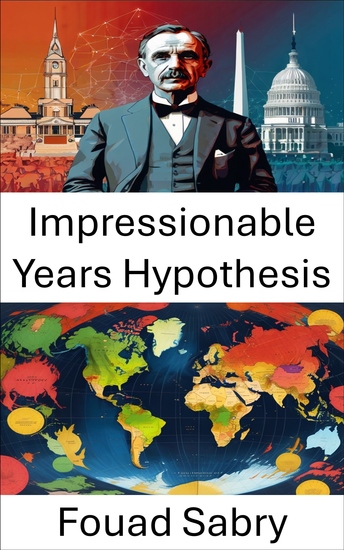
Impressionable Years Hypothesis - How Early Life Shapes Political Beliefs and Behaviors - cover

Impressionable Years Hypothesis - How Early Life Shapes Political Beliefs and Behaviors

Fouad Sabry

Casa editrice: One Billion Knowledgeable

  • 0
  • 0
  • 0

Sinossi

This theory explores the critical role formative years play in shaping lifelong political attitudes and behaviors. "Impressionable Years Hypothesis" explains how early life experiences influence political ideologies, making it essential for understanding political identity development.
 
Gain a deeper understanding of how political beliefs are formed, solidified, and influenced through life stages. Whether you're a student, professional, or enthusiast, this book provides insights into the psychological and social foundations of political behavior.
 
1: Impressionable Years Hypothesis: Learn the core theory of how early experiences shape political attitudes.
 
2: Political Socialization: Explore how family, education, and society influence political values.
 
3: Group Polarization: Understand how group discussions intensify political opinions.
 
4: Selective Exposure Theory: Discover how people favor information that aligns with their beliefs.
 
5: Theories of Political Behavior: Study theories behind political participation and psychological influences.
 
6: Political Psychology: Examine the role of personality and cognition in political behavior.
 
7: Party Identification: Analyze how political loyalty forms in the impressionable years.
 
8: Youth Culture: Investigate how youth culture shapes political identity.
 
9: Baby Boomers: Explore the political behaviors of the Baby Boomer generation.
 
10: Millennials: Discover how Millennials’ experiences shape their political attitudes.
 
11: Political Spectrum: Understand where political ideologies fall on the spectrum.
 
12: Generation: Study how formative experiences create generational political identities.
 
13: Young Adult: Learn how early adulthood solidifies political beliefs.
 
14: Political Party Strength in U.S. States: Assess how early experiences influence state-level party strength.
 
15: Independent Voter: Explore how independent voters differ from party-affiliated individuals.
 
16: Religious Identity: Study the intersection of religion and political identity.
 
17: Theodore Newcomb: Learn about Newcomb’s contributions to political psychology.
 
18: Political Identity: Delve into the lifelong impact of political identity formation.
 
19: Voter Segments in Political Polling: Understand how early socialization affects voter segmentation.
 
20: Political Cognition: Study how cognition in formative years shapes political thought.
 
21: Political Views of Generation Z: Explore the emerging political beliefs of Generation Z.
 
Designed for professionals, students, and anyone curious about the Impressionable Years Hypothesis, this book provides a comprehensive look into how early experiences shape lifelong political identities. Ideal for those looking to go beyond the basics of political behavior and identity formation.
Disponibile da: 01/10/2024.
Lunghezza di stampa: 271 pagine.

Altri libri che potrebbero interessarti

  • The US Supreme Court - A Very Short Introduction - cover

    The US Supreme Court - A Very...

    Linda Greenhouse

    • 0
    • 0
    • 0
    For thirty years, Pulitzer Prize-winning journalist Linda Greenhouse chronicled the activities of the U.S. Supreme Court and its justices as a correspondent for the New York Times. In this Very Short Introduction, she draws on her deep knowledge of the court's history and of its written and unwritten rules to show listeners how the Supreme Court really works. 


    Greenhouse offers a fascinating institutional biography of a place and its people—men and women who exercise great power but whose names and faces are unrecognized by many Americans and whose work often appears cloaked in mystery. How do cases get to the Supreme Court? How do the justices go about deciding them? What special role does the chief justice play? What do the law clerks do? How does the court relate to the other branches of government? Greenhouse answers these questions by depicting the justices as they confront deep constitutional issues or wrestle with the meaning of confusing federal statutes. Throughout, the author examines many individual Supreme Court cases to illustrate points under discussion. 


    The third edition of Greenhouse's Very Short Introduction tracks the changes in the Court's makeup over the past decade, including the landmark decisions of the Obama and Trump eras and the emergence of a conservative supermajority.
    Mostra libro
  • Between the Market and the Nation - Neoliberal Policies Nationalism and Globalization - cover

    Between the Market and the...

    Alexander Nicolaus

    • 0
    • 0
    • 0
    This work provides an in-depth and critical analysis of the interrelationships between neoliberalism, globalization, and the resurgence of nationalism in the 21st century. It explores the origins and theoretical foundations of neoliberalism, highlighting the contributions of influential theorists such as Friedrich Hayek and Milton Friedman, and examines its political rise through the administrations of Margaret Thatcher and Ronald Reagan. The book investigates how economic globalization has expanded neoliberal policies, affecting both developed and developing economies, and analyzes the social and cultural consequences, including the exacerbation of inequality and the crisis of the welfare state. As neoliberal policies advanced, rising inequality and social dissatisfaction fueled the resurgence of nationalist and populist movements in various regions of the world. The book offers a detailed study of these movements, analyzing their causes and implications in the global context. Additionally, it discusses the tensions between globalist and nationalist ideologies, addressing issues such as protectionism, economic nationalism, and the challenges to neoliberal free trade. In the final chapter, the work proposes new global governance models aimed at reconciling national demands with global needs in a context of increasing ideological polarization. With a comprehensive and critical approach, this book is essential reading for academics, researchers, and anyone interested in understanding the contemporary challenges shaping global politics and economics.
    Mostra libro
  • A Relational Agenda - How putting relationships first can reform European society - cover

    A Relational Agenda - How...

    Guy Brandon, Michel Schlüter,...

    • 0
    • 0
    • 0
    What framework can guide Christian engagement with major economic, social and political issues in public life in 21st century Europe?
    What other schools of thought exist apart from Catholic Social Teaching and Christian Democracy?
    
    Sallux has collaborated with the Jubilee Centre in Cambridge over several years to apply a new framework, agenda and strategy for Christian social reform, called Relational Thinking. It starts with the Christian belief that human beings are created by a relational God to form relational societies – the contemporary application of the ancient adage to 'love our neighbour as ourselves'.
    
    This book is a compilation of fi ve reports, two of which discuss the overall concept of Relational Thinking, while the others demonstrate how it can be applied to three contemporary issues: the need for monetary reform, the challenges of artifi cial intelligence and the ethics of remuneration. You can fi nd other examples of issues being analysed from a relational perspective, from business to city transformation.
    
    Deeply biblical, Relational Thinking builds bridges through the language of relationships to connect Christians with people of other faiths or none, and o er a fresh approach to Europe's greatest public policy challenges today.
    Mostra libro
  • Make Enterprise Great Again: The Gods Must Be Crazy! - Cradle of Communism to Catacomb of Capitalism: A Proposal to bring back the House of Roosevelt's - cover

    Make Enterprise Great Again: The...

    Saji Madapat, EPM Mavericks

    • 0
    • 0
    • 0
    It’s halftime America! 
    Ay Yi Yai Yi! We are in the middle of The New World Order! 
    Empires rise, decline, and fall. History has witnessed this cycle with the Romans, the Ottomans, and the British. They have all toppled, and if we are not careful, the US will be the next. 
    Many of today’s enterprises are a gaggle of debt-addicted extreme financial engineering frogs floundering in tepid snake oil. Unfortunately, many will find their demise in the clutches of IP vultures. 
    If we don't play our trump cards right, the next voracious Empire - the Middle Kingdom of China - will consume us; sending their errand boys to collect bills from the US and over a hundred other countries that it has economically and digitally colonized since the Economic Tsunami of 2008, through “Belt and Road Initiative” (BRI) to its “Digital Silk Road” (DSR). 
    “Make Enterprise Great Again” digs into the foundations of capitalism and traces the ideals, triumphs and zeitgeist of the Roosevelt years in order to “Build Back Better” – and to save us from the impending Fourth Reich. 
     Yeah! It's halftime, America!
    Mostra libro
  • Ghost in the Criminal Justice Machine - Reform White Supremacy and an Abolitionist Future - cover

    Ghost in the Criminal Justice...

    Emile Suotonye DeWeaver

    • 0
    • 0
    • 0
    Despite reform efforts that have grown in scope and intensity over the last two decades, the machine of American mass incarceration continues to flourish. In this powerful polemic, formerly incarcerated activist, essayist, and organizer Emile Suotonye DeWeaver argues that the root of the problem is white supremacy. 


    During his twenty-one years in prison, DeWeaver covertly organized to pass legislation impacting juveniles in California's criminal legal system; was a culture writer for Easy Street Magazine; and cofounded Prison Renaissance, an organization centering incarcerated voices and incarcerated leadership. DeWeaver draws on these experiences to interrogate the central premise of reform efforts, including prisoner rehabilitation programs, arguing that they demand self-abnegation, entrench white supremacy, and ignore the role of structural oppression. 


    With lucid, urgent prose, DeWeaver intervenes in contemporary debates on criminal justice and racial justice efforts with his eye-opening discussion of the tools we need to end white supremacy—both within and outside the carceral setting. For readers of Mariame Kaba, Susan Burton, and Derecka Purnell, Ghost in the Criminal Justice Machine adds a sharp and unique perspective to the growing discourse on racial justice, incarceration, and abolition.
    Mostra libro
  • John Stuart Mill - A Very Short Introduction - cover

    John Stuart Mill - A Very Short...

    Gregory Claeys

    • 0
    • 0
    • 0
    John Stuart Mill (1806-73) is widely regarded as the leading liberal philosopher, economist, and political theorist of nineteenth century Britain. In his lifetime he was best known for his System of Logic (1843) and the Principles of Political Economy (1848). Today Mill is chiefly identified with On Liberty (1859), perhaps the definitive text of modern liberal statement of its subject, and probably the single most important work of modern political thought. Mill was also the first major male feminist thinker of the period (author of The Subjection of Women, 1869), and the first, as an MP, to introduce a bill for female enfranchisement before Parliament. 


    This Very Short Introduction offers a brief survey of the life and key ideas of this most influential Victorian British writer. Moving chronologically, Gregory Claeys outlines the philosophical background out of which Mill developed, chiefly through the ideas of Jeremy Bentham and James Mill. He demonstrates how Mill's personal life, especially his 'mental crisis' of 1827, and his relationship with Harriet Taylor, were integral to his intellectual development. Throughout Claeys considers Mill's key works set within the context of his lesser writings and correspondence, and discusses the more controversial aspects of his thought concerning religion, secularism, and birth control.
    Mostra libro