Unisciti a noi in un viaggio nel mondo dei libri!
Aggiungi questo libro allo scaffale
Grey
Scrivi un nuovo commento Default profile 50px
Grey
Iscriviti per leggere l'intero libro o leggi le prime pagine gratuitamente!
All characters reduced
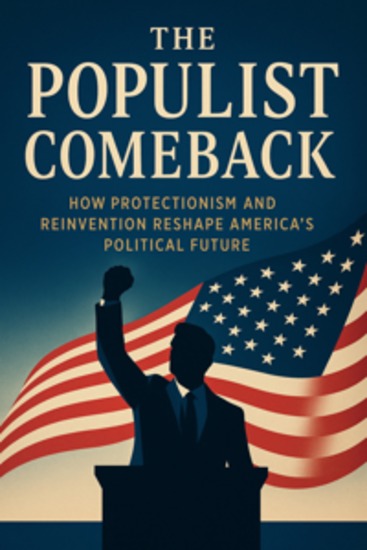
The Populist Comeback: How Protectionism and Reinvention Reshape America’s Political Future - cover

The Populist Comeback: How Protectionism and Reinvention Reshape America’s Political Future

Evelyn Ashcroft

Casa editrice: BookRix

  • 0
  • 0
  • 0

Sinossi

What happens when populism returns with new momentum? The Populist Comeback examines the resurgence of protectionist trade policies, nationalist rhetoric, and populist reinvention in contemporary American politics.Written in a professional and accessible style for students, this book unpacks the dynamics behind trade wars, shifting alliances, and the populist appeal that challenges traditional institutions. It explores how renewed protectionism impacts global markets, reshapes domestic priorities, and fuels political polarization. At the same time, it highlights how populism continually reinvents itself—adapting strategies, language, and platforms to maintain influence.Rather than simply diagnosing problems, the book provides frameworks for understanding populism’s cyclical nature and its implications for democracy. Readers gain both critical insight into today’s political landscape and tools for analyzing how movements of disruption reshape governance.If you want to understand the forces behind modern populism and the protectionist turn in global politics, this book offers the clarity and depth you need.
Disponibile da: 09/09/2025.
Altri libri che potrebbero interessarti

  • Deliberative Policymaking - Redesigning How We Make Education Policy - cover

    Deliberative Policymaking -...

    Elizabeth Grant

    • 0
    • 0
    • 0
    A Choice Outstanding Academic Title of the Year 


    In Deliberative Policymaking, Elizabeth Grant advances a fresh framework for making collective decisions about US schools. Grant argues that education policy can be made better by improving education policymaking methods. Informed by accounts of policymaking actions as well as her own experience, she offers a keen assessment of which components of existing education policy and policymaking have been effective and which have not. 


    Grant presents new approaches to the craft of policymaking. She endorses policy design thinking, including user-centered design; greater attention to education statecraft, such as reinforcing federal-state relations; and partnering with intermediaries who can help policymakers determine where the public interest lies. She underscores how these practices support democratized policymaking and implementation, which can lead to more inclusive, equitable policy. 


    Grant notes that the success of policy work depends on civic capacity to initiate and sustain improvement efforts, and on policy's ability to meet the demands of the time. This book is essential for anyone who makes policy or is interested in education reform.
    Mostra libro
  • A Life in the American Century - cover

    A Life in the American Century

    Jr. Joseph S. Nye

    • 0
    • 0
    • 0
    For the past eight decades, we have lived in "the American Century"—a period during which the US has enjoyed unrivaled power—be it political, economic, or military—on the global stage. Born on the cusp of this new era, Joseph S. Nye Jr. has spent a lifetime illuminating our understanding of the changing contours of America power and world affairs. His many books on the nature of power and political leadership have rightly earned him his reputation as one of the most influential international relations scholars in the world today. 


    In this deeply personal book, Joseph Nye shares his own journey living through the American century. From his early years growing up on a farm in rural New Jersey to his time in the State Department, Pentagon, and Intelligence Community during the Carter and Clinton administrations where he witnessed American power up close, shaping policy on key issues such as nuclear proliferation and East Asian security.  After 9/11 drew the US into wars in Iraq and Afghanistan, Nye remained an astute observer and critic of the Bush, Obama, and Trump presidencies. Today American primacy may be changing, but he concludes with a faint ray of guarded optimism about the future of his country in a richer but riskier world.
    Mostra libro
  • »We Are All Activists« - Exploring Solidarities in Activism By With and For Refugees and Migrants in Hamburg - cover

    »We Are All Activists« -...

    Lea Rzadtki

    • 0
    • 0
    • 0
    Who is meant when people talk about the citizens or the activists? Often, they are implied to mean the most privileged positionalities. Simultaneously, refugees and migrants tend to be seen through their (supposed) legal status. Thus, they are neither practically nor conceptually regarded as activists. The variety of intersecting positionings in migrant rights activism results in complex inequalities and power dynamics within activist groups. Solidarities are continually challenged, negotiated, and built. Lea Rzadtki develops a conceptual view on claims, challenges, and processes that activists experience and deal with. She moves beyond dichotomies and engages in transversal dialogue.
    Mostra libro
  • The United States and the Armenian Genocide - History Memory Politics - cover

    The United States and the...

    Julien Zarifian

    • 0
    • 0
    • 0
    During the first World War, over a million Armenians were killed as Ottoman Turks embarked on a bloody campaign of ethnic cleansing. Scholars have long described these massacres as genocide, one of Hitler's prime inspirations for the Holocaust, yet the United States did not officially recognize the Armenian Genocide until 2021. 


    This is the first book to examine how and why the United States refused to acknowledge the Armenian Genocide until the early 2020s. Although the American government expressed sympathy towards the plight of the Armenians in the 1910s and 1920s, historian Julien Zarifian explores how, from the 1960s, a set of geopolitical and institutional factors soon led the United States to adopt a policy of genocide nonrecognition which it would cling to for over fifty years, through Republican and Democratic administrations alike. He describes the forces on each side of this issue: activists from the US Armenian diaspora and their allies, challenging Cold War statesmen worried about alienating NATO ally Turkey and dealing with a widespread American reluctance to directly confront the horrors of the past. Drawing from congressional records, rare newspapers, and interviews with lobbyists and decision-makers, he reveals how genocide recognition became such a complex, politically sensitive issue.
    Mostra libro
  • Has Populism Won? - The War on Liberal Democracy - cover

    Has Populism Won? - The War on...

    Daniel Drache, Marc D. Froese

    • 0
    • 1
    • 0
    In the shadow of the Russian invasion of Ukraine, two experts show us how and why global populism has taken root and what it will take to turn the tide
    		 
    From Trumpian America to Putin’s nationalist Russia, and from Poland to the Philippines, rapid change and rising inequality have fueled a retreat into tribalist nationalism fed by a fear of being left behind. Populist leaders reach into this fear, using it as a lever to power with empty promises of looking out for the little person and promising a return to national greatness. This is happening in countries spread across the globe and the political spectrum, arising in the right and the left alike, and recently brought into harsh relief against Putin’s brutal invasion of Ukraine. So why are we so susceptible to this pernicious political style at this moment? How did we get here? And more importantly, will we get back to more even-handed governments?
    		 
    Filled with original research, political scientists Drache and Froese have written a chilling, compelling analysis of the rise of populism, and reveal what it will take to douse the flames. This is an essential read for anyone concerned about the encroachments on freedom and the rule of law around the world.
    Mostra libro
  • Confident Pluralism - Surviving and Thriving through Deep Difference - cover

    Confident Pluralism - Surviving...

    John D. Inazu

    • 0
    • 0
    • 0
    The United States seems to become more dramatically polarized and divided with each passing month. There are seemingly irresolvable differences in the beliefs, values, and identities of citizens across the country that too often play out in our legal system in clashes on a range of topics such as the tensions between law enforcement and minority communities. How can we possibly argue for civic aspirations like tolerance, humility, and patience in our current moment? 
     
    In Confident Pluralism, John D. Inazu analyzes the current state of the country, orients the contemporary United States within its broader history, and explores the ways that Americans can—and must—strive to live together peaceably despite our deeply engrained differences. Pluralism is one of the founding creeds of the United States—yet America’s society and legal system continues to face deep, unsolved structural problems in dealing with differing cultural anxieties and differing viewpoints. Inazu not only argues that it is possible to cohabitate peacefully in this country, but also lays out realistic guidelines for our society and legal system to achieve the new American dream through civic practices that value toleration over protest, humility over defensiveness, and persuasion over coercion. 
     
    This new edition of Confident Pluralism is an essential clarion call during one of the most troubled times in US history. Inazu argues for institutions that can work to bring people together as well as political institutions that will defend the unprotected. Confident Pluralism offers a refreshing argument for how the legal system can protect peoples’ personal beliefs and differences and provides a path forward to a healthier future of tolerance, humility, and patience.
    Mostra libro