Unisciti a noi in un viaggio nel mondo dei libri!
Aggiungi questo libro allo scaffale
Grey
Scrivi un nuovo commento Default profile 50px
Grey
Iscriviti per leggere l'intero libro o leggi le prime pagine gratuitamente!
All characters reduced
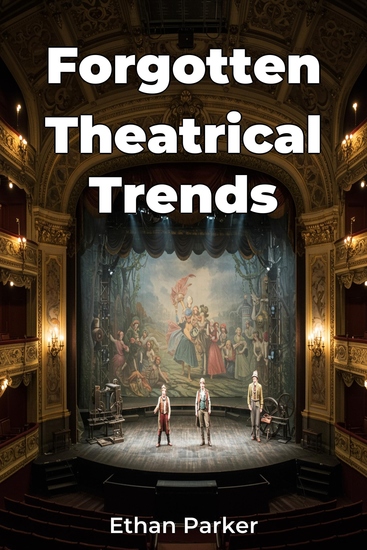
Forgotten Theatrical Trends - cover

Forgotten Theatrical Trends

Ethan Parker

Traduttore A Ai

Casa editrice: Publifye

  • 0
  • 0
  • 0

Sinossi

"Forgotten Theatrical Trends" unearths the captivating history of performance styles and stagecraft innovations that once dominated Western theatre traditions but have since faded. The book delves into theatrical conventions of the 18th, 19th, and early 20th centuries, revealing how forgotten techniques like direct address and elaborate stage machinery shaped dramatic presentation. It highlights the cyclical nature of theatre history, where trends rise, fall, and sometimes re-emerge, reflecting evolving social values and artistic priorities. For example, the once-popular "Pepper's Ghost" illusion captivated audiences, showcasing the era’s fascination with spectacle. Exploring the dominance of melodrama and the narrative power of direct address, the book analyzes digitized archives and historical documents to offer a fresh perspective on theatre history. Each chapter focuses on specific trends, building towards an overview of how their disappearance influences modern theatre. By examining these discarded techniques, "Forgotten Theatrical Trends" provides theatre students, scholars, and enthusiasts with a deeper understanding of the ever-changing theatrical landscape.
Disponibile da: 29/03/2025.
Lunghezza di stampa: 67 pagine.
Altri libri che potrebbero interessarti

  • Is Pleasure Love? - cover

    Is Pleasure Love?

    Jiddu Krishnamurti

    • 0
    • 0
    • 0
    Is pleasure love? - 13 March 1971 
    • Can thought ever solve the whole problem of existence? 
    • What is the function of thought? 
    • Why has sex become so extraordinarily important? 
    • Chastity is the freedom from all image. 
    • Is love desire? 
    • A new thing can take place only when there is an ending of the old. 
    Question topics following the talk include: getting better, controlling thought, the process of invention, vegetarianism, images.
    Mostra libro
  • History of Italy - The Catholic Background in a Country of Popes and Saints - cover

    History of Italy - The Catholic...

    Kelly Mass

    • 0
    • 0
    • 0
    This 2-book combo contains the following historical narratives: 
    1: What comes to mind when you say the words “Vatican City?” The Pope? Big cathedrals or underground catacombs with the corpses of buried saints from the past? Crowds of people with candles? Or a choir of young men in a certain attire?  
    The Vatican is a landlocked, independent city state and enclave in Rome, Italy. The Vatican City State, also called the Vatican, acquired independence from Italy in the year 1929 with the Lateran Treaty, and it is a different terrain under the Holy See's "full ownership, special rule, and sovereign authority and jurisdiction," which makes sure the city state's temporal, diplomatic, and spiritual independence. 
    This is one of the world’s most unique states/countries, something that is definitely worth understanding. With about 1.4 billion Catholics, in the world, it can be worth your while to study this guide to understand where their leadership and headquarters are situated, and what they do. 
    2: Catherine of Siena (who lived from March 25, in 1347 to April 29th, in the year 1380), a Dominican laywoman, was a mystic, activist, and writer who impacted Italian literature and the Catholic Church significantly. She was canonized in 1461 and is a Medical professional of the Church. 
    She was born and raised in Siena and, regardless of her parents' desires, desired dedicate her life to God from an early age. She ended up being a member of the "mantellate," a casual Dominican spirituality group of pious women, mainly widows. Pope Gregory XI's choice to leave Avignon for Rome was affected by her impact. He then dispatched her to Florence to organize a peace treaty.
    Mostra libro
  • Power without Victory - Woodrow Wilson and the American Internationalist Experiment - cover

    Power without Victory - Woodrow...

    Trygve Throntveit

    • 0
    • 0
    • 0
    For decades, Woodrow Wilson has been remembered as either a paternalistic liberal or reactionary conservative at home and as a naïve idealist or cynical imperialist abroad. Historians’ harsh judgments of Wilson are understandable. He won two elections by promising a deliberative democratic process that would ensure justice and political empowerment for all. Yet under Wilson, Jim Crow persisted, interventions in Latin America increased, and a humiliating peace settlement was forced upon Germany. A generation after Wilson, stark inequalities and injustices still plagued the nation, myopic nationalism hindered its responsible engagement in world affairs, and a second vastly destructive global conflict threatened the survival of democracy worldwide—leaving some Americans today to wonder what, exactly, the buildings and programs bearing his name are commemorating. In Power without Victory, Trygve Throntveit argues that there is more to the story of Wilson than these sad truths. Throntveit makes the case that Wilson was not a “Wilsonian,” as that term has come to be understood, but a principled pragmatist in the tradition of William James. He did not seek to stamp American-style democracy on other peoples, but to enable the gradual development of a genuinely global system of governance that would maintain justice and facilitate peaceful change—a goal that, contrary to historical tradition, the American people embraced. In this brilliant intellectual, cultural, and political history, Throntveit gives us a new vision of Wilson, as well as a model of how to think about the complex relationship between the world of ideas and the worlds of policy and diplomacy.
    Mostra libro
  • History of Toulouse - cover

    History of Toulouse

    Henri Ramet

    • 0
    • 0
    • 0
    Plunge headlong into the heart of Toulouse: this audiobook vividly restores, with captivating precision, the epic of a major Midi city—from its Celtic origins to the Roman era, from Visigothic splendor to the dramas of the Albigensian Crusade, and on to municipal affirmation and medieval intellectual growth. Discover a crossroads city shaped by its Garonne River, ramparts, markets, religious orders, and capitouls; a melting pot of arts, law, and faith where troubadours, builders, merchants, and jurists intertwine. Henri Ramet, a magistrate-historian of luminous rigor, weaves a clear, dense, and sensitive fresco: living topography, resurrected monuments, explained institutions, major crises recounted at street level (Taur, Daurade, Saint-Sernin, Château Narbonnais), never sacrificing emotion to knowledge. Narration breathes life and rhythm into this urban chronicle, turning archives and stones into characters. For those who love concrete history, world-cities, and collective destinies, here is a broad, scholarly, and vibrant journey—where one feels the heartbeat of "Palladian" Toulouse, century after century. An instant classic for understanding, seeing, and loving the pink city differently.
    Mostra libro
  • Mikhail Gorbachev: A short biography - 5 Minutes: Short on time – long on info! - cover

    Mikhail Gorbachev: A short...

    5 Minutes, 5 Minute Biographies,...

    • 0
    • 0
    • 0
    Mikhail Gorbachev, Russian president and Nobel Peace prize laureate: Life and work in a short biography! Everything you need to know, brief and concise. Infotainment, education and entertainment at its best!
    Mostra libro
  • The Great Russian Famine of 1601-1603 - Causes and Consequences - cover

    The Great Russian Famine of...

    Sarah Willards

    • 0
    • 0
    • 0
    The Great Russian Famine of 1601-1603 was one of the most catastrophic events in Russian history, causing widespread death, social instability, and economic distress. This famine occurred during a period of political turmoil, just after the death of Tsar Ivan the Terrible and amid the struggle for the Russian throne. The famine’s impact was felt across Russia, particularly in the central and southern regions, and it highlighted both the fragility of the agrarian economy and the vulnerability of the Russian people to climatic and political disruptions. 
    The context of the famine is crucial to understanding its devastating effects. In the late 16th century, Russia was already experiencing significant strain, including the collapse of the feudal system, a declining central government, and the outbreak of the Time of Troubles, a series of civil wars and foreign invasions. The Russian agricultural system, heavily dependent on the success of yearly harvests, was not equipped to deal with the combination of extreme weather, crop failure, and a lack of effective governance. 
    The famine itself was primarily caused by a series of poor harvests, which were exacerbated by severe weather conditions, including droughts and unseasonably cold winters. The summer of 1601 saw a significant drought, which devastated crops, and the following winter brought freezing temperatures that further hindered the ability to cultivate food. As a result, grain production plummeted, and prices soared, making food increasingly inaccessible to the general population.
    Mostra libro