Join us on a literary world trip!
Add this book to bookshelf
Grey
Write a new comment Default profile 50px
Grey
Subscribe to read the full book or read the first pages for free!
All characters reduced
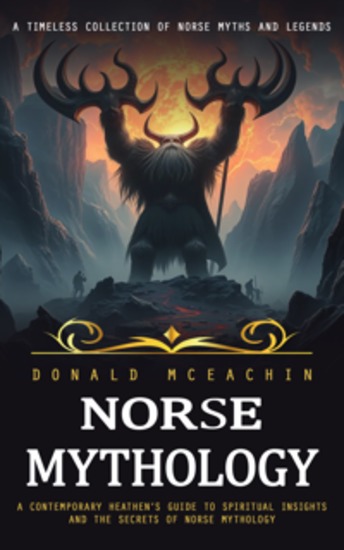
Norse Mythology: A Timeless Collection of Norse Myths and Legends (A Contemporary Heathen’s Guide to Spiritual Insights and the Secrets of Norse Mythology) - cover

Norse Mythology: A Timeless Collection of Norse Myths and Legends (A Contemporary Heathen’s Guide to Spiritual Insights and the Secrets of Norse Mythology)

Donald McEachin

Publisher: Griffeth Mark

  • 0
  • 0
  • 0

Summary

This book is carefully crafted to engage and guide seekers, regardless of experience level. You'll find readily actionable advice that you can weave seamlessly into your modern-day lifestyle, making the stories of the warrior gods and loving goddesses come alive in a personal and transformative way.And with full validity, the rituals and customs will be faithful to the old ways, giving you a genuine connection to the norse pantheon. The information is scholarly yet accessible, promising a thrilling and enlightening journey from start to finish.Inside you will read about...The creation in norse mythologyThe nine worldsMajor gods and goddessesValhallaRagnarokThe sagasThe influence of norse mythology on our lives todayAs Germanic tribes clashed and reconciled, a rich and detailed realm of the gods was created through the melding and exchanging of stories and characters that reflected the complicated historical events around them.The clash of the vanir and the aesir, or the old and new gods, is thought to be indicative of a real conflict between two tribes that later found a way to coexist.Through developing an understanding of the stories that remain, you will learn about the intricacies of ancient nordic culture.
Available since: 04/24/2025.
Print length: 150 pages.

Other books that might interest you

  • History Of Spain - From Ancient Iberia to the Spanish–American War - cover

    History Of Spain - From Ancient...

    History Retold

    • 0
    • 0
    • 0
    Explore the grand history of Spain with this incredible book! 
    Take a journey through the ages and discover the stories and cultures that have shaped Spain from ancient times to the present. 
    Discover how the country has been influenced by its empires, wars, and revolutions, and learn about the vibrant culture of today. 
    We'll explore the people who have shaped and been shaped by this vibrant nation over time, examining their contributions to literature, art, architecture, religion, philosophy, and more. From the legendary Moors to modern-day Spaniards, we'll delve into the many stories that make up Spain's long and fascinating past. 
    Get this book today and explore the fascinating history of Spain!
    Show book
  • Kingdom of Mapungubwe - The Precursor to Great Zimbabwe and Southern Africa's First Kingdom - cover

    Kingdom of Mapungubwe - The...

    Rolf Hedger

    • 0
    • 0
    • 0
    The discovery of Mapungubwe in the early 20th century marked a turning point in the understanding of Southern Africa’s ancient civilizations. Hidden for centuries, this once-thriving kingdom remained unknown to the modern world until 1933, when a group of researchers stumbled upon its ruins on Mapungubwe Hill in present-day South Africa. What they uncovered would challenge colonial-era narratives and reshape the history of African state formation. 
    Archaeological excavations at the site revealed an advanced society that flourished between the 11th and 13th centuries. The remains of elaborate stone structures, pottery, and intricate gold artifacts painted a picture of a powerful kingdom with a sophisticated political and economic system. Among the most significant discoveries was the famous Golden Rhino, a small yet exquisitely crafted artifact that symbolized the wealth and status of Mapungubwe’s elite. Made from delicate sheets of gold carefully shaped around a wooden core, the rhino became an enduring emblem of the kingdom’s prosperity. 
    The site also yielded evidence of a complex social hierarchy. The ruling class resided atop Mapungubwe Hill, separated from the common people who lived in the surrounding lowlands. This physical division suggested a structured society where power was centralized, a departure from earlier African settlements where leadership was more communal. The arrangement of dwellings, burial sites, and ceremonial areas further confirmed that Mapungubwe had developed into a true kingdom with a distinct ruling elite.
    Show book
  • David Copperfield - cover

    David Copperfield

    Charles Dickens

    • 0
    • 0
    • 0
    "Whether I shall turn out to be the hero of my own life, or whether that station will be held by anybody else, these pages must show."
    
    Follow the life of David Copperfield from his idyllic childhood in Blunderstone to the harsh realities of a London bottling factory and his eventual rise as a successful author. Dickens weaves a sprawling narrative of hardship and triumph, populated by a cast of characters so vivid they have become archetypes of the English language.
    
    A Tapestry of Human Experience: Experience the warmth of the Peggotty family living in their upturned boat-house on the Yarmouth sands, and endure the chilling cruelty of the stepfather, Mr. Murdstone. Witness the eternal optimism of the debt-ridden Mr. Micawber—always waiting for "something to turn up"—and the "umblemished" villainy of the "umble" Uriah Heep.
    
    The Personal Masterpiece: David Copperfield is Dickens at the height of his powers, blending humor, pathos, and social critique. It explores the complexities of marriage, the cruelty of child labor, and the importance of perseverance. More than a story of one man, it is a grand observation of the Victorian era, filled with the "discipline of the heart" that transforms a boy into a man of character.
    
    A journey of a thousand memories. Purchase "David Copperfield" today and discover the heart and soul of Dickensian literature.
    Show book
  • Believe - A Memoir in Stories - cover

    Believe - A Memoir in Stories

    Christina H Wilson

    • 0
    • 0
    • 0
    At 36 years old, Christina had it all...two young and healthy boys, an uber successful husband, and a big house in a gated-golf course community. She was young, rich, and on top of the world. On the morning of September 11, 2000, a devastating call would up-end everything and life as she knew it. While this cataclysmic event didn't mark the beginning of end of her life, it would be the test of her character, agency and faith. This book offers insight to a life journey that is extraordinary yet profoundly human. It's the chronical of an evolution from a frail child into a woman shaped by intense love, incredible upheavals, and ultimately, deep personal wisdom. Beginning with a childhood marked by illness and solitude, books and fairytales became Christina's refuge and compass. These influences weave throughout her life and the stories, not as naive fantasies, but as emotional frameworks that conflict with the sharp edges of her reality. Life takes a dramatic turn when at 25, Christina meets Jeffrey, a Wall Street Titan, whose fast-paced existence is worlds away from her quiet, reflective nature. The connection is immediate and all-consuming. Their life becomes exhilarating, fantastical, and materially abundant. The heart of this memoir is the defining moment when an unexpected phone call changes everything. This moment acts as a fault-line in Christina's life, splitting everything into a before and after. From this point on, the story becomes less about the external events and more about the quiet but radical life-changing shifts in Christina's understanding about self, love, loss, and destiny. At it's core, this story is about transformation that only comes when we are challenged and stripped of control and what we know. It's about learning to let life present itself with patience and understanding. This book is a tapestry of life-lesson stories woven together by themes of self-discovery, unconditional love, tragedy, spirituality, family, inner-strength, and grief.
    Show book
  • Advent of Early Modern Warfare The: The History of the Transition from Medieval Military Tactics to the Age of Gunpowder - cover

    Advent of Early Modern Warfare...

    Editors Charles River

    • 0
    • 0
    • 0
    In the time period between the fall of Rome and the spread of the Renaissance across the European continent, many of today’s European nations were formed, the Catholic Church rose to great prominence, some of history’s most famous wars occurred, and a social class system was instituted that lasted over 1,000 years. A lot of activity took place during a period frequently labeled derogatively as the “Dark Ages,” and while that period of time is mostly referred to as the “Middle Ages” instead of the Dark Ages today, it has still retained the stigma of being a sort of lost period of time in which Western civilization made no worthwhile progress.  
    	If anything, the one aspect of the Middle Ages that has been romanticized is medieval warfare. Indeed, the Middle Ages have long sparked people’s imaginations thanks to imagery of armored knights battling on horseback and armies of men trying to breach the walls of formidable castles. What is generally forgotten is that medieval warfare was constantly adapting to the times as leaders adopted new techniques and technology, and common infantry became increasingly important throughout the period. Starting around 1000 CE, there was a gradual consolidation of power in the region after the fragmentation of the Early Middle Ages, and it brought about the rise of more centralized states that could field large armies. The Normans, one of the first groups to do this, were notable for their discipline and organization, and it’s little surprise that they were the last foreigners to successfully invade Britain under William the Conqueror in the mid 11th century.  
    	Meanwhile, political and technological progress led to continuous change of tactics and equipment. Cavalry became ascendant, only to be later replaced by infantry as their weapons improved. By the end of the period, warfare was radically changing thanks to the rise of gunpowder weapons such as the handgun and the bombard. 
    Show book
  • Criminology - The Intricacies of Criminal and Social Justice (2 in 1) - cover

    Criminology - The Intricacies of...

    Kevin Thorley

    • 0
    • 0
    • 0
    This book contains two titles, which are the following: 
    1 - The key processes in the criminal justice system are investigation, arrest, prosecution, pretrial, trial, sentencing, corrections, and reentry. Investigation involves law enforcement investigating a crime, gathering evidence, and identifying suspects. Arrest involves taking suspects into custody based on probable cause. Prosecution involves prosecutors reviewing evidence, deciding on charges, and filing them in court. Pretrial includes bail hearings, plea bargaining, and preliminary hearings. Trial is a court proceeding to determine the guilt or innocence of the accused, including opening statements, witness testimonies, and closing arguments. Sentencing involves a judge determining the sentence for a convicted offender. Corrections involve offenders serving their sentences in correctional facilities or through community-based programs. Reentry involves programs to help former inmates reintegrate into society, aiming to reduce recidivism. 
    2 - Social justice has a rich and complex history, shaped by numerous social, political, and economic movements over centuries. Its roots can be traced back to the Enlightenment era, where philosophers like John Locke and Jean-Jacques Rousseau introduced ideas of equality, individual rights, and the social contract. These concepts laid the groundwork for future social justice movements by emphasizing the inherent rights and dignity of every individual.
    Show book