Unisciti a noi in un viaggio nel mondo dei libri!
Aggiungi questo libro allo scaffale
Grey
Scrivi un nuovo commento Default profile 50px
Grey
Iscriviti per leggere l'intero libro o leggi le prime pagine gratuitamente!
All characters reduced
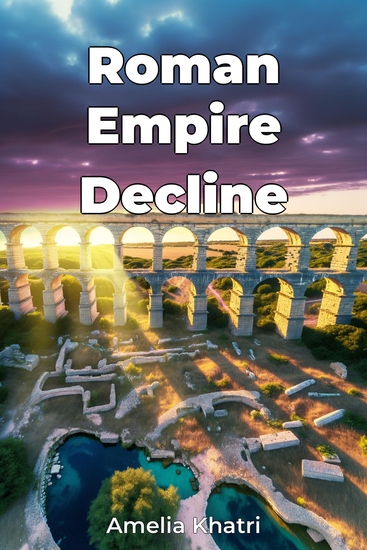
Roman Empire Decline - cover

Roman Empire Decline

Amelia Khatri

Traduttore A AI

Casa editrice: Publifye

  • 0
  • 0
  • 0

Sinossi

"Roman Empire Decline" offers a compelling examination of history's most powerful empire's dissolution, methodically analyzing the complex factors that led to Rome's fall in 476 CE. The book uniquely weaves together three critical elements: political instability during the Crisis of the Third Century, severe economic deterioration, and mounting external pressures from Germanic tribes and Persian forces.

 
Through a careful examination of archaeological evidence and contemporary accounts, including writings from historians Tacitus and Ammianus Marcellinus, the text reveals how these forces worked in concert to undermine the empire's foundations. The narrative progresses chronologically from the Severan dynasty through the deposition of Romulus Augustulus, with particular focus on the tumultuous third through fifth centuries CE.

 
During this period, the empire witnessed unprecedented challenges, including the reign of 26 different emperors in just 49 years, widespread currency debasement, and evolving relationships with neighboring peoples. Rather than presenting a simplified fall-from-grace narrative, the book offers a nuanced analysis of how complex diplomatic relationships, military engagements, and cultural exchanges shaped the empire's trajectory.

 
Drawing parallels between ancient Rome and modern nation-states, the book presents fresh perspectives on long-debated topics while maintaining scholarly rigor and accessibility. It challenges readers to consider broader patterns in state governance and economic systems, making the material relevant to contemporary discussions of political and economic sustainability.

 
The analysis incorporates recent archaeological findings from across Europe and the Mediterranean, providing new insights into this pivotal period of world history.
Disponibile da: 30/01/2025.
Lunghezza di stampa: 105 pagine.

Altri libri che potrebbero interessarti

  • Indus Valley Civilization: An Enthralling Overview of the Harappan Civilization Starting from the Early Harappan through Mohenjo-daro to the Aryan Invasion and Achaemenid Conquest - cover

    Indus Valley Civilization: An...

    Billy Wellman

    • 0
    • 0
    • 0
    The Harappan people occupied the Indus Valley for about two thousand years, all without conflict or war! 
    The Indus Valley civilization was founded at least over five thousand years ago in the area that is now modern-day Pakistan and northern India. The Harappan people lived there in peace by focusing on agriculture, crafting, and trading. This audiobook will discuss how the Harappan built their cities, lived their daily lives, what they believed happened after they died, and so much more! 
    In this audiobook, you will discover the following:The intricate city plans of Mohenjo-daro and other large citiesRitual bathing at the Great BathWhere the Harappans came from and where they wentTrade relationships with Mesopotamia, India, and ChinaExpert bronze statues and artworkBead factories and jewelry-makingThe mysterious Indus Valley scriptDebunking the Aryan invasion theoryLinks to modern-day HinduismBoats big enough to carry elephantsAnd so much more! 
    Click the “add to cart” button to begin learning about the Indus Valley civilization!
    Mostra libro
  • Knowledge and Learning are Two Different Things - Eight Public Meetings with Young People Claremont Colleges USA 1968 - cover

    Knowledge and Learning are Two...

    Jiddu Krishnamurti

    • 0
    • 0
    • 0
    A radical transformation in the psyche itself," 8 November 1968. Duration: 80 minutes.To communicate we must know that the word is not the thing and also be in that state of mind whose quality is attention, care. That can take place only if we are serious.We are the world, and the world is us. To bring about a radical transformation, which is so essential in society, there must be radical transformation in ourselves.Analysis of violence does not end violence, nor is violence ended by thinking of nonviolence.There is no teacher outside, no saviour, no master; you yourself have to change, and therefore you have to learn to observe, to know yourself.Knowledge and learning are two different things.What is this silence you talk about? The silence that I am experiencing comes and goes."Thought is the cause of fear," 10 November 1968. Duration: 76 minutes.Though we have plenty of energy, apparently we lack the drive, enthusiasm, vitality to bring about a change in ourselves.As long as there is fear, there must be violence, aggression, anger, hatred. Thought is the source of fear.Is it possible to live everyday life without thought interfering?
    Mostra libro
  • Sartre's No Exit - Other People Are Hell - cover

    Sartre's No Exit - Other People...

    Sophia Blackwell

    • 0
    • 0
    • 0
    Ever found yourself staring into the void and wished it would at least tell a good joke? Wonder how a chain-smoking French philosopher with unflattering glasses became an intellectual sex symbol? Want to understand existentialism without developing an addiction to black turtlenecks and cigarettes? 
    "Sartre's No Exit" is the antidote to pretentious philosophical despair you've been waiting for. This irreverent guide takes you on a sarcasm-soaked journey through Jean-Paul Sartre's most influential ideas—from radical freedom and bad faith to the hellishness of other people—all while mercilessly mocking the man who made existential angst fashionable. 
    In these pages, you'll discover: 
    How Sartre transformed teenage angst into a philosophical system (and got famous for it) 
    Why your freedom is both absolute and absolutely terrifying 
    How we all lie to ourselves about our lies to ourselves 
    The philosophical roots of your social anxiety and public bathroom discomfort 
    Why "Hell is other people" doesn't mean what you think (but is still a great excuse for canceling plans) 
    How Sartre maintained numerous affairs while writing about authenticity 
    Essential tips for hosting your very own existentialist dinner party, complete with nihilistic cocktails! 
    Whether you're a confused student forced to read "Being and Nothingness," a curious reader wanting to understand what the fuss is about, or someone who enjoys watching intellectual pretension get skewered by razor-sharp wit, this book is your perfect introduction to the man who made misery sound profound and smoking indoors seem philosophical.
    Mostra libro
  • How To Not Die Alone - Learn How to Love the One You Love - cover

    How To Not Die Alone - Learn How...

    M.J. Sulmin

    • 0
    • 0
    • 0
    How To Not Die Alone: Learn How to Live With Love The One You Love. 
    Simple Lessons For A Successful Love Relationships. 
    "Are you tired of feeling lonely and longing for a meaningful relationship? 
    Look no further. 
    In 'Learn How Not to Die Alone: Simple Lessons for a Successful Love Relationship,' you will discover the secrets to finding and maintaining a healthy and fulfilling partnership. 
    Through real-life examples and expert advice, this book guides you on a journey to understanding yourself and what you truly want in a partner and the necessary steps for building and nurturing a loving relationship. 
    Whether you're single, looking for love, or in a relationship and seeking to strengthen your bond, this book offers practical and actionable insights for achieving happy and lasting love. 
    Start your journey today and learn how not to die alone."
    Mostra libro
  • State of the Union 1986 - cover

    State of the Union 1986

    Ronald Reagan

    • 0
    • 0
    • 0
    The 1986 State of the Union Address delivered February 4, 1986, was delayed following the Space Shuttle Challenger disaster which killed its seven crew members. Reagan reports the U.S. is the economic miracle to which the world once again turns, with record economic growth and inflation cut from over 12 to under 4 percent.  
    But the federal budget system is broken. “We do not face large deficits because American families are undertaxed; we face those deficits because the Federal Government overspends.” “We must proceed with Grace commission reforms against waste.” Tax cuts have done more to “help America's economy break free than any program since John Kennedy's tax cut almost a quarter century ago.” 
    We “must redouble our efforts for freer and fairer trade.” We oppose legislation touted as providing protection that raises prices for us all.  
    We see a renaissance in education and support “vouchers that give parents freedom of choice”. Hundreds of billions of dollars in poverty programs have led to a breakdown of the family and deteriorating schools. As Franklin Roosevelt said, “Welfare is a narcotic, a subtle destroyer of the human spirit.” Welfare “should be judged by how many of its recipients become independent of welfare.” 
    Reagan sees technology as the solution to “the greatest problem of the 20th century. A security shield can one day render nuclear weapons obsolete and free mankind from the prison of nuclear terror.”  
    “The American dream is a song of hope… to discover a new universe inside a tiny silicon chip or a single human cell.” “So, let us go forward to create our world of tomorrow in faith, in unity, and in love. God bless you, and God bless America.” 
    Audio recording courtesy of the Ronald Reagan Presidential Library. 
    AspenLeafMedia.com
    Mostra libro
  • The Families of Eleanor of Aquitaine - A Female Network of Power in the Middle Ages - cover

    The Families of Eleanor of...

    J.F. Andrews

    • 0
    • 0
    • 0
    The lives of the sons of Eleanor of Aquitaine are the stuff of legend. Her daughters, however, are less well known, and the fascinating personalities of her daughters-in-law have been almost entirely overlooked, as have those of the daughters she bore Louis VII of France. 


    The Families of Eleanor of Aquitaine redresses this balance and showcases the lives, travels, and careers of these ten very different women, who formed a great international network of political alliances that linked their parents, siblings, husbands, and children all across Europe and the Holy Land. 


    Some of these women found happiness; others endured lives of turmoil and conflict. Some of them were close; others never met. But two things linked them all: their connection to Eleanor and to the kingdoms over which she reigned—and their determination to exert authority on their own terms in a male-dominated world.
    Mostra libro