Join us on a literary world trip!
Add this book to bookshelf
Grey
Write a new comment Default profile 50px
Grey
Subscribe to read the full book or read the first pages for free!
All characters reduced
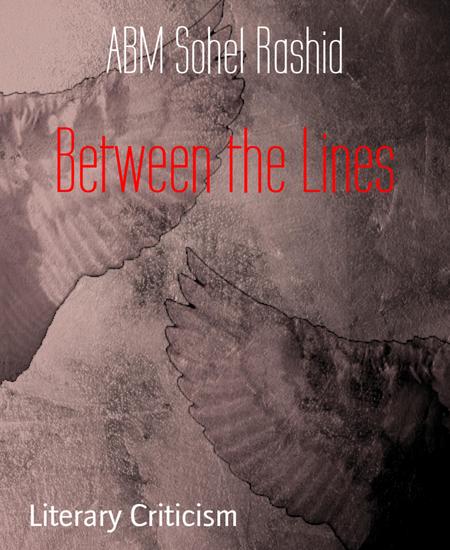
Between the Lines - Essay - cover

Between the Lines - Essay

ABM Sohel Rashid

Publisher: BookRix

  • 0
  • 0
  • 0

Summary

Delve into the profound world of literature with "Between the Lines: Essays on the Essence of Literature." This captivating collection of essays invites readers to explore the intricate tapestry of words, narratives, and the enduring impact of literary expression.
Available since: 11/12/2023.
Print length: 11 pages.

Other books that might interest you

  • Skid Dogs - cover

    Skid Dogs

    Emelia Symington-Fedy

    • 0
    • 0
    • 0
    A raw and riveting coming-of-age story about the wild love of teenage friendships and the casual oppression of nineties rape culture. 


    Emelia Symington-Fedy grew up with her girl gang on the railroad tracks of a small town in British Columbia. Unsupervised and wild, the girls explored the power and shortcomings of "best" friendships and their growing sexuality. 


    Two decades later an eighteen-year-old girl is murdered on Halloween on the same tracks, and Symington-Fedy returns to her hometown to stay with her mother, who is fearful of a murderer at large. 


    While the media narrows its focus on how the girl dared be alone on the tracks, Symington-Fedy slowly comes to terms with the mistreatment of her own teenage body. Giving a bold and often darkly humorous first-hand account of nineties rape culture and the sexual coercion that still permeates girlhood, Symington-Fedy holds her hometown close and accountable and exposes the subtle ways that misogyny shows up daily.
    Show book
  • Resistance to Imperialism - How Colonized Nations Fought for Independence and Sovereignty - cover

    Resistance to Imperialism - How...

    Arlo Holders

    • 0
    • 0
    • 0
    Imperialism, a system of domination and exploitation, has shaped the course of human history for centuries. At its core, imperialism refers to the policy of a nation extending its power and influence through diplomacy or military force. Colonization, often considered its most aggressive form, involves the establishment of control over a foreign territory, exploiting its resources, and subjugating its people. The roots of imperialism date back to ancient civilizations, but the most notable period of imperial expansion occurred between the 15th and early 20th centuries, driven by European powers such as Britain, France, Spain, and Portugal. 
    The Age of Exploration, beginning in the late 15th century, marked the beginning of a new era of European imperialism. With the development of advanced navigational technologies, European nations sought to expand their empires by discovering new trade routes and territories. Colonization became intertwined with economic ambition, as European countries sought access to valuable resources like gold, spices, and sugar. The discovery of the Americas by Christopher Columbus in 1492 marked the start of extensive European colonization in the Western Hemisphere, followed by the establishment of colonies in Asia and Africa. 
    The motivations for colonization were multifaceted. Economically, European nations sought to control trade routes and establish lucrative colonies that could supply raw materials, which would fuel the industrial revolutions in Europe. Politically, nations pursued imperialism as a way to enhance their power and prestige on the world stage. Colonization also provided a solution to domestic issues, such as overpopulation and unemployment, by offering new lands for settlement and economic opportunity.
    Show book
  • The White Album - Essays - cover

    The White Album - Essays

    Joan Didion

    • 0
    • 0
    • 0
    "First appearing in print in 1979, this remarkable and intimate audiobook chronicles the implosion of the 1960s and reports on the people, mores, and trends that defined that turbulent time."—AudioFileFirst published in 1979, Joan Didion's The White Album records indelibly the upheavals and aftermaths of the 1960s. Examining key events, figures, and trends of the era—including Charles Manson, the Black Panthers, and the shopping mall—through the lens of her own spiritual confusion, Joan Didion helped to define mass culture as we now understand it. Written with a commanding sureness of tone and linguistic precision, The White Album is a central text of American reportage and a classic of American autobiography.
    Show book
  • The Shocking Truth about Social Movements - cover

    The Shocking Truth about Social...

    Zoey Fraisers

    • 0
    • 0
    • 0
    Social movements have shaped the course of history, challenging oppressive systems, advocating for change, and giving a voice to the marginalized. From civil rights struggles to labor movements, from feminist activism to climate change protests, these collective efforts have demonstrated the power of ordinary people to influence political, social, and economic landscapes. But what makes a social movement successful? Why do some fizzle out while others spark revolutions? This book explores the truth behind social movements—their origins, strategies, challenges, and impact on society.  
      
    Social movements arise from deep-seated grievances, often triggered by inequality, injustice, or political repression. When institutions fail to address these concerns, people come together to demand change. While some movements rely on peaceful protests, petitions, and advocacy, others take a more radical or even violent turn. The paths they take can determine their success or failure. Movements like the U.S. civil rights movement and India’s independence struggle succeeded through persistent, organized, and nonviolent resistance. In contrast, some movements collapse due to internal divisions, government crackdowns, or loss of public support.  
      
    In today’s digital age, technology has transformed activism. Social media has made it easier to mobilize large numbers of people, spread awareness, and hold those in power accountable. However, it has also given rise to misinformation, government surveillance, and fleeting activism that lacks long-term commitment. Movements that once took years to build can now emerge overnight, but sustaining them remains a challenge. 
    Show book
  • The Most Inspiring Short Stories for Seniors - 22 True & Engaging Tales about Sports Animals Travel Nature Kindness & More - For Men & Women Over 65! - cover

    The Most Inspiring Short Stories...

    Wildemind Publications

    • 0
    • 0
    • 0
    Did you know that listening to a story engages the mind twice as much as watching the the TV? 
    Stories are known to improve mental cognition, improve memory, and keep the mind stimulated. 
    Perhaps you (or your parents) are looking for some inspiring stories from the last century? 
    Our audiobook is exactly that! A handful of 22 short-stories (each around 10 minutes) that will bring joy, entertainment & knowledge to those who have lived through the 1950's, 1960's, 1970's and all the way to the present day. 
    This professionally narrated audiobook is:No reading, just listening - Perfect for older readers to relax with!Uplifting & relatable stories from the 1950's to 1990's...Each of the 22 varied stories are around 1000 words long - pick it up & put it down anytime...Stories about sports, nature, animals, miracles, kindness, history, and so much more!Voiced by a true professional - an older American gentleman called Eric.. 
    No matter whether this audiobook is for you, or your parents - it is sure to bring joy & entertainment - all while stimulating the mind and bringing back great memories from decades prior! 
    If you want the older person in your life to engage with some incredible stories... 
    Then listen to this audiobook now!
    Show book
  • The Genealogy of Morals - cover

    The Genealogy of Morals

    Friedrich Nietzsche

    • 0
    • 0
    • 0
    Friedrich Nietzsche's genealogical analysis in The Genealogy of Morals is an exploration of the historical development of certain moral values, specifically those associated with notions of justice, honour, and good. Taking a critical stance against the Enlightenment-era reception of Kantian morality, Nietzsche argues that these values were formed through a process of power dynamics rather than abstract principles. Read in English, unabridged.
    Show book