Begleiten Sie uns auf eine literarische Weltreise!
Buch zum Bücherregal hinzufügen
Grey
Einen neuen Kommentar schreiben Default profile 50px
Grey
Jetzt das ganze Buch im Abo oder die ersten Seiten gratis lesen!
All characters reduced
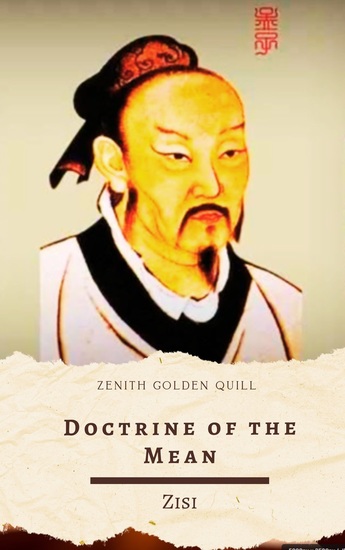
Doctrine of the Mean - The Confucian Classic of Harmony Virtue and Self-Cultivation by Zisi - cover

Doctrine of the Mean - The Confucian Classic of Harmony Virtue and Self-Cultivation by Zisi

Zi Zisi, Zenith Golden Quill

Verlag: Zenith Golden Quill

  • 0
  • 0
  • 0

Beschreibung

Balance. Moderation. Inner harmony. The path to wisdom lies not in extremes, but in the middle way.

Doctrine of the Mean (Zhongyong) is one of the Four Books of Confucian philosophy and a cornerstone of Eastern thought. Authored by Zisi, the grandson of Confucius, this profound text explores how individuals can align themselves with cosmic order, cultivate moral character, and achieve harmony within society and self.

Bridging ethics, politics, and spirituality, this work remains timeless in its call for moderation, sincerity, and righteous living—a message increasingly relevant in today's polarized world.

📘 This Edition Features:
✔ Complete English translation
✔ Kindle-optimized formatting with interactive table of contents
✔ Essential reading for students of philosophy, spirituality, or Chinese classics

💬 What Readers Say:
"A brilliant guide to inner peace and societal integrity."
"One of the most spiritually profound books I've ever read."
"As relevant today as it was 2,000 years ago."

📥 Download Doctrine of the Mean today and discover the timeless Confucian path to virtue, clarity, and peace.
Verfügbar seit: 08.05.2025.
Drucklänge: 37 Seiten.

Weitere Bücher, die Sie mögen werden

  • Cognitive Behavioral Therapy: Discover How to Relieve Stress & Anxiety Boost Self-Esteem and Break Out of Negative Thought Patterns (A Complete Guide for Beginners) - cover

    Cognitive Behavioral Therapy:...

    Max Sterling

    • 0
    • 0
    • 0
    Imagine a life free from the chains of stress, anxiety, and negative thoughts – a future that can be yours in just 21 days, even if your life feeling overwhelming right now. 
    Have you been seeking the key to unlock a happier, healthier mindset, but feel lost in a sea of self-help jargon and with no real results to show for it? 
    Are you craving control over your mind and emotions instead of feeling like you're constantly fighting a losing battle with them? 
    Inside, you'll discover: 
    * A detailed breakdown of what CBT is and how it can transform your life, even in the most challenging times 
    * Proven strategies for overcoming anxiety and stress that are fully adaptable to your unique journey 
    * The major principles of CBT that, once mastered, can become your blueprint for a lifetime of mental wellness 
    * An in-depth exploration of thought patterns, uncovering why we think the way we do and how to revolutionize your mindset 
    * A comprehensive plan designed to take you from novice to skilled practitioner of CBT 
    * How to use CBT to boost self-esteem and eradicate self-doubt 
    * Practical exercises to implement CBT techniques into your daily routine, leading to a significant reduction in your stress and anxiety levels 
    * Tools to combat disruptive emotional responses and build resilience against life's continuous challenges 
    * Powerful techniques to incorporate mindfulness and self-compassion into your life 
    * How technology can enhance your CBT journey and a useful list of recommended apps and websites 
    ...and much, much more! 
    If you’re ready to embrace a future untethered from stress and anxiety, to unlock a more confident and resilient self, scroll up and get the book now!
    Zum Buch
  • War on the Waves - The Naval Battles That Defined World War II's Maritime Struggle - cover

    War on the Waves - The Naval...

    Sage Winters

    • 0
    • 0
    • 0
    The naval power wielded by the world’s great nations during World War II shaped not only the outcome of the conflict but also the geopolitical landscape for decades to come. Control of the seas became a decisive factor in determining the success or failure of military strategies and the fate of nations. This maritime struggle, fought on vast oceans and distant shores, was as much a war of technology, tactics, and intelligence as it was of sheer naval might. 
      
    The importance of naval dominance cannot be overstated. For the Allies, particularly the United States and Great Britain, securing control of the seas was vital for maintaining supply lines, especially in the Atlantic, where the threat of German U-boats could sever critical routes for war materials and reinforcements. In the Pacific, the Japanese Empire’s early victories left much of Southeast Asia and the Pacific Ocean under its control, presenting a formidable challenge. The battle for these waters would evolve into a series of iconic naval engagements that would shape the course of the war. 
      
    From the early days of the conflict, when the British Royal Navy faced off against the mighty Kriegsmarine of Nazi Germany, to the far-reaching campaigns of the Pacific theater, naval warfare introduced new technologies and strategies. The use of aircraft carriers, submarines, radar, and sonar reshaped traditional naval combat and rendered earlier tactics obsolete. The role of intelligence, particularly the breaking of the Enigma code, became a pivotal advantage, enabling the Allies to counter the Axis powers’ naval threats.
    Zum Buch
  • Heian Period - The Golden Age of Art Literature and Aristocratic Rule - cover

    Heian Period - The Golden Age of...

    Rolf Hedger

    • 0
    • 0
    • 0
    The Heian Period, spanning from 794 to 1185 CE, marks one of the most culturally rich and politically significant eras in Japanese history. This chapter lays the groundwork for understanding the historical context, political dynamics, and societal structure that defined the early stages of the Heian era. The period officially began when Emperor Kanmu moved the imperial capital from Nara to Heian-kyō, present-day Kyoto. This relocation was intended to establish a new seat of power free from the influence of powerful Buddhist monasteries that had grown too entwined with politics in Nara. 
    The move to Heian-kyō signified more than a change in geography—it was the beginning of a new political and cultural identity. The city was meticulously planned, modeled after the Chinese capital of Chang’an, with a grid-like structure that reflected a vision of order and centralized authority. However, over time, the influence of the emperor waned as powerful aristocratic families, particularly the Fujiwara clan, rose to prominence. By marrying their daughters into the imperial family and acting as regents, the Fujiwara effectively controlled the court, shaping policy and governance from behind the scenes. 
    The political landscape of early Heian Japan was one of ceremonial grandeur and subtle manipulation. Real power resided in the hands of a few elite families, and the imperial court became increasingly detached from the provinces. This created a division between the cultured, refined life of the capital and the often turbulent realities of rural Japan, where local warrior clans began to assert their own authority.
    Zum Buch
  • Native American Resistance in the Midwest: The History and Legacy of the Wars that Pushed Indigenous Groups Out of the Region - cover

    Native American Resistance in...

    Editors Charles River

    • 0
    • 0
    • 0
    Throughout history, there have been men of war and men of peace, but few have actually had a war named after them. One of them was Pontiac, also known as Obwandiyag, an Odawa chief who left his mark on history by continuing the battle against the British after their official triumph during the French and Indian War. While modern historians question how important Pontiac’s role was in shaping America’s destiny, his leadership during Pontiac’s War was seen at that time as important enough to warrant significant articles and even a few 18th century books. Since these books were written by the British, or at least men who supported their cause, the descriptions of Pontiac were often not complimentary. Likewise, 19th century authors tended to portray him as something of an evil genius who plotted against the British and then drove his people into battle. Not surprisingly, 20th century scholarship depicted him differently, portraying Pontiac as an important leader who had more influence over his own local band of Native Americans than over some vast army. 
    When it comes to Pontiac, a few facts are certain. For one thing, he certainly led the first major attack of Pontiac’s War in May 1763, when he and 300 of his men attacked Fort Detroit in what is now the city by the same name. Unfortunately for his cause, Pontiac failed to gauge just how strong the British presence there was, and his attack was quickly repelled. On the other hand, he was not a man who gave up easily, so instead of retreating, he and his warriors would lay siege to the British stronghold. In the days that followed, word spread of his efforts, and in short order nearly 1,000 men from various tribes in the area had joined him. They remained camped around the fort throughout the summer before finally giving up the siege.
    Zum Buch
  • Unlocking Your Inner Zelensky - Lessons We Can All Learn from an Unexpected Leader - cover

    Unlocking Your Inner Zelensky -...

    Jessie Asya Kanzer

    • 0
    • 0
    • 0
    This program includes a bonus conversation between the author and editor.Volodymyr Zelensky captivated the world when his country was invaded by Russia in February 2022. His appearances were accompanied by countless inspiring statements. But there's a single one that informs Unlocking Your Inner Zelensky: "We are all simple people."Jessie Kanzer sees Zelensky as a Spiritual Leader for Our Times. As a native Russian speaker (like Zelensky himself), she picks up on the deep philosophical ramifications behind his words. Rich and yet easily understood, the life lessons in Unlocking Your Inner Zelensky are accessible and wise, and are more about starting where you are than about war.Kanzer herself has a bit part in Zelensky's life story, acting in one of his movies filmed in the States. She's a self-described "spiritual nerd" who followed Zelensky long before he stood before a blue and yellow backdrop on the national stage. She writes, "What is so incredible about our man Volodymyr is that his belief in himself stems not from seeing himself as special, but from seeing himself as ordinary and from knowing there is great power in this ordinariness."A Macmillan Audio production from St. Martin's Press Essentials.
    Zum Buch
  • Grilling Dahmer - The Interrogation Of "The Milwaukee Cannibal" - cover

    Grilling Dahmer - The...

    Patrick Kennedy, Robyn Maharaj

    • 0
    • 10
    • 0
    The Milwaukee detective who interrogated the notorious serial killer shares a vivid chronicle of what was revealed during the weeks-long encounter. In the late hours of July 22, 1991, Detective Patrick “Pat” Kennedy of the Milwaukee Police Department was asked to respond to a possible homicide. Little did he know that he would soon be delving into the dark mind of one of America's most notorious serial killers, the “Milwaukee Cannibal” Jeffrey Dahmer. As the media clamored for details, Kennedy spent the next six weeks, sixteen hours a day, locked in an interrogation room with Dahmer. There the thirty-one-year-old killer described in lurid detail how he lured several young men to his apartment where he strangled, sexually assaulted, dismembered, and in some cases, cannibalized his victims. In Grilling Dahmer,Kennedy takes readers inside the mind of evil as he patiently, meticulously, listens to unspeakable horrors.
    Zum Buch