¡Acompáñanos a viajar por el mundo de los libros!
Añadir este libro a la estantería
Grey
Escribe un nuevo comentario Default profile 50px
Grey
Suscríbete para leer el libro completo o lee las primeras páginas gratis.
All characters reduced
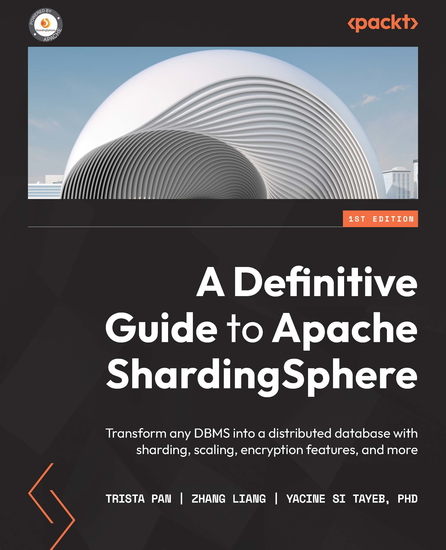
A Definitive Guide to Apache ShardingSphere - Transform any DBMS into a distributed database with sharding scaling encryption features and more - cover

A Definitive Guide to Apache ShardingSphere - Transform any DBMS into a distributed database with sharding scaling encryption features and more

Zhang Liang, Trista Pan, Yacine Si Tayeb

Editorial: Packt Publishing

  • 0
  • 0
  • 0

Sinopsis

Apache ShardingSphere is a new open source ecosystem for distributed data infrastructures based on pluggability and cloud-native principles that helps enhance your database.
This book begins with a quick overview of the main challenges faced by database management systems (DBMSs) in production environments, followed by a brief introduction to the software's kernel concept. After that, using real-world examples of distributed database solutions, elastic scaling, DistSQL, synthetic monitoring, database gateways, and SQL authority and user authentication, you’ll fully understand ShardingSphere's architectural components, how they’re configured and can be plugged into your existing infrastructure, and how to manage your data and applications. You’ll also explore ShardingSphere-JDBC and ShardingSphere-Proxy, the ecosystem’s clients, and how they can work either concurrently or independently to address your needs. You’ll then learn how to customize the plugin platform to define personalized user strategies and manage multiple configurations seamlessly. Finally, the book enables you to get up and running with functional and performance tests for all scenarios.
By the end of this book, you’ll be able to build and deploy a customized version of ShardingSphere, addressing the key pain points encountered in your data management infrastructure.
Disponible desde: 22/07/2022.
Longitud de impresión: 466 páginas.

Otros libros que te pueden interesar

  • Man Child - cover

    Man Child

    Pat Allen

    • 0
    • 0
    • 0
    It all begins with an encounter that irrevocably changed the life of an ordinary girl. She was cute but not statuesque or gorgeous, or even voluptuous. She was just an ordinary girl who was incredibly lucky.
    Ver libro
  • Progressive Planet - Modern Techniques for Recycling and Reclaiming Earth - cover

    Progressive Planet - Modern...

    Alexander Hodzic

    • 0
    • 0
    • 0
    "Progressive Planet: Modern Techniques for Recycling and Reclaiming Earth" is a groundbreaking guide to modern, sustainable living, offering insights into our environmental challenges and empowering readers to shape a sustainable future. Starting with an overview of the planet's state, the book addresses climate change and biodiversity loss, emphasizing the importance of acknowledging and understanding these issues. 
     
    Chapter 2 delves into the complexities of our waste problem, exploring both obvious and hidden culprits like food waste. The book advocates a shift to a circular economy to combat environmental degradation caused by waste overload. Chapter 4 explores advanced recycling techniques, from plastic recycling to industrial composting and e-waste recycling, making readers informed eco-conscious consumers. 
     
    Chapter 6 emphasizes individual responsibility, providing practical tips for small changes that collectively make a big difference. The book extends beyond recycling, introducing concepts like upcycling, repurposing, urban mining, habitat restoration, and support for renewable energy and regenerative agriculture. 
     
    "Progressive Planet" concludes with actionable steps, including reviewing government policies, corporate responsibility, and activism. The book ends on a hopeful note, empowering readers to contribute to a sustainable and resilient Earth. 
     
    With a call to action, "Progressive Planet: Modern Techniques for Recycling and Reclaiming Earth" is not just a book but a guide for responding to the planet's needs with knowledge, consciousness, and care.
    Ver libro
  • The Code of War - Grow as a developer assert your dominance and obliterate your enemies - cover

    The Code of War - Grow as a...

    Marko Zivanovic

    • 0
    • 0
    • 0
    Unleash Your Inner Strategist with 'The Code of War'! 
    Are you stuck in the tech career game? Step into the role of master strategist with 'The Code of War.' Each page is packed with dark humor, real-life stories, and battle-tested tactics that help you dominate your workplace and ascend to the heights of your career. 
    Dive into the cunning world of IT with "The Code of War," your satirical field manual for navigating the treacherous waters of tech companies. Crafted from the sharp wit and seasoned experience of an industry insider, this book peels back the curtain to reveal the maneuvers and machinations that can help you not just survive but thrive in the corporate jungle. 
    What's Inside:Survival Tactics for the Tech Jungle: Navigate the tricky corridors of tech environments with a smile.Outsmart Your Rivals: Learn the art of tech subterfuge to stay one step ahead.Climb the Corporate Ladder: Techniques that put you in the spotlight and ready for promotion. 
    In "The Code of War," you'll be regaled with tales of ambition and subterfuge, all wrapped in a veneer of dark humor and sharp observation. Far from your typical dry professional development tome, this book reads like the secret playbook of the most successful—and notorious—names in tech. 
    Every chapter draws from real-life characters—the masterminds and the manipulators, the schemers, and the dreamers—each with a lesson on what to do (and sometimes, what not to do). Their stories serve as a backdrop to a series of strategies that will arm you with the know-how to navigate the office politics of IT with confidence and flair. 
    Grab your copy now and step into the arena armed with wit, wisdom, and a dash of mischief. Your IT career will never be the same.
    Ver libro
  • Lean Project Management - Streamlining Processes for Efficient Project Delivery - cover

    Lean Project Management -...

    Chuck Sherman

    • 0
    • 0
    • 0
    In the fast-paced and ever-changing landscape of project management, organizations are constantly seeking ways to enhance efficiency and deliver value to customers promptly. "Lean Project Management: Streamlining Processes for Efficient Project Delivery" offers a comprehensive and practical guide to embracing Lean principles and practices to achieve optimal project outcomes. 
    This book begins by introducing the core concepts of Lean Project Management and highlighting its benefits in comparison to traditional project management approaches. Readers will gain a clear understanding of how Lean principles can eliminate waste, enhance collaboration, and drive continuous improvement in project execution. 
    Through a step-by-step exploration of Lean methodologies, readers will learn how to apply Lean principles from project initiation to successful delivery. They will discover how to identify customer needs, engage stakeholders, and prioritize requirements using Lean techniques, leading to well-defined project scopes and realistic goals. 
    In the execution phase, the book delves into Agile practices that align seamlessly with Lean principles. Readers will explore Lean project controls, performance measurement, and risk management strategies to ensure timely and quality project deliveries. The book also addresses the critical aspect of building a Lean project team, emphasizing a culture of empowerment, trust, and continuous learning. 
    Finally, the book addresses the challenge of sustaining Lean Project Management practices. By outlining strategies to overcome obstacles, create a continuous improvement culture, and integrate Lean into organizational processes, readers will be equipped with the tools to ensure long-term success and benefits from Lean implementations. 
     
    Ver libro
  • High Energy Physics - Exploring the Science of High-Energy Particles - cover

    High Energy Physics - Exploring...

    Mark Hedges

    • 0
    • 0
    • 0
    High Energy Physics (HEP), also known as particle physics, is the branch of physics that explores the fundamental building blocks of nature and the forces that govern their interactions. It seeks to answer fundamental questions about the universe, such as the nature of matter, the origins of mass, and the unification of forces. By studying subatomic particles at extremely high energies, physicists gain insights into the fundamental laws of nature, often pushing the boundaries of human knowledge. 
    The origins of high energy physics trace back to the early 20th century with the development of quantum mechanics and special relativity. The discovery of the electron, proton, and neutron laid the foundation for the understanding of atomic structure. However, as experimental techniques improved, scientists found that protons and neutrons were not fundamental particles but were composed of even smaller constituents called quarks. This led to the formulation of the Standard Model of Particle Physics, which describes the known fundamental particles and the forces that act between them. 
    High energy physics relies on particle accelerators, which propel charged particles to nearly the speed of light before colliding them. These high-energy collisions create conditions similar to those present in the early universe, allowing scientists to observe rare and exotic particles. The most famous accelerator, the Large Hadron Collider (LHC) at CERN, has been instrumental in discoveries such as the Higgs boson, a particle responsible for giving mass to elementary particles.
    Ver libro
  • Artificial General Intelligence - (The MIT Press Essential Knowledge series) - cover

    Artificial General Intelligence...

    Julian Togelius

    • 0
    • 0
    • 0
    Artificial intelligence surrounds us. More and more of the systems and services you interact with every day are based on AI technology. Most AI is narrowly specific; that is, it can only do a single thing, in a single context. For example, your spellchecker can't do mathematics, and the world's best chess-playing program can’t play Tetris. Human intelligence is different. We can solve a variety of tasks, including those we have not seen before. In Artificial General Intelligence, Julian Togelius explores technical approaches to developing more general artificial intelligence and asks what general AI would mean for human civilization. 


    Togelius starts by giving examples of narrow AI that have superhuman performance in some way. He then discusses what it would mean to have general intelligence, by looking at definitions from psychology, ethology, and computer science. Next, he explores the two main families of technical approaches to developing more general artificial intelligence: foundation models through self-supervised learning, and open-ended learning in virtual environments. The final chapters of the book investigate potential artificial general intelligence beyond the strictly technical aspects. The questions discussed here investigate whether such general AI would be conscious, whether it would pose a risk to humanity, and how it might alter society.
    Ver libro