Unisciti a noi in un viaggio nel mondo dei libri!
Aggiungi questo libro allo scaffale
Grey
Scrivi un nuovo commento Default profile 50px
Grey
Iscriviti per leggere l'intero libro o leggi le prime pagine gratuitamente!
All characters reduced
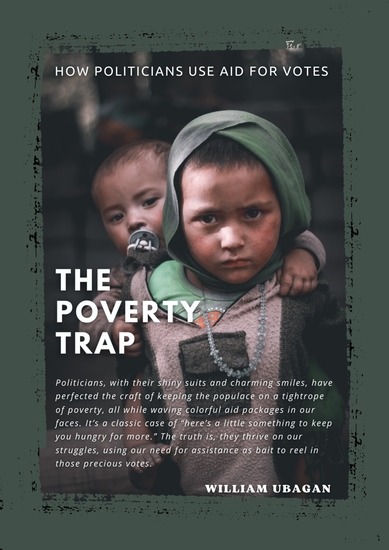
The Poverty Trap - How Politicians Use Aid for Votes - cover

The Poverty Trap - How Politicians Use Aid for Votes

William Ubagan

Casa editrice: ZRK Book Shop

  • 0
  • 0
  • 0

Sinossi

In The Poverty Trap: How Politicians Use Aid for Votes, William Ubagan explores the dark side of political manipulation in aid distribution—unveiling how aid programs, intended to alleviate poverty and foster development, are often distorted to serve the personal and electoral ambitions of politicians. Through in-depth analysis, historical examples, and contemporary case studies, this book delves into the detrimental effects of aid dependency and highlights the need for reforms that prioritize empowerment, transparency, and sustainable growth. Offering a thought-provoking perspective, Ubagan challenges readers to rethink the relationship between aid and power, advocating for a future where aid truly serves its purpose of uplifting communities and fostering lasting change.
Disponibile da: 17/01/2025.
Lunghezza di stampa: 123 pagine.

Altri libri che potrebbero interessarti

  • The Shortest History of Greece - The Odyssey of a Nation from Myth to Modernity - cover

    The Shortest History of Greece -...

    James Heneage

    • 0
    • 0
    • 0
    Philosophy, art, democracy, language, even computers—the glories of Greek civilization have shaped our world even more profoundly than we realize. Pericles and the Parthenon may be familiar, but what of Epaminondas, the Theban general who saved the Greek world from Spartan tyranny? Alexander the Great's fame has rolled down the centuries, but the golden Hellenistic Age that followed is largely forgotten. "Byzantine" conjures decadence and deadly intrigue, yet the thousand-year empire that ruled from Constantinople and saved Europe twice from invasion was, in fact, Greek. 


    Greece's modern chapter, too, tells of triumph and calamity—from liberation and expansion to schism, homegrown dictatorship, Nazi occupation, and civil war. Today's nation is battered by austerity, encroaching climate change, and a refugee crisis—yet unwavering in its ancient values. 


    James Heneage captures the full Grecian drama in this riveting, short history, revealing Greece as the wellspring of Western civilization—and a model that may yet save modern democracy.
    Mostra libro
  • Everyday Freedom - Designing the Framework for a Flourishing Society - cover

    Everyday Freedom - Designing the...

    Philip K. Howard

    • 0
    • 0
    • 0
    Something basic is missing in our culture. Americans know it. Nothing much works as it should. Simple daily choices seem impossible, or fraught with peril. In the workplace, we walk on eggshells. Big projects get stalled in years of review. Endemic social problems such as homelessness become, well, more endemic. 


    Everyday Freedom offers a radical reinterpretation of the corrosion of American culture. The assault on authority after the 1960s, aimed at enhancing freedom, instead created a plague of powerlessness. The teacher in the classroom, the principal in a school, the nurse in the hospital, the official in Washington, the parent on a field trip . . . all have their hands tied. Things don't work, and Americans have lost the freedom to be themselves. 


    Everyday Freedom offers a radical vision for change: Re-empower Americans in their everyday choices. The massive legal structures erected since the 1960s were based on flawed notions that human judgment could be replaced by elaborate dictates. These failed structures must be replaced with simpler frameworks activated by human responsibility and accountability. Nothing will work sensibly until Americans are free to draw on their skills, intuitions, and values when confronting daily challenges. This is the only cure to alienation. This is also the only way to deliver good government.
    Mostra libro
  • The Death of Expertise - The Campaign against Established Knowledge and Why it Matters 2nd Edition - cover

    The Death of Expertise - The...

    Tom Nichols

    • 0
    • 0
    • 0
    Fully updated chapters continue to address how technology and increasing levels of education have exposed people to more information than ever before. These societal gains, however, have also helped fuel a surge in narcissistic and misguided intellectual egalitarianism that has crippled informed debates on any number of issues. Over the past several years, the rise of populism and conspiracy theories have taken this to new levels. All voices, even the most ridiculous, demand to be taken with equal seriousness, and any claim to the contrary is dismissed as undemocratic elitism. 


    Tom Nichols' The Death of Expertise, Second Edition, follows up on how this rejection of experts has occurred: the openness of the internet, the emergence of a customer satisfaction model in higher education, the transformation of the news industry into a 24-hour entertainment machine, and importantly, the election of Donald Trump. Paradoxically, the increasingly democratic dissemination of information, rather than producing an educated public, has instead created an army of ill-informed and angry citizens who denounce intellectual achievement. When ordinary citizens believe that no one knows more than anyone else, democratic institutions themselves are in danger of falling either to populism or to technocracy or, in the worst case, a combination of both.
    Mostra libro
  • The Betrayal - How Mitch McConnell and the Senate Republicans Abandoned America - cover

    The Betrayal - How Mitch...

    Ari Shapiro

    • 0
    • 0
    • 0
    In two previous highly regarded books on the US Senate, Ira Shapiro chronicled the institution from its apogee in the 1970s through its decline in the decades since. Now, Shapiro turns his gaze to how the Senate responded to the challenges posed by the Trump administration and its prospects under President Biden. The Founding Fathers gave the US Senate many functions, but it had one fundamental responsibility—its raison d'etre: to provide the check against a dangerous president who threatened our democracy. Two hundred and thirty years later, when Donald Trump, a potential authoritarian, finally reached the White House, the Senate should have served as both America's first and last lines of defense. Instead, we had the nightmare scenario: today's Senate, reduced through a long period of decline to a hyper-partisan, gridlocked shadow of its former self, was unable to meet its fundamental responsibility. Shapiro documents the pivotal challenges facing the Senate during the Trump administration, arguing that the body's failure to provide leadership represents the most catastrophic failure of government in American history. The last section covers the Senate's performance during President Biden's first year in office and looks forward to the 2022 Senate elections and beyond.
    Mostra libro
  • Party People - Candidates and Party Evolution - cover

    Party People - Candidates and...

    Allan Sikk, Phillip Koker

    • 0
    • 0
    • 0
    Candidates are the literal "face" of political parties, yet they are not wedded to them permanently: candidates can enter or leave politics, switch parties, move along or stay behind when parties split or merge. Even in parties that look stable, candidate change happens below the surface, ultimately altering what the parties stand for. Inspired by evolutionary theories, Party People: Candidates and Party Evolution conceptualizes candidates as "party genes" and develops a candidate-based approach to party evolution. Tracking candidates between elections and parties opens up new perspectives on party development in complex and dynamic settings in Central and Eastern Europe (CEE) and beyond. Based on a new database of 200,000 electoral candidates from over sixty elections across nine CEE democracies, this book presents a groundbreaking study of party evolution using candidate change as an indicator of party change. Allan Sikk and Philipp Köker offer a series of methodological and conceptual advances for the measurement of candidate turnover, party fission and fusion, programmatic change, and party leadership change; the resulting analyses make a significant contribution to the study of CEE party politics as well as to the general scholarship on elections, parties, and political change.
    Mostra libro
  • Authoritarianism and Totalitarianism - Examining the Structure and Influence of Authoritarian Regimes (3 in 1) - cover

    Authoritarianism and...

    Arlo Holders

    • 0
    • 0
    • 0
    This bundle consists of the following books: 
      - Totalitarianism Unmasked: Totalitarianism is a political system in which the state holds total control over every aspect of public and private life, leaving no room for opposition or individual freedoms. Unlike other forms of governance, where political competition and individual rights are somewhat preserved, totalitarianism demands absolute loyalty and conformity. The concept of totalitarianism emerged in the early 20th century, though its roots can be traced back to ancient and medieval periods. In its modern form, it is most closely associated with dictatorial regimes that arose in the aftermath of World War I and throughout the 20th century. 
      - Kleptocracy: Kleptocracy, derived from the Greek words kleptēs (thief) and kratos (rule), refers to a system of governance where leaders exploit their positions of power to enrich themselves at the expense of the public. It is a regime of theft, where corruption is not merely an incidental byproduct of governance but a fundamental aspect of its operation. In kleptocratic systems, the state becomes a tool for personal and collective gain for a small elite, often at the cost of societal well-being and economic development. 
      - Corporatism: Corporatism, as a political and economic system, refers to the integration of corporate and governmental interests, where the lines between the state and private enterprises often blur. It involves the collaboration of various sectors, such as businesses, government, and occasionally labor unions, to form policies and frameworks that benefit the economy and society, but sometimes at the expense of democratic processes. 
    Take advantage of this discounted box set right now!
    Mostra libro