Unisciti a noi in un viaggio nel mondo dei libri!
Aggiungi questo libro allo scaffale
Grey
Scrivi un nuovo commento Default profile 50px
Grey
Iscriviti per leggere l'intero libro o leggi le prime pagine gratuitamente!
All characters reduced
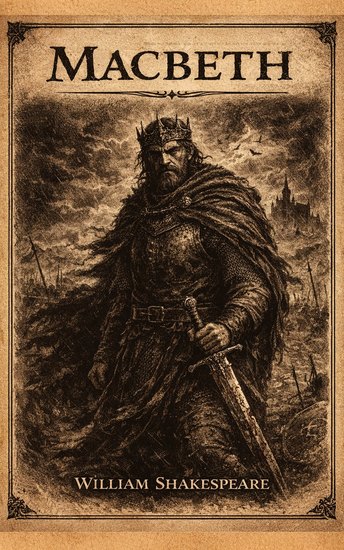
Macbeth - cover

Macbeth

William Shakespeare

Casa editrice: CLXBX

  • 0
  • 0
  • 0

Sinossi

A haunting tale of ambition, power, and moral corruption, Macbeth is one of William Shakespeare's most compelling and enduring tragedies. Set against the shadowed landscapes of medieval Scotland, this dramatic masterpiece explores the devastating consequences of unchecked ambition and the fragile boundaries between fate and free will.

The story follows Macbeth, a brave and respected Scottish general, whose life is forever altered after a prophetic encounter with three mysterious witches. They foretell that he will rise to become King of Scotland. Spurred by this tantalizing prediction—and urged on by the fierce determination of Lady Macbeth—he is consumed by a relentless desire for power. What begins as a spark of possibility quickly ignites into a blaze of ruthless ambition.

Driven by fear and hunger for the crown, Macbeth commits an unthinkable act that sets him on a path of bloodshed and tyranny. As suspicion and paranoia take hold, he descends deeper into violence, ordering further murders to secure his position. Meanwhile, Lady Macbeth, once resolute and unyielding, begins to unravel under the crushing weight of guilt.

In Macbeth, Shakespeare masterfully examines the psychological toll of wrongdoing. Themes of ambition, conscience, guilt, betrayal, and the supernatural intertwine in a tense and atmospheric narrative. The play poses timeless questions: Is destiny predetermined, or shaped by choice? How far will a person go to achieve greatness? And what remains of the soul when morality is sacrificed for power?

Rich with unforgettable imagery, poetic language, and dramatic intensity, Macbeth remains one of the most frequently performed and studied works in world literature. From the eerie chants of the witches to Lady Macbeth's chilling descent into madness, the play continues to captivate audiences with its dark beauty and profound insight into human nature.

A gripping exploration of ambition's destructive force, Macbeth stands as a powerful reminder that the pursuit of power without integrity can lead not to triumph—but to ruin.
Disponibile da: 20/02/2026.
Lunghezza di stampa: 67 pagine.
Altri libri che potrebbero interessarti

  • The Lost Continent - A thrilling post-apocalyptic Science Fiction adventure through the savage ruins of an unrecognizable beast-ridden Europe Cross the forbidden meridian and survive the forgotten empire - cover

    The Lost Continent - A thrilling...

    Edgar Rice Burroughs

    • 0
    • 0
    • 0
    Two centuries after the Great War, Europe has been wiped from the map—and crossing the deadline means certain death. 
    It is the year 2137. The Pan-American Federation has enjoyed two hundred years of absolute peace, isolated from the Eastern Hemisphere by the draconian edicts of longitude 30. No ship has crossed the meridian and returned. No man knows what lies beyond. But when a catastrophic malfunction strands Lieutenant Jefferson Turck and his aero-submarine over the forbidden waters of the Atlantic, he is left with a dire choice: face execution for treason at home, or chart a course eastward into the terrifying unknown. 
    Landing on the shores of ancient England, Turck discovers not the glorious civilization of history books, but a savage, overgrown wilderness teeming with fierce predators and primitive, brutal human tribes. Stripped of his high-tech advantages, the modern naval officer must rely on his raw survival instincts. With the help of Victory, a fiercely independent tribal queen, Turck must navigate the crumbling ruins of London, battle apex predators reigning from the thrones of kings, and escape the barbaric warlords who wish them both dead. 
    Why you will love this audiobook: Fans of classic Science Fiction will be mesmerized by this thrilling blend of post-apocalyptic survival, dystopian world-building, and high-octane pulp adventure. Combining futuristic exploration, military sci-fi undertones, and lost world tropes, this action-packed odyssey delivers an unforgettable vision of a fallen empire reclaimed by nature. 
    Edgar Rice Burroughs (1875–1950) was a legendary pioneer of 20th-century speculative fiction. Best known for creating Tarzan and John Carter of Mars, his fast-paced narratives laid the foundation for modern science fiction.
    Mostra libro
  • The Pilgrim's Progress from this world to that which is to come - One Man’s Journey from Earthly Struggle to Eternal Glory - cover

    The Pilgrim's Progress from this...

    John Bunyan

    • 0
    • 0
    • 0
    "The Pilgrim's Progress from This World to That Which Is to Come," written by John Bunyan in the late 17th century, is an allegorical novel that follows the journey of a character named Christian, who represents all of humanity. Christian embarks on a spiritual quest from the "City of Destruction" to the "Celestial City," seeking salvation and enlightenment through various trials and challenges. 
    At the beginning of the story, Christian is depicted as bearing a heavy burden and grappling with existential despair. After reading a troubling book that reveals his doomed state, he becomes increasingly distressed, ultimately crying out for salvation. His path soon intersects with the character Evangelist, who directs him to the wicket gate as a way to escape his dire fate. 
    Throughout his journey, Christian faces the temptation to succumb to worldly advice and the folly of straying from his divine purpose. This underscores themes of faith, redemption, and the challenges encountered on the path to spiritual truth.
    Mostra libro
  • One Summer Night - From their pens to your ears genius in every story - cover

    One Summer Night - From their...

    Ambrose Bierce

    • 0
    • 0
    • 0
    Ambrose Gwinnett Bierce was born on 24th June 1842 at Horse Cave Creek in Meigs County, Ohio. His parents were poor but they introduced him to literature at an early age, instilling in him a deep appreciation of books, the written word and the elegance of language.  
    Growing up in Koscuisko County, Indiana poverty and religion were defining features of his childhood, and he would later describe his parents as “unwashed savages” and fanatically religious, showing him little affection but always quick to punish. He came to resent religion, and his introduction to literature appears to be their only positive effect. 
    At age 15 Bierce left home to become a printer’s devil, mixing ink and fetching type at The Northern Indian, a small Ohio paper. Falsely accused of theft he returned to his farm and spent time sending out work in the hopes of being published. 
    His Uncle Lucius advised he be sent to the Kentucky Military Institute. A year later he was commissioned as an Officer.  As the Civil War started Bierce enlisted in the 9th Indiana Infantry Regiment.  
    In April 1862 Bierce fought at the Battle of Shiloh, an experience which, though terrifying, became the source of several short stories. Two years later he sustained a serious head wound and was off duty for several months. He was discharged in early 1865.  
    A later expedition to inspect military outposts across the Great Plains took him all the way to San Francisco. He remained there to become involved with publishing and editing and to marry, Mary Ellen on Christmas Day 1871.  They had a child, Day, the following year.  
    In 1872 the family moved to England for 3 years where he wrote for Fun magazine. His son, Leigh, was born, and first book, ‘The Fiend’s Delight’, was published.  
    They returned to San Francisco and to work for a number of papers where he gained admiration for his crime reporting. In 1887 he began a column at the William Randolph Hearst’s San Francisco Examiner.  
    Bierce’s marriage fell apart when he discovered compromising letters to his wife from a secret admirer. The following year, 1889 his son Day committed suicide, depressed by romantic rejection. 
    In 1891 Bierce wrote and published the collection of 26 short stories which included ‘An Occurrence at Owl Creek Bridge’.  Success and further works including poetry followed.  
    Bierce with Hearst’s resources helped uncover a financial plot by a railroad to turn 130 million dollars of loans into a handout. Confronted by the railroad and asked to name his price Bierce answered “my price is $130 million dollars. If, when you are ready to pay, I happen to be out of town, you may hand it over to my friend, the Treasurer of the United States”.  
    He now began his first foray as a fabulist, publishing ‘Fantastic Fables’ in 1899.  But tragedy again struck two years later when his second son Leigh died of pneumonia relating to his alcoholism.  
    He continued to write short stories and poetry and also published ‘The Devil’s Dictionary’.  
    At the age of 71, in 1913 Bierce departed from Washington, D.C., for a tour of the battlefields where he had fought during the civil war. At the city of Chihuahua he wrote his last known communication, a letter to a friend. It’s closing words were “as to me, I leave here tomorrow for an unknown destination,” Ambrose Bierce then vanished without trace.
    Mostra libro
  • A Garland of Earth - From their pens to your ears genius in every story - cover

    A Garland of Earth - From their...

    Dorothy Edwards

    • 0
    • 0
    • 0
    Amelia Ann Blanford Edwards was born on 7th June 1831 in Islington, London.  She was educated at home by her mother and showed early promise as a writer, publishing her first poem at the age of 7 and her first story at 12.  Thereafter several popular periodicals published her poetry, stories and articles. 
    In addition she also illustrated some of her own writings and painted scenes from books she had read.  This talent was not supported by her parents, who saw an artist’s life as scandalous.  Undeterred Amelia took up composing and performing music until a bout of typhus caused throat damage.  Other interests soon followed until, early in the 1850s, Amelia focused exclusively on writing.  Her early novels were well received, and with ‘Barbara's History’ in 1864, a work revolving around bigamy, her reputation was established.  
    Amelia’s pen was also the purveyor of ghost stories for magazines and are still anthologized as classic tales to this day. 
    In January 1851, Amelia became engaged, apparently to please her parents, but she quickly broke it off.  In reality her emotional attachments were almost exclusively with women.  From the early 1860s she lived with Ellen Drew Braysher, a widow 27 years her senior, until both women died in early 1892.  During this relationship other women also entered and left her life.  Her frequent travelling companion, Lucy Renshaw, accompanied her to Egypt in the winter of 1873 and there she found a life-changing interest in Egyptology.  Aware of increasing threats from tourism and modern development she became an advocate for their research and preservation.  
    To advance the work Amelia largely abandoned much of her writing in favour of Egyptology and even took on strenuous lecture tours to raise funds. 
    After catching influenza, Amelia Edwards, ‘the Godmother of Egyptology’ died on 15th April 1892 at Weston-super-Mare.  She was 60.
    Mostra libro
  • Aunt Agatha Takes the Count - cover

    Aunt Agatha Takes the Count

    P. G. Wodehouse

    • 0
    • 0
    • 0
    "Everything was under control… which, in retrospect, should have rung alarm bells."
    In Aunt Agatha Takes the Count, Bertie Wooster has, for once, acted with rare foresight: fled the country, secured an excellent hotel, and placed a reassuring stretch of sea between himself and his formidable Aunt Agatha. What could possibly go wrong?
    As it happens—quite a lot.
    A chance acquaintance, a dangerously winning smile, and a gesture of pure Wooster generosity… and suddenly Bertie finds himself edging into one of those situations that are not merely awkward, but the sort of thing that simply doesn't bear thinking about.
    Fortunately, Jeeves is at hand.
    Calm, imperturbable, and gifted with that quiet brilliance which has so often preserved the Wooster fortunes, he observes, deduces, and—when required—intervenes with quiet precision.
    A bright, fast-moving Wodehouse jewel: elegant, absurd, and impeccably timed. Ideal for listeners who enjoy their humor dry, their chaos refined, and their rescues flawlessly executed.
    Because in Bertie Wooster's world, disaster is never far away… but neither, thank heaven, is Jeeves.
    Mostra libro
  • 3 Stories with Murder as an Act of Love - A trio of classic tales perfect for a commute walk or quiet night in - cover

    3 Stories with Murder as an Act...

    William Faulkner, Ellen Glasgow,...

    • 0
    • 0
    • 0
    There is something about the number 3.    
    The Ancient Greeks believed 3 was the perfect number, and in China 3 has always been a lucky number, and they know a thing or two.   
    Most religions also have 3 this and 3 that and, of course, in these more modern times, three’s a crowd may be too many, except when it’s a ménage à trois.  It seems good things usually come in threes. 
    Whatever history and culture says WE think 3, a hat-trick of stories, is a great number to explore themes and literary avenues that classic authors were so adept at creating.
    Mostra libro