Join us on a literary world trip!
Add this book to bookshelf
Grey
Write a new comment Default profile 50px
Grey
Subscribe to read the full book or read the first pages for free!
All characters reduced
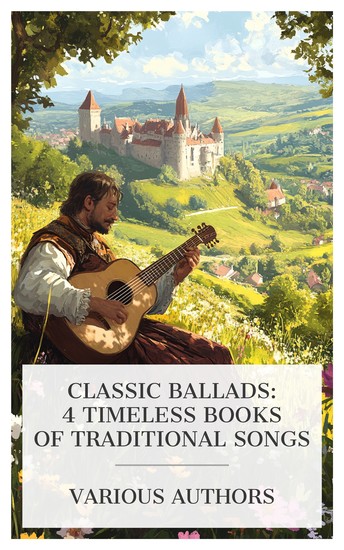
Classic Ballads: 4 Timeless Books of Traditional Songs - Old Ballads Ballad Book Ballads of Scottish Tradition and Romance English Songs and Ballads etc - cover

Classic Ballads: 4 Timeless Books of Traditional Songs - Old Ballads Ballad Book Ballads of Scottish Tradition and Romance English Songs and Ballads etc

William Shakespeare, Lord Byron, Samuel Taylor Coleridge, William Makepeace Thackeray, Oliver Goldsmith, James Hogg, Robert Burns, John Keats, Percy Bysshe Shelley, Robert Browning, John Fletcher, William Wordsworth, Walter Scott, Thomas More, William Blake, William Cowper, Lord Tennyson

Publisher: e-artnow

  • 0
  • 0
  • 0

Summary

Classic Ballads: 4 Timeless Books of Traditional Songs is a remarkable confluence of poetic ingenuity, capturing the essence of traditional ballads as they traverse themes of love, loss, and folklore. This anthology brings together a diverse range of styles from romantic lyricism to the vivid storytelling characteristic of the ballad form. The timeless nature of the ballads is reflected in their ability to engage contemporary readers with themes that resonate universally. This collection highlights significant pieces that illustrate the raw beauty and emotional depth of balladry while remaining unanchored to any single author, thus showcasing the collective brilliance and vivid imagination of these literary giants. Featuring contributions from literary luminaries such as Shakespeare, Shelley, and Keats, among others, this anthology offers a treasure trove of narrative voices that capture the rich tapestry of the Romantic and Victorian eras. The involved authors bring a depth of experience and a variety of perspectives that contribute to a resonant exploration of traditional balladic themes. Through their renditions, the collection aligns itself with the broader historical and cultural movements of its time, enabling readers to appreciate the intersection of personal expression with societal narratives. Offering readers an enriching dive into a multiplicity of perspectives, Classic Ballads serves as both a scholarly resource and a timeless journey into the heart of traditional song. This anthology is a unique opportunity for enthusiasts to engage with the shared heritage of balladry. Its diverse array of contributions fosters a dynamic dialogue between eras, and its educational value lies in the breadth of insights it provides, offering a deeper understanding of how these timeless songs continue to echo throughout the ages.
Available since: 03/04/2025.
Print length: 2000 pages.

Other books that might interest you

  • Works of Edgar Allan Poe The - Volume 6 - Tales - Horror and Death - cover

    Works of Edgar Allan Poe The -...

    Edgar Allan Poe

    • 0
    • 0
    • 0
    this volume of the 10 volume series is subtitled "Tales of Horror and Death" 
    - includes some of Poe's most famous works including "The Pit and the Pendulum", "The Cask of Amontillado", "The Fall of the House of Usher" and 10 others 
    Acclaimed American writer, Edgar Allan Poe (1809 to 1849) was known particularly for his mysteries and tales of the macabre. He was one of the country's earliest practitioners of the short story, and is considered the inventor of the detective fiction genre. 
    Poe's father abandoned the family when he was just 1 year old and his mother died the following year. He was taken in by John and Frances Allan and lived with them into young adulthood. Poe attended the University of Virginia but had to leave due to lack of money. He quarreled with John Allan over the lack of funds for his education. In 1827, Poe enlisted in the United States Army under an assumed name and also published his first collection. Poe failed as an officer cadet at West Point, decided to be a full-time writer, and thus the relationship with the Allans was severed.
    Show book
  • The Keelie Hawk - Poems in Scots - cover

    The Keelie Hawk - Poems in Scots

    Kathleen Jamie

    • 0
    • 0
    • 0
    Read by the author, Kathleen Jamie.The Keelie Hawk is a landmark collection from Kathleen Jamie, the current Makar (National Poet) of Scotland. For the first time, Kathleen Jamie has brought her astonishing lyric talent to the language of her homeland, with outstanding results. The Keelie Hawk is a deeply resonant collection written in Scots, with each poem accompanied by a translation into English. Its publication is a significant event in Scottish literature, not only a reclaiming by one of our finest poets of the mouth-music of literary Scots, but a furthering of that language: ‘by making poems, a language develops’, Jamie observes in a fascinating afterword.
    Show book
  • Meister Eckhart's Book of Darkness & Light - Meditations on the Path of the Wayless Way - cover

    Meister Eckhart's Book of...

    Meister Eckhart, Jon M Sweeney,...

    • 0
    • 0
    • 0
    “Within each of us is a divine treasure, and if we hope to discover it we need to go deep into the heart of who we are.”—Meister Eckhart Meister Eckhart has been a huge influence on spirituality for more than 800  years, including to philosopher Arthur Schopenhauer, Eckhart Tolle, Richard Rohr, D. T. Suzuki, Rudolf Steiner, and Matthew Fox—all crediting Eckhart as being an important influence on their thought.   This book of Meister Eckhart meditations is for people seeking the “wayless way.” It is not for those looking for a simple path. Many people in our time still go looking for a straight path toward a defined goal, without detours, led by a guide who tells them what to do and what not to do. They would be uncomfortable with Meister Eckhart—a Christian mystic from the century of Rumi and Francis of Assisi—who said to “take leave of God for the sake of God.” And, “Learn not to love in order that you may learn to love.” And, “All things are equal and alike in God and are God.”   These fresh, stunning renderings of his writings in poetic form bring life to one of the great spiritual voices of any age. They reveal what it means to love God and find meaning in darkness. In a culture that craved light—and what culture does not?—Eckhart dared to imagine that the darkness is what matters most. Not darkness in general, but your darkness, because it is the one thing you know something about, and without facing your darkness, you’ll never know what it means to desire the light. You’ll never even imagine what light is about. Only when you are in the darkness, Meister says, do you have even the possibility of seeing the light.
    Show book
  • A Rhyme A Dozen ― Spring - 12 Poets 12 Poems 1 Topic - cover

    A Rhyme A Dozen ― Spring - 12...

    Claude McKay, William Morris,...

    • 0
    • 0
    • 0
    ‘A dime a dozen’ as known in America, is perhaps equal to the English ‘cheap as chips’ but whatever the lingua franca of your choice in this series we hereby submit ‘A Rhyme a Dozen’ as 12 poems on many given subjects that are a well-rounded gathering, maybe even an essential guide, from the knowing pens of classic poets and their beautifully spoken verse to the comfort of your ears. 
    1 - A Rhyme A Dozen - 12 Poems, 12 Poets, 1 Topic - Spring - An Introduction 
    2 - Ode on the Spring by Thomas Gray 
    3 - Sonnet VIII - To Spring by Charlotte Smith 
    4 - Spring by Gerard Manley Hopkins 
    5 - I Have a Bird in Spring by Emily Dickinson 
    6 - Spring by Alfred Lord Tennyson 
    7 - Prairie Spring by Willa Cather 
    8 - In Springtime by Rudyard Kipling 
    9 - Spring in New Hampshire by Claude McKay 
    10 - Spring's Bedfellow by William Morris 
    11 - Spring Showers by James Thomson 
    12 - Spring Rain by Sara Teasdale 
    13 - These, I, Singing in Spring by Walt Whitman
    Show book
  • Marquis de Sade's Midsummer Night's Dream Conceivable - cover

    Marquis de Sade's Midsummer...

    Ophelia T'Wat, Robert Dwight...

    • 0
    • 0
    • 0
    Full-Cast Audiobook! 
    Go Beyond Your Wettest Dreams... as If You Are Penniless and Yet Listening From Outside the Globe Theater! 
    In the last decade of the 16th century, William Shakespeare could not dare write A Midsummer Night's (Wet) Dream unabridged. By the happenchance of his birth-century, The Bard wrote in a poetic 'Shakespearean Code', hinting at sexualities and paraphilias he fully intended to compose and expose his Elizabethan audience to. His intended 'erotica for every fetish' morphed instead into a 'humane and wise drama' by happenchance.  
    But What If? there was a multiversal reality where the Marquis de Sade deciphered the Shakespearean Code during his long stay at the lunatic asylum at Charenton. But now Ophelia T'Wat, living in a much more sexually accepting century, can reach across realities to snatch these pages from the bloody quill of the Marquis and finally, fatefully publish the Wettest Midsummer Night'sDream conceivable! 
    Show book
  • A Midsummer Night's Dream - cover

    A Midsummer Night's Dream

    William Shakespeare

    • 0
    • 0
    • 0
    A Midsummer Night's Dream is a comedy written by William Shakespeare.    It portrays the events surrounding the marriage of Theseus, the Duke of Athens, to Hippolyta, the former queen of the Amazons. These include the adventures of four young Athenian lovers and a group of six amateur actors (the mechanicals) who are controlled and manipulated by the fairies who inhabit the forest in which most of the play is set. The play is one of Shakespeare's most popular works for the stage and is widely performed across the world.    The play consists of four interconnecting plots, connected by a celebration of the wedding of Duke Theseus of Athens and the Amazon queen, Hippolyta, which is set simultaneously in the woodland and in the realm of Fairyland, under the light of the moon.    The play opens with Hermia, who is in love with Lysander, resistant to her father Egeus' demand that she wed Demetrius, whom he has arranged for her to marry. Helena meanwhile pines unrequitedly for Demetrius. Enraged, Egeus invokes an ancient Athenian law before Duke Theseus, whereby a daughter must marry the suitor chosen by her father, or else face death. Theseus offers her another choice: lifelong chastity while worshipping the goddess Artemis as a nun.    Peter Quince and his fellow players Nick Bottom, Francis Flute, Robin Starveling, Tom Snout, and Snug plan to put on a play for the wedding of the Duke and the Queen, "the most lamentable comedy and most cruel death of Pyramus and Thisbe". Quince reads the names of characters and bestows them to the players. Nick Bottom, who is playing the main role of Pyramus, is over-enthusiastic and wants to dominate others by suggesting himself for the characters of Thisbe, the Lion, and Pyramus at the same time. He would also rather be a tyrant and recites some lines of Ercles. Bottom is told by Quince that he would do the Lion so terribly as to frighten the duchess and ladies enough for the Duke and Lords to have the players hanged. Quince ends the meeting with "at the Duke's oak we meet."
    Show book