Unisciti a noi in un viaggio nel mondo dei libri!
Aggiungi questo libro allo scaffale
Grey
Scrivi un nuovo commento Default profile 50px
Grey
Iscriviti per leggere l'intero libro o leggi le prime pagine gratuitamente!
All characters reduced
The Old Humanities and the New Science - cover

The Old Humanities and the New Science

William Osler

Casa editrice: DigiCat

  • 0
  • 0
  • 0

Sinossi

In "The Old Humanities and the New Science," William Osler masterfully interweaves the worlds of the classical humanities with the burgeoning field of modern science. Through a series of eloquent essays, Osler engages with the philosophical underpinnings of medicine, emphasizing a holistic approach that values both the scientific method and the humanistic tradition. His literary style is characterized by rich narratives and insightful reflections, situated in a context where the turn of the 20th century witnessed an evolving understanding of medical practice, embodying a synthesis of knowledge that transcends mere empirical observation. William Osler, a revered physician and founding professor of medicine at Johns Hopkins University, was instrumental in shaping contemporary medical education. His extensive background in both the humanities and the sciences endowed him with a unique perspective that informs this work. Osler's commitment to a broadened understanding of medicine was motivated by his belief in the importance of empathy and ethical responsibility, bridging the gap between the art of medicine and scientific inquiry. Readers seeking an enriching exploration of the interconnectedness of humanities and science will find Osler's essays both thought-provoking and inspiring. This book not only serves as a compelling invitation to reflect on the human aspects of medicine but also stands as a testament to the enduring relevance of integrating diverse fields of knowledge in an increasingly specialized world.
Disponibile da: 21/11/2022.
Lunghezza di stampa: 33 pagine.
Altri libri che potrebbero interessarti

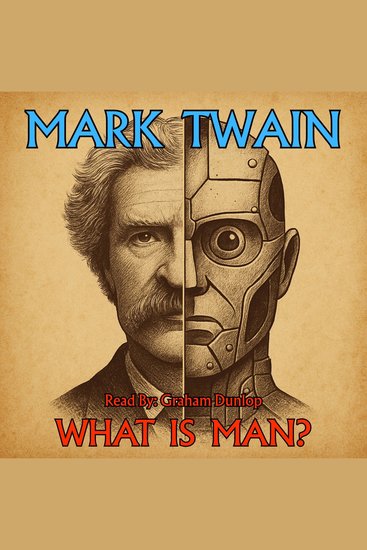
  • What is Man? - cover

    What is Man?

    Mark Twain

    • 0
    • 0
    • 0
    In this thought-provoking dialogue, Mark Twain strips away illusions about free will, morality, and the nature of human behavior. Presented as a sharp exchange between a young idealist and a seasoned philosopher, What Is Man? challenges cherished beliefs, probing whether humans are truly autonomous or simply products of their training, environment, and inherent machinery. 
    Witty, uncompromising, and intellectually bracing, Twain’s work pushes listeners to question their assumptions about themselves and others. This unflinching philosophical conversation reveals a side of Twain rarely seen—one that’s as incisive as it is unsettling. 
    Perfect for fans of classic literature, moral philosophy, and fearless inquiry, this audiobook offers a timeless exploration of what it really means to be human.
    Mostra libro
  • Dark Psychology and Manipulation (2 Books in 1) - Learn Dark Psychology Secrets Persuasion Techniques NLP Body Language and Outsmart Everybody Else - cover

    Dark Psychology and Manipulation...

    Leo Sanders

    • 0
    • 0
    • 0
    2 Books Box SetThis book includes: 
    - How to Analyze People with Dark Psychology 
    - Secret Manipulation TechniquesDo you want to learn to defend yourself against Mental Manipulation? 
    Do you want to learn body language basics, detect manipulative and toxic people? 
    Do you often feel people take advantage of you or control you in order to "help you"? 
    What do they think? How do they feel? Are they lying? 
    Have you always wanted to learn about dark psychology, but you never knew where to begin? 
    Dark psychology is the art and science of manipulation and mind control, and through its studies, you will learn to control how other people think as well as how to control their actions and interactions. It may seem like a difficult feat at first, but you will achieve all of that, and much more! 
    Reading this book you’ll learn the most powerful principles in the world of Dark Psychology. Not sure if you'll be able to use them in practice? Don’t worry! Each chapter explains an aspect of Dark Psychology in a way that is easily accessible and readily understandable for all. 
    Here’s just a little of what you’ll discover inside: 
    - Dark Side of the Idea of Human Consciousness 
    - Techniques to Read People 
    - The Psychology of Dreams 
    - Psychology of the Insane 
    - The Benefits of Meeting Our Dark Side 
    - Secret Manipulation Techniques 
    - Neuro-Linguistic Programming 
    - Reverse Psychology 
    - Emotional Intelligence 
    - Body Language 
    - The Psychology of Death 
    - Exploring Yourself with Psychology 
    - Techniques to Control and Influence Minds 
    - Control Your Mind Thoughts 
    - Master Your Emotions 
    - Simple Methods to Avoid Brainwashing 
    - How to Become an Effective Communicator 
    - Dark Psychological Tricks 
    - Gain Control of Your MindAre you ready to delve into the secrets of our minds?
    Mostra libro
  • The Tank War - The British Band of Brothers - One Tank Regiment's World War II - cover

    The Tank War - The British Band...

    Mark Urban

    • 0
    • 0
    • 0
    From Dunkirk to North Africa, from D-Day to Hamburg, the 5th Royal Tank Regiment were in the frontline. Few regiments had longer wars or saw more action than the 'Filthy Fifth'.In this remarkable narrative history, acclaimed author Mark Urban tells the story of World War II through the eyes of this brave regiment. In many ways, the fighting Fifth's journey reflects Britain - early losses turned to eventual victory through ingenuity, daring and exceptional bravery. Fighting against overwhelming odds, they beat back the infamous German Panzer Divisions and paved the way for an Allied resurgence. Drawing on interviews, archives and new sources, The Tank War is a moving personal story which brings a fresh perspective on the crucial role of tanks in the Allied victory.From the author of Task Force Black, Big Boys' Rules and Rifles.
    Mostra libro
  • Ram Dass - On The Bhagavad Gita - cover

    Ram Dass - On The Bhagavad Gita

    Sripad Jaganantha Das

    • 0
    • 0
    • 0
    “We're all just walking each other home.” 
     
    “The quieter you become, the more you can hear.” 
     
    “We're fascinated by the words--but where we meet is in the silence behind them.” 
     
    “It is important to expect nothing, to take every experience, including the negative ones, as merely steps on the path, and to proceed.” 
    ― Ram Dass 
     
    Dr. Richard Alpert, a former Harvard professor and Timothy Leary cohort, was an icon of the hippie, LSD-fueled revolution of the 1960s. Thereafter, on a trip to India - like Clark Kent changing into Superman - he became the much-beloved spiritual teacher Baba Ram Das. His 1970s' iconic book Be Here Now turned on a generation to the deep, non-sectarian spirituality within us all. 
     
    Author Sripad Jagannatha Dasa became friends with Ram Das in the early '70s and traveled across America, playing Indian drums at his speaking engagements. During that time, the two discussed the publication of some of his lectures, but nothing was ever done, and the two lost touch. Now, finally, after all these years, Jagannatha Dasa keeps his promise to his old friend, publishing this original audio history of one of our most inspired and cherished spiritual teachers.
    Mostra libro
  • The Making and the Re-Making of a Codependent Mind - A Journey Into and Out of Codependency - cover

    The Making and the Re-Making of...

    Brian Birdbell, Stephanie Birdbell

    • 0
    • 0
    • 0
    Are you stuck in toxic relationship patterns? Do you seem to attract narcissists or other disordered people? Are you ready to learn how to love yourself and others? 
    Based on the acclaimed podcast of the same name, follow Brian's transformative journey from codependency and despair to joyful, fulfilling and sustaining relationships. Gain guidance into examining your own life and crafting a personalized pathway to heal from codependency and trauma. 
    In Part 1 Brian explores:The family dynamics in childhood that set the stage for codependent habits.The long term effects of trauma, including its complex and chronic manifestations.Threat responses (particularly freeze and fawn) and the connection to the behaviors that make up codependency.The role of shame and fear in deepening codependent habits.How codependent behaviors foster isolation and perpetuate dysfunctional relationship dynamics.The toxic interplay between narcissism and codependency, and the trauma bonds that arise in relationships with abusive narcissists. 
    In Part 2 Brian explains:What is on the other side of codependency? Is it worth it?Healing from emotional wounds by connecting with other people, repairing emotional systems and re-writing stories.Breaking the codependent habits that prevent emotionally intimate relationships.Acquiring a new approach to romantic relationships.
    Mostra libro
  • Spanish Empire in the Americas The: The History of Spain’s Colonization across Central America and South America - cover

    Spanish Empire in the Americas...

    Editors Charles River

    • 0
    • 0
    • 0
    By the time Christopher Columbus started setting east from the New World, he had explored San Salvador in the Bahamas (which he thought was Japan), Cuba (which he thought was China), and Hispaniola, the source of gold. As the common story goes, Columbus, en route back to Spain from his first journey, called in at Lisbon as a courtesy to brief the Portuguese King John II of his discovery of the New World. King John subsequently protested that according to the 1479 Treaty of Alcáçovas, which divided the Atlantic Ocean between Spanish and Portuguese spheres of influence, the newly discovered lands rightly belonged to Portugal. To make clear the point, a Portuguese fleet was authorized and dispatched west from the Tagus to lay claim to the “Indies,” which prompted a flurry of diplomatic activity in the court of Ferdinand and Isabella. At the time, Spain lacked the naval power to prevent Portugal from acting on this threat, and the result was the hugely influential 1494 Treaty of Tordesillas. 
    The Treaty of Tordesillas was one of the most important documents of its kind of the age, for it established the essential parameters of the two competing empires, the first of the major European imperial entities. The Treaty of Tordesillas drew an imaginary line from pole to pole, running 100 leagues west of the westernmost islands of the Azores. According to the terms of a supporting papal bull, all the lands to the west of that belonged to Spain, and all of those to the east belonged to Portugal. What this meant in practical terms was that Portugal was given Africa and the Indian Ocean while Spain was granted all the lands to the west, including the Americas and the Caribbean, all collectively known as the “Indies,” or the New World. 
    Perhaps inevitably, a regional rivalry had developed as the Portuguese began to establish a colony in Brazil and push its boundaries southwards. 
    Mostra libro