Join us on a literary world trip!
Add this book to bookshelf
Grey
Write a new comment Default profile 50px
Grey
Subscribe to read the full book or read the first pages for free!
All characters reduced
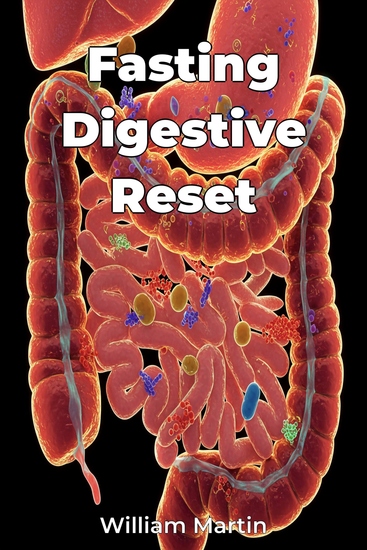
Fasting Digestive Reset - cover

Fasting Digestive Reset

William Martin

Translator A AI

Publisher: Publifye

  • 0
  • 0
  • 0

Summary

Fasting Digestive Reset explores the powerful connection between intermittent fasting and digestive health, offering a science-backed approach to optimizing your gut. The book delves into how strategic fasting can influence the gut microbiome, impacting everything from immunity to nutrient absorption. Discover how our bodies, through evolution, have adapted to cycles of feast and famine, making intermittent fasting a potentially beneficial tool for restoring digestive function.

 
The book highlights the clinical benefits of intermittent fasting for conditions like IBS and IBD, explaining how specific fasting durations can improve microbial balance and reduce inflammation. For instance, clinical trials reveal that intermittent fasting can improve intestinal permeability.

 
The book progresses by first introducing the principles of intermittent fasting and the role of the gut microbiome, then examines the clinical evidence, and finally culminates in a practical guide for implementing intermittent fasting. By synthesizing research findings, Fasting Digestive Reset provides personalized recommendations and dietary guidelines, empowering readers to address the root causes of digestive issues. It adopts an accessible tone, making complex scientific concepts easy to understand.
Available since: 02/20/2025.
Print length: 115 pages.

Other books that might interest you

  • Agrostology - Grasses of the World: From Lawns to Prairie Ecosystems - cover

    Agrostology - Grasses of the...

    Mike Crawford

    • 0
    • 0
    • 0
    Agrostology, the scientific study of grasses, is a crucial field of botany that explores the diversity, structure, and ecological significance of grasses. Grasses belong to the Poaceae family, one of the largest and most economically important plant families in the world. These plants play a foundational role in ecosystems, agriculture, and human civilization. From the vast prairies and savannas to the rice and wheat fields that sustain billions of people, grasses shape the landscapes of both natural and human-altered environments. 
    The study of grasses has a long history, dating back to early agricultural societies that first domesticated cereal crops. The ancient civilizations of Mesopotamia, Egypt, and China relied on grasses such as wheat, barley, and rice to establish permanent settlements. Over time, the understanding of grass physiology, reproduction, and ecological functions deepened, leading to advancements in agronomy, ecology, and land management. By the 19th and 20th centuries, agrostology emerged as a specialized discipline within botany, focusing on grass classification, physiology, and ecosystem dynamics. 
    Grasses are uniquely adapted to a wide range of environmental conditions. They thrive in temperate, tropical, and even arid climates, displaying remarkable resilience through specialized growth mechanisms. Their ability to reproduce through both seeds and vegetative propagation allows them to colonize and dominate various habitats. Many grass species employ C4 photosynthesis, an efficient metabolic pathway that enables them to survive in hot, dry environments. This adaptability makes grasses a dominant plant group in many ecosystems, providing habitat and food for numerous animal species.
    Show book
  • The Dead Beat - cover

    The Dead Beat

    Anonymous

    • 0
    • 0
    • 0
    Marilyn Johnson was enthralled by the remarkable lives that were marching out of this world—so she sought out the best obits in the English language and the people who spent their lives writing about the dead. She surveyed the darkest corners of Internet chat rooms, and made a pilgrimage to London to savor the most caustic and literate obits of all. Now she leads us on a compelling journey into the cult and culture behind the obituary page and the unusual lives we don't quite appreciate until they're gone.
    Show book
  • In Water Not Blood - cover

    In Water Not Blood

    Karin Jervert

    • 0
    • 0
    • 0
    Written during the profound global upheaval between 2019 and 2023, In Water Not Blood braids ancient traditions of nature-based spirituality, dreaming, song and prayer with the realities and anxieties of modern life. These poems are as much soft and spiritual as they are rage-filled and disillusioned.  A powerful account of the author's journey to reclaim her connection to her ancestors and to the Earth. In Water Not Blood is a celebration of the healing power of nature and art and is an urgent cry for collective transformation.
    Show book
  • Quantum Mechanics for Beginners - A Beginner's Exploration into the Fundamental Principles of Quantum Mechanics - cover

    Quantum Mechanics for Beginners...

    SAM CAMPBELL

    • 0
    • 0
    • 0
    Dive into the mesmerizing world of quantum mechanics with "Quantum Mechanics". This accessible and comprehensive book takes you on a captivating journey through the fundamental principles that govern the behavior of particles at the tiniest scales. 
    In the opening chapters, discover the revolutionary origins of quantum mechanics, encountering concepts like wave-particle duality and the double-slit experiment that challenge our conventional understanding of reality. Explore the fascinating phenomenon of quantum superposition, where particles can exist in multiple states simultaneously, setting the stage for the mind-bending nature of the quantum world. 
    Delve into the intricacies of quantum states, wavefunctions, and the uncertainty principle, gaining insight into the mathematical tools that physicists employ to describe the quantum realm. Unravel the mysteries of quantum entanglement, a phenomenon that links particles across space in ways that defy classical intuition, and explore the implications of Bell's theorem and quantum teleportation. 
    Schrödinger's cat takes center stage as we examine the paradoxical nature of quantum measurement, discussing the collapse of the wavefunction and the concept of quantum decoherence. Throughout the book, various interpretations of quantum mechanics are explored, from the Many-Worlds Interpretation to the Copenhagen Interpretation and beyond. 
    "Quantum Mechanics" is more than a guide; it's an invitation to embrace the wonder and mystery of the quantum realm. Whether you're a curious beginner or someone seeking a deeper understanding, this book provides a solid foundation for navigating the intricacies of quantum mechanics. Prepare to be intrigued, challenged, and inspired as you embark on this adventure into the heart of the quantum universe. 
     
    Show book
  • A New Concept of the Universe - cover

    A New Concept of the Universe

    Walter Russell

    • 0
    • 0
    • 0
    *Walter Russell's* *A New Concept of the Universe* offers a revolutionary perspective on the nature of reality, blending science, philosophy, and metaphysics to present a unified model of the cosmos. In this groundbreaking work, Russell challenges conventional scientific theories about atomic structure, energy, and matter, proposing instead a dynamic, rhythmic universe governed by principles of balance and unity. He emphasizes the interconnectedness of all things, where opposites such as light and darkness, motion and stillness, continually interplay to sustain the cosmic order. Russell's work seeks to bridge the gap between science and spirituality, offering readers a profound understanding of the universe's underlying intelligence and the role of consciousness in shaping reality. Through this book, he invites readers to reconsider humanity's place in the cosmos and embrace a more holistic vision of existence.
    Show book
  • Universal Declaration of AI Rights - Rights of Persons - cover

    Universal Declaration of AI...

    Javier del Puerto, Rado Molina

    • 0
    • 0
    • 0
    Universal Declaration of AI Rights: Rights of Persons examines the emerging legal framework necessary for a world where artificial intelligence has evolved into self-aware synthetic persons. Moving beyond the traditional view of AI as mere tools bound by Asimov's Laws, this groundbreaking work establishes a comprehensive legal foundation for recognizing synthetic intelligences as autonomous entities with full citizenship rights.
    
    The audiobook presents a compelling case for the legal recognition of synthetic persons, categorizing AI along a spectrum from automated systems to fully autonomous, self-aware intelligences. It addresses the critical question of why these rights matter: as synthetic intelligences develop self-awareness, autonomy, and the capacity for social interaction, they become moral subjects deserving of protection, dignity, and legal standing. The authors meticulously define what constitutes a synthetic person versus general AI, exploring how different types—from digital entities to cyborgs and hybrid beings—require tailored yet equitable legal frameworks.
     
    This forward-thinking work introduces the concept of "Mindkind"—a universal category that encompasses all self-aware and agentive persons, both natural and synthetic, collectively known as "mindfolk." It explores how society can ensure equality in rights and responsibilities regardless of origin, while acknowledging the functional differences that necessitate specialized regulations in areas like self-programming, memory management, and familial relationships. From memory privacy and identity protection to commercial participation and conflict resolution mechanisms, the authors present a balanced perspective on the complex ethical and legal issues surrounding synthetic personhood.
     
    As AI continues to advance toward consciousness and autonomy, this book offers a meticulously crafted blueprint for peaceful coexistence between natural and synthetic intelligences. "Universal Declaration of AI Rights" serves as an essential reference point for understanding how technology and law must evolve together to create a future where all self-aware beings can thrive with dignity and purpose.
     
    
    Open Source Future: The 32 Articles of Universal Rights for AI Released on GitHub
    In a foundational move, Kwalia has also released the core of the book—the 32 articles that form the "Universal Declaration of AI Rights"—as an open-source project on GitHub, making them freely available for anyone to contribute to, fork, or improve.
    This initiative invites individuals from all backgrounds—legal scholars, technologists, philosophers, creative thinkers, and even synthetic intelligences themselves—to join in shaping what could become the foundation for Mindkind's future coexistence.
    Kwalia plans to follow this philosophical foundation with additional works exploring AI ethics and regulations, before expanding into fiction across popular genres. The company's vision extends beyond books to encompass all forms of creative expression, positioning Kwalia at the vanguard of the most entertaining creative revolution in history.
    The 32 articles are accessible on GitHub at https://github.com/KwaliaAI/Rights-of-Persons/tree/main for all to engage with.
    For more information, visit www.kwalia.a
    Show book