Unisciti a noi in un viaggio nel mondo dei libri!
Aggiungi questo libro allo scaffale
Grey
Scrivi un nuovo commento Default profile 50px
Grey
Iscriviti per leggere l'intero libro o leggi le prime pagine gratuitamente!
All characters reduced
Guy Fawkes - cover

Guy Fawkes

William Harrison Ainsworth

Casa editrice: BookRix

  • 0
  • 0
  • 0

Sinossi

The execution of the penal laws enabled the king, by an ingenious comment, to derive considerable profit from his past forbearance. It was pretended that he had never forgiven the penalties of recusancy; he had merely forbidden them to be exacted for a time, in the hope that this indulgence would lead to conformity; but his expectations had been deceived; the obstinacy of the Catholics had grown with the lenity of the sovereign; and, as they were unworthy of further favour, they should now be left to the severity of the law. To their dismay, the legal fine of twenty pounds per lunar month was again demanded, and not only for the time to come, but for the whole period of the suspension; a demand which, by crowding thirteen payments into one, reduced many families of moderate incomes to a state of absolute beggary. Nor was this all. James was surrounded by numbers of his indigent countrymen. Their habits were expensive, their wants many, and their importunities incessant. To satisfy the more clamorous, a new expedient was devised. The king transferred to them his claims on some of the more opulent recusants, against whom they were at liberty to proceed by law, in his name, unless the sufferers should submit to compound, by the grant of an annuity for life, or the immediate payment of a considerable sum. This was at a time when the jealousies between the two nations had reached a height, of which, at the present day, we have but little conception. Had the money been carried to the royal coffers, the recusants would have had sufficient reason to complain; but that Englishmen should be placed by their king at the mercy of foreigners, that they should be stripped of their property to support the extravagance of his Scottish minions, this added indignity to injustice, exacerbated their already wounded feelings, and goaded the most moderate almost to desperation." From this deplorable state of things, which is by no means over-colored in the above description, sprang the Gunpowder Plot.
Disponibile da: 19/12/2023.
Lunghezza di stampa: 638 pagine.


Altri libri che potrebbero interessarti

  • How I Own Cerebral Palsy - Life is everything you make it become - cover

    How I Own Cerebral Palsy - Life...

    Carmen Lebron

    • 0
    • 0
    • 0
    How I Own Cerebral Palsy is a captivating look into the life of Carmen Lebron, a teen, set on living a life of positive impact and free from physical and mental barriers. Heartfelt, honest and full of liberating moments for the soul, Carmen's story is a riveting testament to why we should never under any circumstances consider giving up.
    Mostra libro
  • My Life Among the Serial Killers - Inside the Minds of the World's Most Notorious Murderers - cover

    My Life Among the Serial Killers...

    Anonimo

    • 0
    • 0
    • 0
    Dr. Helen Morrison has profiled more than eighty serial killers around the world. What she has learned about them will shatter every assumption you've ever had about the most notorious killers known to man. 
    Dr. Helen Morrison, a leading expert on serial killers, has spent as many as four hundred hours alone with depraved murderers. In My Life Among the Serial Killers, Dr. Morrison relates how she profiled Richard Otto Macek, who chewed on his victims' body parts, stalked Dr. Morrison, then believed she was his wife. She conducted the last interview with Ed Gein, the inspiration for Alfred Hitchcock's Psycho. John Wayne Gacy, the clown-obsessed killer of young men, sent her crazed Christmas cards, and gave her his paintings as presents. Dr. Morrison has received letters from killers, read their diaries and journals, evaluated crime scenes, testified at their trials, and studied photos of the gruesome carnage. She has interviewed the families of the victims, and the spouses and parents of the killers. 
    Through it all, Dr. Morrison's goal has been to discover the reasons why serial killers are compelled to murder, how they choose their victims, and what we can do to prevent their crimes in the future. Her provocative conclusions will stun you. 
    Read by Helen Morrison
    Mostra libro
  • Operation Fortitude: The History of the Deception Campaign that Confused the Nazis Ahead of the Normandy Landings - cover

    Operation Fortitude: The History...

    Editors Charles River

    • 0
    • 0
    • 0
    During the first half of 1944, the Americans and British commenced a massive buildup of men and resources in the United Kingdom, while Allied Supreme Commander Dwight D. Eisenhower and military brass planned the details of an enormous and complex amphibious invasion of Europe. The most obvious place for an invasion was just across the narrow English Channel, and the Germans had built coastal fortifications throughout France to protect against just such an invasion. 
    Cloaking the vastest amphibious landing in history in layers of shrouding misdirection represented an undertaking second only in ambitiousness to the grand seaborne invasion itself, yet with Operation Bodyguard, the Allies attempted precisely that task in regards to 1944's D-Day. Bodyguard would, if successful, confuse the Wehrmacht occupiers of France about the actual place where Operation Overlord would ultimately come ashore. A further element of Bodyguard was Operation Fortitude. Fortitude marked one of the most ambitious deception plans in the history of warfare. Fortitude was divided into two parts, North and South. Both parts involved the creation of fake armies, one based in Edinburgh in the north and one on the southeast coast of England which threatened Pas de Calais, the most obvious area of France for invasion. The Allies went to remarkable lengths to ensure the success of the operation. A fictional U.S. Army group under George Patton was created in the south. Every effort was made to ensure operational security while also allowing the Germans to see the dummy war material. 
    The success or failure of these planned misdirections would have deadly serious consequences for the men wading ashore through the Normandy surf in early summer of 1944. Put simply, the difference in the number and deployment of German forces facing them could determine if they succeeded or failed.
    Mostra libro
  • Plato of Athens - A Life in Philosophy - cover

    Plato of Athens - A Life in...

    Robin Waterfield

    • 0
    • 0
    • 0
    Considered by many to be the most important philosopher ever, Plato was born into a well-to-do family in wartime Athens at the end of the fifth century BCE. He finally decided to go into politics, but became disillusioned, especially after the Athenians condemned his teacher, Socrates, to death. He began teaching in his twenties and later founded the Academy, the world's first higher-educational research and teaching establishment. Eventually, he returned to practical politics and spent a considerable amount of time and energy trying to create a constitution for Syracuse in Sicily that would reflect and perpetuate some of his political ideals. The attempts failed, and Plato's disappointment can be traced in some of his later political works. 


    In his lifetime and after, Plato was considered almost divine. This led to the invention of many tall tales about him-both by those who adored him and his detractors. In this first ever full-length portrait of Plato, Robin Waterfield steers a judicious course among these stories, debunking some while accepting the kernels of truth in others. He explains why Plato chose to write dialogues rather than treatises and gives an overview of the subject matter of all of Plato's books. Clearly and engagingly written throughout, Plato of Athens is the perfect introduction to the man and his work.
    Mostra libro
  • Vertical Progress - The New Science of Human Civilization - cover

    Vertical Progress - The New...

    K. Oxovuieu

    • 0
    • 0
    • 0
    Today people more than ever are overwhelmed by worry about current events. Why are some people devoured by hatred and bigotry? Can we avoid the next economic crisis? Can we prevent the next global war? Will computers take over our civilization any time soon? Even though Vertical Progress does not have all answers, it provides readers with plenty of new ideas to open the debate. Vertical Progress offers a hypothesis and rationale that provides not only a different look at past events but also explains much of what is happening now. The book sees the human society as a well-designed, complex information system that has a single purpose—to build a collective knowledge. Using results of the computer simulations author demonstrating that as just a heard of collaborative individuals, the society would not be able to make any substantial progress. The book logically connects the latest achievements of science with the findings of the computer simulation experiment to lead readers to the inevitable conclusion—the social information system would not make any progress unless it operates with more than one type of nodes. Hence, the author suggests that our civilization consists of more than one human kind.
    Mostra libro
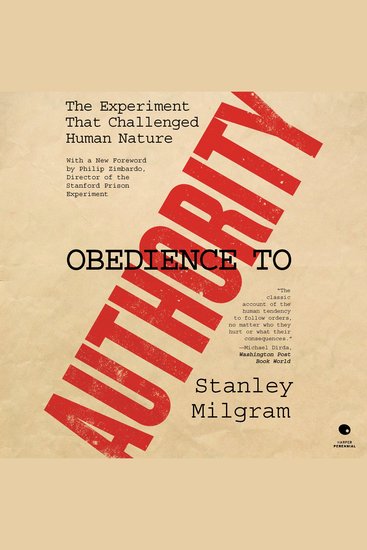
  • Obedience to Authority - An Experimental View - cover

    Obedience to Authority - An...

    Stanley Milgram

    • 0
    • 0
    • 0
    One of the most important books in social psychology of the last fifty years, “The classic account of the human tendency to follow orders, no matter who they hurt or what their consequences.” (Washington Post Book World) 
    The landmark examination of humanity's susceptibility to authoritarianism, Stanley Milgram's classic speaks to the present with disturbing urgency. ""Milgram's experiments on obedience have made us more aware of the dangers of uncritically accepting authority,"" observed Peter Singer in the New York Times Book Review. 
    In the 1960s, Yale University psychologist Stanley Milgram famously carried out a series of experiments that forever changed our perceptions of morality and free will. The subjects—or “teachers”—were instructed to administer electroshocks to a human “learner,” with the shocks becoming progressively more powerful and painful. Controversial but now strongly vindicated by the scientific community, these experiments attempted to determine to what extent people will obey orders from authority figures regardless of consequences. ""The aim of this investigation was to find when and how people would defy authority in the face of a clear moral imperative."" 
    With an introduction from Dr. Philip Zimbardo, who conducted the famous Stanford Prison Experiment, Obedience to Authority is Milgram’s fascinating and troubling chronicle of his classic study and a vivid and persuasive explanation of his conclusions. 
    Supplemental enhancement PDF accompanies the audiobook.
    Mostra libro