Join us on a literary world trip!
Add this book to bookshelf
Grey
Write a new comment Default profile 50px
Grey
Subscribe to read the full book or read the first pages for free!
All characters reduced
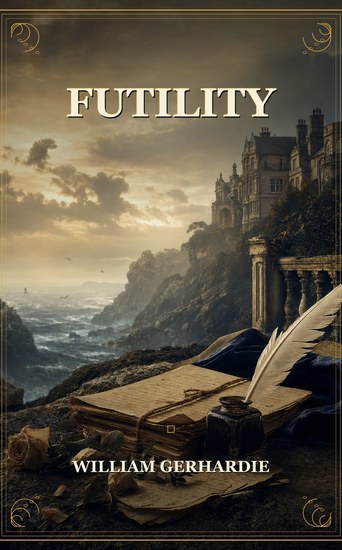
Futility - cover

Futility

William Gerhardie

Publisher: Caelwick Press

  • 0
  • 0
  • 0

Summary

Andrei Andreiech, a young Russian-English man, finds himself in the company of the three lovely daughters of the Bursanov family. Their father, Nikolai Vasilievich, is a man of potential means, but besides a large house most of his wealth is tied up in a series of non-productive Siberian goldmines. Still, the possibility of future income is enough to keep him afloat, along with his daughters, his lover, his ex-wife, and a whole series of extended family members and hangers-on. Both Nikolai and his retinue seem locked into a holding pattern, their lives unable to progress without some inflection point that never seems to arrive. Futility is William Gerhardie's first novel, published while he was attending Oxford after a stint in the British army. Like his protagonist, he was born and raised in Russia, then joined the English army as an officer, but he was careful to note that "the 'I' of this book is not me." The book was critically acclaimed: both Evelyn Waugh and H. G. Wells championed him, and Edith Wharton wrote a preface for this edition. It has been cited as one of the earliest appearances of a theme that would become recurrent in twentieth century literature: that of "waiting" (a theme made most famous in Beckett's Waiting for Godot ). William Gerhardie (died 1977) was a significant literary figure of the 20th century. Their work has endured across generations and continues to be read and studied worldwide. As a work of classic literary fiction, Futility exemplifies the narrative craft and social insight that defined great storytelling of its era. Literary fiction of this period was characterized by careful attention to character psychology, social milieu, and the moral questions that animated public discourse.
Available since: 05/19/2026.
Print length: 206 pages.

Other books that might interest you

  • The Little Governess - cover

    The Little Governess

    Katherine Mansfield

    • 0
    • 0
    • 0
    "The Little Governess" is a 1915 short story by Katherine Mansfield. It was first published in Signature on 18 October 1915 under the pen name of Matilda Berry, and later reprinted in Bliss and Other Stories. The text is written in the modernist mode, without a set structure, and with many shifts in the narrative.
    After receiving advice from the lady at the Governess Bureau, a young and naive English governess (referred to throughout as "the little governess") is off on the train from France to Munich, from where she will go to a new house for work. The governess has never been abroad before, and is duly forewarned of the dangers by the lady at the Governess Bureau, who tells her to "mistrust people at first". She is harassed by a porter on the way to her train, and once aboard, by a group of rowdy French men.
    Show book
  • A Passion in the Desert - From their pens to your ears genius in every story - cover

    A Passion in the Desert - From...

    Honoré de Balzac

    • 0
    • 0
    • 0
    Honoré de Balzac was born on the 20th May, 1799 in the French city of Tours into an upper middle class family.  
    At birth Balzac was wet-nursed and often then schooled away from home by parents who seemed remote.  So difficult was life that at 15 he attempted suicide. The family’s intention was for him to have a career in law but Balzac preferred literature.  An avid reader, he began writing but his early attempts showed little promise.  
    He thereafter settled in Paris and began to publish anonymously across political, philosophical, and historical novels. 
    In 1825, Balzac purchased a printing house.  He was soon bankrupt and forced to return to writing in order to reduce his debts.  But his literary fortunes had changed, and his writing was now to achieve considerable success.  He was accepted among the city’s literary élites and its salons and would play an important role in establishing the copyright law in France.  
    Balzac often worked on more than one project at a time and in his magnus opus ‘The Human Comedy’ all types of texts were collected to offer a rare narrative of different classes and social stereotypes of society.  For many Balzac is considered the father of French realism, yet his works also cover philosophical and psychological questions.  His writing was a fundamental source of inspiration for many distinguished and later writers such as Flaubert, Zola and Proust.  
    Balzac also tried his hand at magazine publication with ‘La Chronique de Paris’ and ‘La Revue Parisienne.’  Although he was partnered with others such as Victor Hugo, it was another complete financial failure.  
    As a committed Catholic, Balzac’s stories also dealt with themes of mysticism, esotericism and spirituality, as well as universality and humanism.  
    In politics, he was a staunch defender of the French Crown but unlike his contemporaries he was not an implacable enemy of the republicans.  He often presented disagreements between royalists and republicans as a tolerable difference in political opinion.  
    Despite many relationships Balzac married only towards the end of his life and it was in 1833 that he met the Polish Countess Hanska, who only became his wife 17 years later after an extensive relationship by correspondence and, by then, his health was ruinously bad.  
    Honoré de Balzac died on 18th August 1850 in Paris.  He was 51.
    Show book
  • The Bride Comes to Yellow Sky - cover

    The Bride Comes to Yellow Sky

    Stephen Crane

    • 0
    • 0
    • 0
    In the quiet frontier town of Yellow Sky, order depends on routine, reputation, and one man—Marshal Jack Potter. 
    But on a long train ride from San Antonio, Potter has done something unthinkable. He has married without warning his town, and now returns with his new bride to face the judgment of a community that holds tradition above all else. 
    As the couple approaches Yellow Sky, a different kind of tension grips the town. Scratchy Wilson, the last remnant of its lawless past, roams the streets in a drunken fury, daring anyone to face him. 
    What follows is not a gunfight—but something far more unexpected. 
    In The Bride Comes to Yellow Sky, Stephen Crane delivers a masterful Western that quietly marks the passing of an era. With subtle irony and restrained tension, this story captures the moment when the wild frontier begins to yield to something softer, stranger, and entirely new. 
    Narrated by Tony J. Martin, this classic tale unfolds with humor, humanity, and a powerful sense of transition—where the Old West meets the modern world, and nothing ends quite the way anyone expects.
    Show book
  • A Spirit Elopement - From their pens to your ears genius in every story - cover

    A Spirit Elopement - From their...

    Clothilde Graves

    • 0
    • 0
    • 0
    Clotilde Augusta Inez Mary Graves was born on the 3rd June 1863 at Buttevant Castle, Co. Cork, to parents with military backgrounds. 
    At age nine, the family moved to Southsea in England for yet another military posting.  Her father’s postings gave her valuable experiences that would be put to good use in later years in some of her literary works. 
    She was educated at a Catholic convent in Lourdes before returning to London in 1884 to study art in Bloomsbury.  She worked part-time at the British Museum and the Royal Female School of Art and generated further income by drawing little pen-and-ink grotesques for the comic papers.  
    A few years later a chance meeting found her writing extra lyrics for a pantomime version of Puss in Boots.  She followed up with several financially successful plays, both in London and New York, and gained a measure of notoriety in one with the comparison of marriage and prostitution.   
    Despite her dramatic success she published her first novel in 1911 under the pseudonym of Richard Dehan which she continued to use for later works.  As well as novels and plays she published collections of short stories which glow with talent and invention. 
    She was an unusual figure in London society, wearing her hair short, taking on a masculine manner and cut of clothing, and smoking cigarettes in public when such traits were considered eccentric at best.  Add to this her admired collection of Chinese and Japanese trophies, her enthusiasm for fly-fishing and her riding of a tricycle and you have a perfect image of this fascinating writer. 
    Clotilde Graves died at the convent of Our Lady of Lourdes at Hatch End in Middlesex, on the 3rd December 1932.  She was 69.
    Show book
  • The Masque of the Red Death - cover

    The Masque of the Red Death

    Edgar Allan Poe

    • 0
    • 0
    • 0
    Step into the eerie and haunting world of Edgar Allan Poe with "The Masque of the Red Death," the first part of an Edgar Allan Poe short story collection, narrated by Jake Urry. In this chilling tale, Prince Prospero and his courtiers attempt to escape a deadly plague by secluding themselves in a lavish abbey. Their sense of security is shattered when a mysterious figure cloaked in red appears during their masquerade ball, reminding them that death cannot be escaped. 
    Jake Urry's narration brings the suspense and gothic horror of Poe's story to life, making this audiobook an immersive experience. Perfect for both long-time fans and newcomers to Poe's work, this recording captures the dark, atmospheric essence of "The Masque of the Red Death," delivering a truly unforgettable listening experience.
    Show book
  • A Princess Of Mars - cover

    A Princess Of Mars

    Edgar Rice Burroughs

    • 0
    • 0
    • 0
    First published in 1912, "A Princess of Mars" is the debut novel in Edgar Rice Burroughs' Barsoom series. It follows the story of John Carter, a former Confederate captain, who inexplicably finds himself on the Red Planet, known to its inhabitants as Barsoom. There, he encounters strange alien races, including the Tharks, tall four-armed green beings, and the more humanoid Red Martians. John Carter is taken prisoner, proves himself in gladiatorial combat, and ultimately befriends Tars Tarkas, a Thark chieftain. As the tale unfolds, Carter meets and falls in love with Dejah Thoris, a princess of the Red Martian city of Helium. Together, they face numerous challenges in their quest for peace and unity on Barsoom.
    Show book