Unisciti a noi in un viaggio nel mondo dei libri!
Aggiungi questo libro allo scaffale
Grey
Scrivi un nuovo commento Default profile 50px
Grey
Iscriviti per leggere l'intero libro o leggi le prime pagine gratuitamente!
All characters reduced
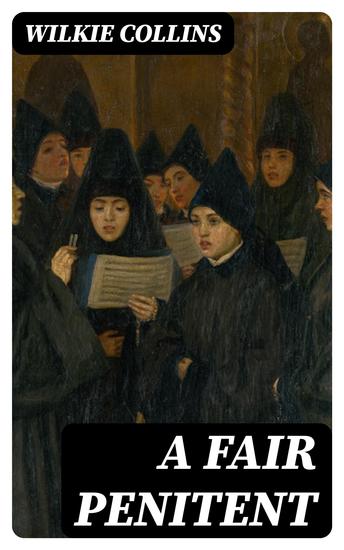
A Fair Penitent - Enriched edition - cover

A Fair Penitent - Enriched edition

Wilkie Collins

Casa editrice: DigiCat

  • 0
  • 0
  • 0

Sinossi

In "A Fair Penitent," Wilkie Collins masterfully weaves a tale exploring themes of morality, guilt, and societal expectation through the lens of Victorian England. The novella presents a gripping narrative that delves into the complexities of human relationships, particularly focusing on the dichotomy of desire and duty. Collins employs a signature blend of realism and sensationalism, characterized by intricate character development and a vivid portrayal of contemporary social mores, which continues to resonate with modern readers. The novella's sharp dialogue and detailed settings augment its exploration of the ethical dilemmas faced by its protagonists, particularly the haunting struggles of the titular penitent. Wilkie Collins, often celebrated as one of the pioneers of the detective genre, was heavily influenced by his own experiences and the literary milieu of his time. As a close associate of Charles Dickens and a prominent figure in Victorian literature, Collins grappled with the constraints placed on women and their roles in society. His insights into the intricacies of personal motivation and moral conflict are reflective of his progressive views on gender and social justice, making him a compelling voice of his era. This novella merits a place on the shelf of any reader interested in the intersections of ethics and personal tragedy within a historical context. Collins's keen observations and rich characterizations breathe life into a narrative that artfully prompts reflection on the enduring dilemmas of human nature. Readers willing to engage with the moral complexities presented will find themselves captivated by Collins's deft storytelling and philosophical depth.

In this enriched edition, we have carefully created added value for your reading experience:
- A succinct Introduction situates the work's timeless appeal and themes.
- The Synopsis outlines the central plot, highlighting key developments without spoiling critical twists.
- A detailed Historical Context immerses you in the era's events and influences that shaped the writing.
- An Author Biography reveals milestones in the author's life, illuminating the personal insights behind the text.
- A thorough Analysis dissects symbols, motifs, and character arcs to unearth underlying meanings.
- Reflection questions prompt you to engage personally with the work's messages, connecting them to modern life.
- Hand‐picked Memorable Quotes shine a spotlight on moments of literary brilliance.
- Interactive footnotes clarify unusual references, historical allusions, and archaic phrases for an effortless, more informed read.
Disponibile da: 04/09/2022.
Lunghezza di stampa: 109 pagine.

Altri libri che potrebbero interessarti

  • Captain Rogers - From their pens to your ears genius in every story - cover

    Captain Rogers - From their pens...

    W Jacobs

    • 0
    • 0
    • 0
    William Wymark Jacobs was born on 8th September 1863 in Wapping, East London.  
    He was educated at a private school and then Birkbeck Literary and Scientific Institution, now part of the University of London. 
    In 1879, Jacobs began work as a clerk in the civil service, in the Post Office Savings Bank.  In 1885 his first short story was published but it was not until almost the turn of the century that he would abandon his post office career to that as a full-time writer. By then he was a very popular author, his collections selling extremely well and with an excellent income. 
    His best-known work is the macabre ‘The Monkey's Paw’ and he is also highly regarded for his ghost stories although much of his remaining short story output is streaked with humour.  His characters are immediately identifiable and we all know that life will take chunks out of them in no time at all.  
    Jacobs married the noted suffragette Agnes Eleanor Williams in 1900 at West Ham, Essex. They went on to have two daughters and three sons as they settled down to life.  
    By the outbreak of the First World War his literary output had declined and he now mainly spent his time rewriting his earlier stories for the stage.  In all he wrote 18 plays. 
    W W Jacobs died on 1st September 1943 at Hornsey Lane, Islington in London. He was 79.
    Mostra libro
  • The Wisdom of Father Brown - cover

    The Wisdom of Father Brown

    G. K. Chesterton

    • 0
    • 0
    • 0
    The Father Brown stories sit in relation to other detective literature much as the diminutive and seemingly unworldly Priest himself often sits; quietly, thoughtfully and often to be overlooked. However, when he at lasts speaks it is with such understanding of human knowledge that the self-styled sophisticates that surround him are dumbfounded.C.K Chesterton is not concerned with the procedural minutiae of the detective’s work, nor with leaving a trail of red herrings with which to keep us guessing. Father Brown reaches his conclusions through staring into the human psyche, indeed, at times, into the human soul.
    Mostra libro
  • Les Misérables: Volume 3: Marius - Book 5: The Excellence of Misfortune (Unabridged) - cover

    Les Misérables: Volume 3: Marius...

    Victor Hugo

    • 0
    • 0
    • 0
    Victor-Marie Hugo (26 February 1802 - 22 May 1885) was a French poet, novelist, essayist, playwright, and dramatist of the Romantic movement. During a literary career that spanned more than sixty years, he wrote abundantly in an exceptional variety of genres: lyrics, satires, epics, philosophical poems, epigrams, novels, history, critical essays, political speeches, funeral orations, diaries, and letters public and private, as well as dramas in verse and prose.
    BOOK 5: THE EXCELLENCE OF MISFORTUNE: Life became hard for Marius. It was nothing to eat his clothes and his watch. He ate of that terrible, inexpressible thing that is called de la vache enragé; that is to say, he endured great hardships and privations.
    Mostra libro
  • Mac Beth - cover

    Mac Beth

    William Shakespeare

    • 0
    • 0
    • 0
    "Macbeth," a timeless and intricately woven tragedy, unveils the dark, intricate layers of human ambition, fate, power, and morality. Set against the backdrop of medieval Scotland, this play serves as an exploration of the human condition, revealing the devastating consequences of unchecked ambition and the corrupting force of power. 
     
    Historical and political contexts provide a foundation for understanding "Macbeth." The play draws inspiration from Holinshed's Chronicles, which chronicle Scottish history, and it resonates with the political anxieties of the early 17th century. King James I's ascent to the English throne in 1603 adds depth to the themes of regicide and political instability. "Macbeth" can thus be seen as a reflection of the Stuart monarchy, emphasizing the questions of legitimacy and the dangers of seeking power through usurpation. Macbeth's unchecked desire for power drives him to commit heinous acts and lose his sense of self, showcasing the moral decay that ambition can bring. The interplay between "fate and free will" is another central theme. While the witches' prophecies set events in motion, it is Macbeth's choices that lead to his tragic demise. This duality raises profound questions about human agency in the face of external forces. "Power and morality" are intertwined themes in the play. As Macbeth ascends to the throne by committing regicide, the consequences of ruthless ambition become evident. The disruption of the natural order is mirrored in the play's imagery, reflecting the moral chaos of Macbeth's actions. 
    In conclusion, "Macbeth" remains a masterful work of literature, captivating and thought-provoking at the university level and beyond. With its intricate characters, rich themes, and masterful use of language, it offers a profound exploration of human nature, ambition, fate, and morality.
    Mostra libro
  • Hunchback of Notre-Dame The (Book 11) - cover

    Hunchback of Notre-Dame The...

    Victor Hugo

    • 0
    • 0
    • 0
    Book 11: The Hunchback of Notre-Dame or Notre-Dame de Paris is a French Gothic novel by Victor Hugo, published in 1831. - The story is set in Paris in 1482 during the reign of Louis XI. The gypsy Esmeralda (born as Agnes) captures the hearts of many men, including those of Captain Phoebus and Pierre Gringoire, but especially Quasimodo and his guardian Archdeacon Claude Frollo. Frollo is torn between his obsessive lust for Esmeralda and the rules of Notre Dame Cathedral. He orders Quasimodo to kidnap her, but Quasimodo is captured by Phoebus and his guards, who save Esmeralda. Gringoire, who attempted to help Esmeralda but was knocked out by Quasimodo, is about to be hanged by beggars when Esmeralda saves him by agreeing to marry him for four years.
    Mostra libro
  • The Complete Novels of Jane Austen (Ribbon Classics) - All Major Works of Regency Era Romance and Social Satire - cover

    The Complete Novels of Jane...

    Anonimo

    • 0
    • 0
    • 0
    This comprehensive collection brings together the complete longer fiction of Jane Austen, including her six finished novels, her early epistolary novella, and her unfinished works.
    
    Spanning the Regency period, these works explore courtship, inheritance, social ambition, moral growth, and the delicate balance between emotion and reason. With wit, irony, and psychological precision, they portray the intimate dramas of family life and the quiet tensions of English country society.
    
    Included in this volume:
    
    Sense and Sensibility (1811)
    
    Pride and Prejudice (1813)
    
    Mansfield Park (1814)
    
    Emma (1816)
    
    Northanger Abbey (1818, posthumous)
    
    Persuasion (1818, posthumous)
    
    Lady Susan (1871, posthumous)
    
    The Watsons (unfinished)
    
    Sanditon (unfinished)
    
    From sparkling social satire to more mature meditations on regret and second chances, this collection reveals the full arc of Austen's artistic development. The inclusion of the unfinished works offers readers a rare glimpse into her creative process and evolving narrative voice.
    
    Presented in a single, carefully formatted volume, this edition is ideal for students, scholars, and readers who wish to experience the complete range of Austen's fiction in one place.
    Mostra libro