Unisciti a noi in un viaggio nel mondo dei libri!
Aggiungi questo libro allo scaffale
Grey
Scrivi un nuovo commento Default profile 50px
Grey
Iscriviti per leggere l'intero libro o leggi le prime pagine gratuitamente!
All characters reduced
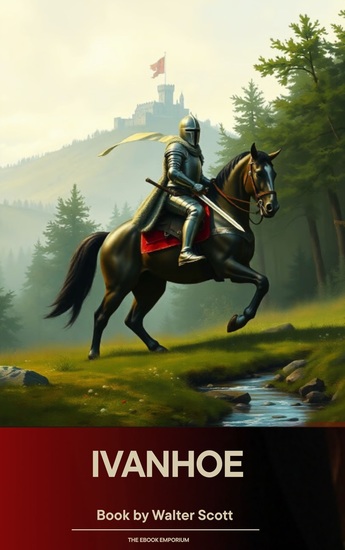
Ivanhoe - cover

Ivanhoe

Walter Scott

Casa editrice: The Ebook Emporium

  • 0
  • 0
  • 0

Sinossi

"A kingdom divided, a knight disinherited, and the return of a King."

England is a land of tension. While King Richard the Lionheart languishes in an Austrian prison, his brother Prince John plots to seize the crown, fanning the flames of hatred between the conquered Saxons and the ruling Normans. Into this volatile world returns Wilfred of Ivanhoe, a Saxon knight cast out by his father for his loyalty to the Norman King. From the thrilling tournament at Ashby-de-la-Zouch to the siege of Torquilstone Castle, Ivanhoe brings the 1190s to life with unrivaled color. Featuring legendary figures like Robin Hood (Locksley) and the heroic Rebecca of York, Scott's novel is a pulse-pounding journey through a world of outlaws, Templars, and the code of honor that binds them.

The Rebirth of Robin Hood: Sir Walter Scott is largely responsible for the modern image of Robin Hood as a noble outlaw and a brilliant archer. By weaving "Locksley" into the political struggle of the novel, Scott transformed a collection of folk ballads into a cohesive national myth that still dominates our screens today.

The Complexity of Chivalry: While the novel celebrates bravery, it also questions the cost of the knightly code. Through the tragic figure of Rebecca, the Jewish healer, Scott explores prejudice and religious intolerance, making Ivanhoe a surprisingly modern critique of societal divisions.

Why It Is a Literary Landmark: Ivanhoe did for the Middle Ages what Star Wars did for space; it created an entire aesthetic of heroism. It moved historical fiction away from dry facts and into the realm of high adventure, making it a foundation stone for all fantasy and historical drama that followed.

Answer the call of the trumpet. Purchase "Ivanhoe" today.
Disponibile da: 19/01/2026.
Lunghezza di stampa: 621 pagine.
Altri libri che potrebbero interessarti

  • All's Well That Ends Well - cover

    All's Well That Ends Well

    William Shakespeare

    • 0
    • 0
    • 0
    A Shakespeare Society Production. The complete play in five acts. 
    Desperately in love with Bertram, the son of a Spanish countess, Helena schemes with the virginal Diana to fulfill Bertram’s stipulations and win his love. As Bertram’s infidelity and Helena’s deceits are revealed, the estranged lovers reunite, but the audience is left to wonder if, in love, the end justifies the means.
    Mostra libro
  • The Unrest Cure - From their pens to your ears genius in every story - cover

    The Unrest Cure - From their...

    Saki Saki

    • 0
    • 0
    • 0
    Hector Hugh Munro, more familiarly known by his pen-name ‘Saki’ was born in what was then Akyab in British Burma on 18th December 1870. His father was an Inspector General for the Indian Imperial Police, and his mother the daughter of a Rear Admiral. 
    When he was 2 his mother died and he and his siblings were sent back to England to be raised by their grandmother and paternal maiden aunts in a strict, puritanical household near Barnstaple, Devon. Educated by governesses Saki used many of these women as character models for his later writing. 
    At 17 his father retried and returned to England and then embarked on a series of European travels with Saki and his siblings. 
    After a short stint working in Burma with the Indian Imperial Police Saki decided to move to London to make a living as a writer. Initially he wrote as a journalist for a number of newspapers and magazines before attempting an historical study, ‘The Rise of the Russian Empire’, whose real value lay in directing him to writing short stories instead, the first of which, ‘Dogged’, he published in 1899. 
    From here it was a short stab of the pen to writing political satire before in 1902 he became the foreign correspondent for The Morning Post, first in the Balkans, then Russia, Paris and back to London in 1908, where 'the agreeable life of a man of letters with a brilliant reputation awaited him.'  
    Collections of his short stories full of witty, mischievous and often macabre stories that satirized Edwardian society and two novels now appeared in the years up to the Great War.  At its’ outbreak he was 43 but managed to join as an ordinary trooper. More than once he returned to the battlefield when officially too sick or injured.  
    On 14th November 1916 Hector Hugh Munro was sheltering in crater during the Battle of the Ancre, when he was shot and killed by a German sniper. According to several sources, his last words were "Put that bloody cigarette out!"
    Mostra libro
  • All’s Well That Ends Well - cover

    All’s Well That Ends Well

    Tom Wheelwright, William...

    • 0
    • 0
    • 0
    The young and virtuous physician’s daughter Helena desperately loves Count Bertram, but he regards her as beneath his notice. 
    When Helena cures the king of France of a mortal illness, he rewards her with Bertram’s hand, but before their marriage can be consummated, the count flees. To win her husband back again, Helena forms a daring and resourceful plan. 
    A plot to unmask the strutting soldier Parolles makes up another strand in this sometimes disturbing comedy of deception and disguise. 
    ACT IScene 1. Bertram, the young Count of Rossillion, is leaving home to take his place at the court of the King of France, who is gravely ill. Bertram bids farewell to his mother the widowed Countess, her friend the old lord Lafew and the young and virtuous Helena, daugther of a famous doctor now deceased, who lives as a dependent in the old Countess’ household. Helena is passionately in love with Bertram, though without hope because he is so far above her in birth. Parolles, a blustering soldier who has attached himself to Bertram, is also going to the French court and Helena determines to follow. She has learned the mysteries of medicine from her father; if she can cure the King, she may win Bertram’s heart.Scene 2. The ailing King tells of war between the Florentines and Sienese; he will give permission to any young gentleman of France who wishes to go to Italy in search of glory. Bertram arrives and the King greets him warmly. Scene 3. The Countess gently forces Helena to admit her love for Bertram and reveal her plan to attempt the King’s cure. The old lady kindly offers her support. 
    ACT IIScene 1. Lafew announces the arrival at court of a young woman who claims to be able to heal the King. The King is deeply skeptical, but Helena persuades him to allow her to make the attempt. Should she succeed, the King is to grant her the husband of her choice.Scene 2. The Countess’ fool Lavatch is to be sent to the court. He claims that he has a response that will serve him in all social situations, but the Countess exposes his folly.Scene 3. Helena has restored the King to joyful health. He offers her the hand in marriage of any of the young lords at court, but when she chooses Bertram he recoils in horror. Angrily, the King commands Bertram to wed Helena instantly. The marriage takes place, but Bertram vows that he will never sleep with his bride and determines to steal away to the Italian wars at once.Scene 4. Helena receives a letter from Bertram telling her that he has been called away and ordering her to take leave of the King.Scene 5. Lafew warns Bertram that Parolles is a hollow sham. Helena enters and Bertram dismisses her curtly, instructing her to return to the Countess. 
    ACT IIIScene 1. The Duke of Florence prepares to welcome the young Frenchmen who come to fight on his behalf.Scene 2. Helena has received a letter from Bertram: until she can get the ring from his finger, which he has vowed never to remove, and produce a child that she has conceived by him, she will never be able to call him husband.Scene 3. The Duke of Florence, impressed by Bertram’s military promise, has given him an important command. Scene 4. The Countess has received a letter from Helena telling her that she has gone on a pilgrimage to atone for her sin in aspiring to Bertram’s love and freeing him from his responsibility for her. The Countess bitterly deplores her son’s arrogance and blindness.Scene 5. Helena has come to Florence where she meets a kindly widow and her beautiful daughter, Diana. The widow tells her that Bertram has fought heroically in the war but also that he has been attempting to seduce Diana. Scene 6. The French soldiers hatch a plot to convince Bertram of Parolles’ cowardliness; pretending to be enemy soldiers, they will capture him, then see if he is prepared to betray his friends.Scene 7. Helena, too, is setting a plot. Diana is to pretend to yield to Bertram’s suit on condition that he give her his ring. She
    Mostra libro
  • The Book of Haggai -The Holy Bible King James Version - cover

    The Book of Haggai -The Holy...

    Haggai

    • 0
    • 0
    • 0
    A prophet called Haggai lectures the people and their leaders about the importance of being industrious, saving money, and rebuilding derelict buildings.
    Mostra libro
  • Three Lives - cover

    Three Lives

    Gertrude Stein

    • 0
    • 0
    • 0
    'You see that Anna led an arduous and troubled life… Her face was worn, her cheeks were thin, her mouth drawn and firm, and her light blue eyes were very bright. Sometimes they were full of lightning and sometimes full of humour, but they were always sharp and clear.'
    Under the grey, industrial skies of Bridgepoint (modelled on Baltimore), three women – Anna, Melanctha and Lena – live, work and love. Painting a powerful portrait of women trapped in drudgery, Stein's Three Lives is a ground-breaking portrayal of abuse and non-heteronormative sexuality, and is a searing indictment of the struggles of the working class in turn-of-the-century America.
    An astonishing work that toys with style and conventions, Three Lives stands as a monument in Modernism and experimental literature, and comes from the pen of a writer whose intelligence and understanding bleeds from every page.
    Mostra libro
  • Effi Briest in simple language - based on plain language - cover

    Effi Briest in simple language -...

    Theodor Fontane

    • 0
    • 0
    • 0
    Theodor Fontane's best-known novel is published in simple language for the first time.Theodor Fontane's best-known novel is published in simple language for the first time. It largely complies with the ISO 24495-1:2023 plain language standard. We have also largely adapted it for plain language.The content is also typographically designed to be particularlyreader-friendly. The book is suitable for readers with limited readingability, English as a second language or with cognitive impairments.This means that as many people as possible can enjoy readingand understanding one of Germany's most famous novels.aibo publishing produces the World Literature series in simple and plain language. The first publications generated a media response across Europe, including in the FAZ and The Times London, and, according to the NZZ, triggered a "culture war"."Effi Briest" is about love and freedom. A young woman is married at an early age. She is torn between her feelings and the strict rules of society. Her curiosity and zest for life are her destiny. She is caught between two men. They fight a duel. This is no longer in keeping with the times. But they don't know better.The novel is set in 19th century Germany. It can be compared to the Russian novel "Anna Karenina" or the French "Madame Bovary". "Effi Briest" became world-famous and was often made into a film. Theodor Fontane is considered a representative of poetic realism.
    Mostra libro