Unisciti a noi in un viaggio nel mondo dei libri!
Aggiungi questo libro allo scaffale
Grey
Scrivi un nuovo commento Default profile 50px
Grey
Iscriviti per leggere l'intero libro o leggi le prime pagine gratuitamente!
All characters reduced
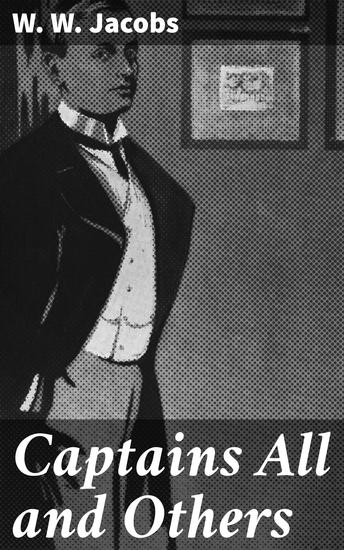
Captains All and Others - Sailors Sea Captains and Coastal Adventures: A Collection of Nautical Tales with Humor Suspense and Moral Lessons - cover

Captains All and Others - Sailors Sea Captains and Coastal Adventures: A Collection of Nautical Tales with Humor Suspense and Moral Lessons

W. W. Jacobs

Casa editrice: Good Press

  • 0
  • 0
  • 0

Sinossi

In "Captains All and Others," W. W. Jacobs presents a captivating collection of short stories that vividly explore the lives of fishermen and seafaring men in the late 19th and early 20th centuries. Utilizing a distinctive regional dialect infused with humor and vivid imagery, Jacobs skillfully navigates themes of camaraderie, the struggles of daily life, and the inexorable connection to the sea. This work is deeply rooted in the literary context of the period, reflecting societal shifts and a growing fascination with nautical literature, while showcasing Jacobs' talent for blending realism with an undercurrent of humor and irony. W. W. Jacobs (1863-1943) was an English author known for his maritime expertise and foundational experiences near the coast of Essex. His formative years spent around the fishing communities imbued him with a rich understanding of the characters and tales that populate "Captains All and Others." Jacobs' work often captures the nuances of regional culture, and it is likely that his own experiences inspired the diverse array of personalities and scenarios depicted in this collection. This anthology is highly recommended for readers interested in robust storytelling that combines simplicity with depth. Jacobs'Äô wit and industry-specific knowledge provide an engaging glimpse into maritime life, making it a must-read for both literary enthusiasts and those intrigued by the culture of the sea.
Disponibile da: 12/08/2023.
Lunghezza di stampa: 120 pagine.

Altri libri che potrebbero interessarti

  • A Successful Rehearsal - From their pens to your ears genius in every story - cover

    A Successful Rehearsal - From...

    Anthony Hope

    • 0
    • 0
    • 0
    Sir Anthony Hope Hawkins was born on 9th February 1863 in Clapton, London.  
    He was educated at St John's School, Leatherhead, Marlborough College and Balliol College, Oxford.  Hope trained as a lawyer and barrister and was called to the Bar by the Middle Temple in 1887. Despite what was thought to be a promising legal career he had literary ambitions and wrote in his spare time. 
    His early works appeared in various periodicals of the day but for his first book ‘A Man of Mark’ (1890), with no publisher interested, he published with his own resources.  
    More novels and short stories followed, including the mildly successful ‘Mr Witt's Widow’ in 1892. Hope even found time to run as the Liberal candidate for Wycombe in the election that same year but was unsuccessful. 
    His first major literary success came with ‘The Dolly Dialogues’, a collection of previously published magazine pieces followed very quickly by his instant classic, ‘The Prisoner of Zenda’. He now gave up the vestiges of his legal career to pursue writing full-time. 
    Despite never again reaching the same pinnacle of success he was popular and wrote prolifically across novels, plays and of course, short stories though his writing output rapidly diminished after the war. 
    In 1918 he was knighted for his contribution to propaganda efforts during World War I.  
    His short stories are delicate, mannered and often surprising with their wit, humour and interplay of characters who say one thing and usually mean another.  He was very definitely a writer of escapist rather than serious fare but they are no less enjoyable for that. 
    Anthony Hope died of throat cancer on 8th July 1933 at his country home, Heath Farm at Walton-on-the-Hill in Surrey. He was 70.
    Mostra libro
  • Anathema - From their pens to your ears genius in every story - cover

    Anathema - From their pens to...

    Alexander Kuprin

    • 0
    • 0
    • 0
    Alexander Kuprin was born in Narovchat, Penza in Russia on 7th September 1870. 
    At 3 his Father died and he and mother moved to Moscow. By 10 he was enrolled at the Second Moscow Military High School and there his interest in literature began. The Alexander Military Academy followed and two years later he was a sub-lieutenant and posted to an Infantry Regiment for a further four years. 
    Despite his duties he was a now a keen writer and published his first short story at this time. His military duties also garnered him experiences for his breakthrough work ‘The Duel’.  Leaving the military he left for Kiev to work for local newspapers.  He continued to publish both stories and novels and by 1901 he was in St Petersburg becoming part of a group that included Chekhov, Ivan Bunin, Maxim Gorky and Leonid Andreyev.  
    In the years that followed further controversial works and acclaim followed.  His comments on the regime meant he was also put under secret police surveillance.   
    As World War I erupted, Kuprin opened a military hospital but was then given command of an infantry company in Finland. He was soon discharged on grounds of ill health.  
    The October Revolution saw him praise Lenin, but he warned that the Bolsheviks threatened Russian culture and might cause further widespread suffering to the peasants.  As Civil War raged he took his family to Helsinki and then on to Paris. 
    Exile saw his talents decline further and his succumbing to alcoholism. He became lonely and withdrawn. The family's poverty increased his malaise.   
    In May 1937, the Kuprin’s returned to Moscow.  He now saw his work published but wrote almost nothing new.  In 1938 his health rapidly deteriorated.  Already suffering from a kidney problems and sclerosis, he had now developed cancer of the oesophagus.  
    Alexander Kuprin died on 25th August 1938.
    Mostra libro
  • Red Star Over Hebrides - cover

    Red Star Over Hebrides

    Donald S Murray

    • 0
    • 0
    • 0
    Even as he grew up on the edge of Lewis, the vastness of Russia never felt too distant for Donald S Murray. Its great literary traditions were often discussed in his home village, while the political unrest and religious fervour that marked its past and present were occassionally reflected in his life on the island. Inspired by the Russian canon, the songs, verse and stories contained within these pages draw upon the experiences of his youth, shifting continually between myth and history, the absurd and moving, the satirical and everyday. Its extraordinary and diverse narratives underline the truth of its opening line: 'I can see these islands mirror Russia.'
    Mostra libro
  • From the Memoirs of Satan - From their pens to your ears genius in every story - cover

    From the Memoirs of Satan - From...

    William Hauff

    • 0
    • 0
    • 0
    The bookshelves of European literature are incredible collections that have gathered together centuries of very talented authors.  From this continent their fame spread and whilst among their number many are now forgotten or neglected their talents endure.  Among them is William Hauff.
    Mostra libro
  • Men Without Women - cover

    Men Without Women

    Ernest Hemingway

    • 0
    • 0
    • 0
    Originally published in October 1927, the second short-story collection published by Pulitzer Prize winner and Nobel Laureate Ernest Hemingway contains the following fourteen stories: The Undefeated In Another Country Hills Like White Elephants The Killers Che Ti Dice La Patria? Fifty Grand A Simple Enquiry Ten Indians A Canary for One An Alpine Idyll A Pursuit Race Today is Friday Banal Story Now I Lay Me Themes and subject matter range from bullfighting, boxing, and prizefighting to divorce, infidelity, and death. Critics at the time praised Hemingway's concise language and powerful prose. Content Warning: As a part of the public domain, Men Without Women is a literary work that reflects the time in which it was published—both its good and its ill. The original text of Men Without Women contains slurs and depictions that represent prejudiced and harmful beliefs regarding race, ethnicity, and religion. To erase or bury this representation of inequity and prejudice would be akin to pretending it never existed, a denial that only perpetuates and extends the original harm done. Thus, in the interest of preserving and documenting both the faults and highlights of literary history—an instrumental, crucial function of works entering the public domain—this text is unedited and uncensored in this audiobook recording. Please proceed with discretion.
    Mostra libro
  • Vincente Blasco Ibanez - A Short Story Collection - One of Spains finest writers who's work has been made into countless Hollywood films we have an incredible anthology translated to English for your ears - cover

    Vincente Blasco Ibanez - A Short...

    Vincente Blasco Ibanez

    • 0
    • 0
    • 0
    Vicente Blasco Ibáñez was born in Valencia, Spain on 29th January 1867.  
     
    At university, he studied law and graduated in 1888 but never felt the urgency to practice - he was more interested in politics, journalism, literature and women.   
     
    Politically he was a militant Republican partisan and, in his youth, founded a newspaper, El Pueblo (The People). The newspaper was taken to court many times and he made many enemies. In one incident he was shot and almost killed. In 1896, Ibáñez was arrested and sentenced to a few months in prison. 
     
    Despite this colourful background he found time to write novels. His first published work was ‘La Araña Negra’ (The Black Spider) in 1892, a work that he later repudiated although at the time it was a useful vehicle for him to express his anti-clerical views. 
     
    In 1894, he published ‘Arroz y Tartana’ (Airs and Graces), about a late 19th Century widow in Valencia trying to keep up appearances in order to marry her daughters well.   
     
    Ibáñez’s next sequence of books studied rural life in the farmlands of Valencia and failed to gain much of an audience.   
     
    His writing now took on a new direction with its now familiar sensational and melodramatic themes in 1908 with ‘Sangre y Arena’ (Blood and Sand), which follows the career of Juan Gallardo from his poor beginnings as a child in Seville, to his rise to becoming a famous matador in Madrid 
     
    However, his greatest success was ‘Los Cuatro Jinetes del Apocalipsis (The Four Horsemen of the Apocalypse) in 1916, which tells a tangled tale of the French and German sons-in-law of an Argentinian land-owner who find themselves fighting on opposite sides in the First World War.  It was a literary and commercial sensation and became the best-selling book of 1919.  It also propelled Rudolph Valentino to stardom in the 1921 film. 
     
    Ironically his fame in the English-speaking world has come not as a novelist but as the stories behind some of Hollywood’s greatest silent movies. 
     
    Vicente Blasco Ibáñez died in Menton, France on January 28th, 1928, the day before his 61st birthday. 
     
    01 - Vicente Blasco Ibanez - A Short Story Collection - An Introduction 
    02 - Compassion by Vicente Blasco Ibanez 
    03 - Luxury by Vicente Blasco Ibanez 
    04 - Rabies by Vicente Blasco Ibanez 
    05 - The Last Lion by Vicente Blasco Ibanez 
    06 - The Windfall by Vicente Blasco Ibanez<
    Mostra libro