Unisciti a noi in un viaggio nel mondo dei libri!
Aggiungi questo libro allo scaffale
Grey
Scrivi un nuovo commento Default profile 50px
Grey
Iscriviti per leggere l'intero libro o leggi le prime pagine gratuitamente!
All characters reduced
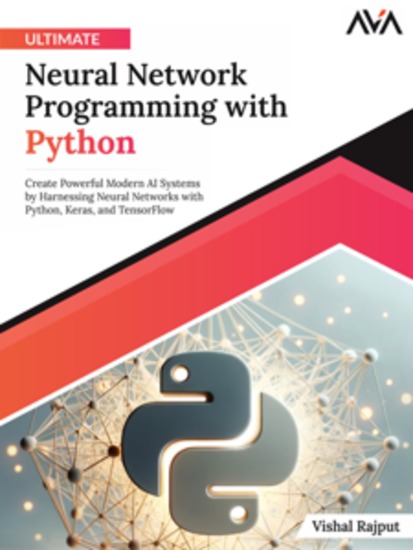
Ultimate Neural Network Programming with Python: Create Powerful Modern AI Systems by Harnessing Neural Networks with Python Keras and TensorFlow - cover

Ultimate Neural Network Programming with Python: Create Powerful Modern AI Systems by Harnessing Neural Networks with Python Keras and TensorFlow

Vishal Rajput

Casa editrice: Orange Education Pvt Ltd

  • 0
  • 0
  • 0

Sinossi

Master Neural Networks for Building Modern AI Systems. 
 Key Features ● Comprehensive Coverage of Foundational AI Concepts and Theories.● In-Depth Exploration of Maths Behind Neural Network Mathematics.● Effective Strategies for Structuring Deep Learning Code.● Real-world applications of AI Principles and Techniques.Book DescriptionThis book is a practical guide to the world of Artificial Intelligence (AI), unraveling the math and principles behind applications like Google Maps and Amazon. The book starts with an introduction to Python and AI, demystifies complex AI math, teaches you to implement AI concepts, and explores high-level AI libraries.Throughout the chapters, readers are engaged with the book through practice exercises and supplementary learning. The book then gradually moves to Neural Networks with Python before diving into constructing ANN models and real-world AI applications. It accommodates various learning styles, letting readers focus on hands-on implementation or mathematical understanding.This book isn't just about using AI tools; it's a compass in the world of AI resources, empowering readers to modify and create tools for complex AI systems. It ensures a journey of exploration, experimentation, and proficiency in AI, equipping readers with the skills needed to excel in the AI industry.What you will learn● Leverage TensorFlow and Keras while building the foundation for creating AI pipelines.● Explore advanced AI concepts, including dimensionality reduction, unsupervised learning, and optimization techniques.● Master the intricacies of neural network construction from the ground up.● Dive deeper into neural network development, covering derivatives, backpropagation, and optimization strategies.● Harness the power of high-level AI libraries to develop production-ready code, allowing you to accelerate the development of AI applications.● Stay up-to-date with the latest breakthroughs and advancements in the dynamic field of artificial intelligence.Who is this book for?This book serves as an ideal guide for software engineers eager to explore AI, offering a detailed exploration and practical application of AI concepts using Python. AI researchers will find this book enlightening, providing clear insights into the mathematical concepts underlying AI algorithms and aiding in writing production-level code. This book is designed to enhance your skills and knowledge to create sophisticated, AI-powered solutions and advance in the multifaceted field of AI.Table of Contents1. Understanding AI History2. Setting up Python Workflow for AI Development3. Python Libraries for Data Scientists4. Foundational Concepts for Effective Neural Network Training5. Dimensionality Reduction, Unsupervised Learning and Optimizations6. Building Deep Neural Networks from Scratch7. Derivatives, Backpropagation, and Optimizers8. Understanding Convolution and CNN Architectures9. Understanding Basics of TensorFlow and Keras10. Building End-to-end Image Segmentation Pipeline11. Latest Advancements in AI       Index
Disponibile da: 11/02/2025.
Lunghezza di stampa: 402 pagine.
Altri libri che potrebbero interessarti

  • Generative AI on AWS - Building Context-Aware Multimodal Reasoning Applications - cover

    Generative AI on AWS - Building...

    Shelbee Eigenbrode, Chris...

    • 0
    • 0
    • 0
    Companies today are moving rapidly to integrate generative AI into their products and services. But there's a great deal of hype (and misunderstanding) about the impact and promise of this technology. With this book, Chris Fregly, Antje Barth, and Shelbee Eigenbrode from AWS help CTOs, ML practitioners, application developers, business analysts, data engineers, and data scientists find practical ways to use this exciting new technology. 


    You'll learn the generative AI project life cycle including use case definition, model selection, model fine-tuning, retrieval-augmented generation, reinforcement learning from human feedback, and model quantization, optimization, and deployment. And you'll explore different types of models including large language models (LLMs) and multimodal models such as Stable Diffusion for generating images and Flamingo/IDEFICS for answering questions about images. 


    You'll also discover how to apply generative AI to your business use cases; determine which generative AI models are best suited to your task; perform prompt engineering and in-context learning; fine-tune generative AI models on your datasets with low-rank adaptation (LoRA); align generative AI models to human values with reinforcement learning from human feedback (RLHF); augment your model with retrieval-augmented generation (RAG); explore libraries such as LangChain and ReAct to develop agents and actions; and build generative AI applications with Amazon Bedrock.
    Mostra libro
  • Summary: How to Do the Work - Recognize Your Patterns Heal from Your Past and Create Yourself By Dr Nicole LePera: Key Takeaways Summary and Analysis - cover

    Summary: How to Do the Work -...

    Brooks Bryant

    • 0
    • 0
    • 0
    DISCLAIMER: THIS IS NOT THE OFFICIAL BOOK. 
    This is a summary, and it does not accompany the official 
    In 'How to Do the Work' by Dr. Nicole LePera, the author challenges the limitations of traditional psychotherapy with her holistic approach to mental, physical, and spiritual wellness. Dr. LePera, known as 'The Holistic Psychologist,' integrates various scientific and healing modalities to help individuals recognize and heal from the adverse effects of childhood experiences and trauma. The book emphasizes the impact of these experiences on whole-body dysfunction, triggering stress responses that lead to harmful patterns like codependency, emotional immaturity, and trauma bonds. Dr. LePera provides tools and guidance for breaking free from these destructive behaviors, advocating for self-healing, and empowering readers to create more vibrant, authentic, and joyful lives. 'How to Do the Work' presents a paradigm shift in the approach to mental wellness and self-care, promoting a journey of self-discovery and transformation.
    Mostra libro
  • The Hidden Cosmos - Dark Matter's Place in the Galactic Landscape - cover

    The Hidden Cosmos - Dark...

    Dirk Fallon

    • 0
    • 0
    • 0
    Dark matter is one of the most intriguing and elusive subjects in modern astrophysics, captivating the minds of scientists and enthusiasts alike. It represents a type of matter that does not emit, absorb, or reflect light, making it invisible to the entire electromagnetic spectrum. Despite its invisible nature, dark matter exerts gravitational influence on visible matter, affecting the behavior of galaxies and the large-scale structure of the universe. 
    The concept of dark matter originated from astronomical observations that could not be explained by visible matter alone. Early studies of the rotational speeds of galaxies revealed that stars at the edges of galaxies were moving much faster than expected based on the mass of visible stars and gas. This anomaly led to the hypothesis that an unseen mass was responsible for the additional gravitational pull. As a result, dark matter is thought to make up about 85 percent of the total matter in the universe, profoundly influencing the formation and evolution of galaxies. 
    Scientific research on dark matter has involved numerous observational and theoretical studies. Researchers have relied on indirect methods to study this mysterious substance, such as analyzing the gravitational lensing effect, where the gravity of dark matter bends the light from distant objects. This effect not only provides evidence of dark matter's presence but also offers insights into its distribution across the cosmos. The study of cosmic microwave background radiation, the afterglow of the Big Bang, further supports the existence of dark matter by revealing fluctuations that can be linked to its gravitational effects in the early universe.
    Mostra libro
  • Drunk Flies and Stoned Dolphins - A Trip Through the World of Animal Intoxication - cover

    Drunk Flies and Stoned Dolphins...

    One R. Pagan

    • 0
    • 0
    • 0
    From the cup of coffee that jumpstarts the day to dangerously addictive drugs, the recreational use of plants with psychoactive properties has a long history among humans.But, as with many things, it turns out that other animals got there first.From parrots to primates, consuming medicinal chemicals is an instinctive behavior that helps countless organisms fight infection and treat disease. But the similarities don't end there: Like us, many creatures also consume substances that have no apparent benefit . . . except for inducing intoxication. In fact, animals have been using drugs for recreational purposes since prehistoric times. We may even have animals to thank for the idea—legend says that coffee was discovered by observing the behavior of goats that had eaten it. In his previous book, Strange Survivors, author and biologist Oné R. Pagán introduced readers to some of the truly bizarre strategies animals use to survive in the cutthroat world of natural selection. Now, in Drunk Flies and Stoned Dolphins, he sheds light on the surprising cravings they indulge when it's time to unwind. In this book, you'll get an eye-opening glimpse into the mind-altering behavior of the non-human members of the animal kingdom, spanning insects to elephants—including the dolphin species that apparently likes to pass around an intoxicating pufferfish as if they were sharing a joint. Combining fascinating science with humor and enthusiasm, Pagán's latest is full of the kind of unforgettable stories and odd facts that you'll find yourself repeating to everyone you meet. From fruit fly happy hour to the evolutionary reasons behind nature's drugs, Drunk Flies and Stoned Dolphins takes you on a trip through the colorful world of animal intoxication—and along the way, explores what this science reveals about the surprising connections between all the world's creatures.
    Mostra libro
  • Multi-Billion-Dollar Pet Food Fraud - cover

    Multi-Billion-Dollar Pet Food Fraud

    Dr. Tom Lonsdale

    • 0
    • 0
    • 0
    Based on keen observation over a lifetime of veterinary practice, Dr Tom Lonsdale gives us the tools to keep our pets healthy. The early chapters reveal essential dietary information—the foundation of good health for all species.Recounting testimonials from grateful pet owners, Tom describes the failings of modern veterinary practice. We learn how veterinary schools brainwash young vets. He helps us identify how most vets selectively disregard scientific facts as they push pet food industry propaganda costing our pets their lives and costing us $billions. Tom’s writings inspire confidence. We learn simple ways to care for our pets leading to huge savings on vet bills.Relying on rock-solid evidence, Tom presents a withering critique of the junk pet food/veterinary alliance. He helps us see through the smokescreens of misinformation and the false and misleading pet food ads. He shows how the media, government regulators and people in high places share responsibility for the multi-billion-dollar pet food fraud.
    Mostra libro
  • Mastering Computer Vision with PyTorch 20 - Discover Design and Build Cutting-Edge High Performance Computer Vision Solutions with PyTorch 20 and Deep Learning Techniques - cover

    Mastering Computer Vision with...

    M. Arshad Siddiqui

    • 0
    • 0
    • 0
    Unleashing the Power of Computer Vision with PyTorch 2.0.
    Book DescriptionIn an era where Computer Vision has rapidly transformed industries like healthcare and autonomous systems, PyTorch 2.0 has become the leading framework for high-performance AI solutions. [Mastering Computer Vision with PyTorch 2.0] bridges the gap between theory and application, guiding readers through PyTorch essentials while equipping them to solve real-world challenges.
    Starting with PyTorch’s evolution and unique features, the book introduces foundational concepts like tensors, computational graphs, and neural networks. It progresses to advanced topics such as Convolutional Neural Networks (CNNs), transfer learning, and data augmentation. Hands-on chapters focus on building models, optimizing performance, and visualizing architectures. Specialized areas include efficient training with PyTorch Lightning, deploying models on edge devices, and making models production-ready.
    Explore cutting-edge applications, from object detection models like YOLO and Faster R-CNN to image classification architectures like ResNet and Inception. By the end, readers will be confident in implementing scalable AI solutions, staying ahead in this rapidly evolving field. Whether you're a student, AI enthusiast, or professional, this book empowers you to harness the power of PyTorch 2.0 for Computer Vision.
    Table of Contents1. Diving into PyTorch 2.02. PyTorch Basics3. Transitioning from PyTorch 1.x to PyTorch 2.04. Venturing into Artificial Neural Networks5. Diving Deep into Convolutional Neural Networks (CNNs)6. Data Augmentation and Preprocessing for Vision Tasks7. Exploring Transfer Learning with PyTorch8. Advanced Image Classification Models9. Object Detection Models10. Tips and Tricks to Improve Model Performance11. Efficient Training with PyTorch Lightning12. Model Deployment and Production-Ready Considerations       Index
    Mostra libro