Begleiten Sie uns auf eine literarische Weltreise!
Buch zum Bücherregal hinzufügen
Grey
Einen neuen Kommentar schreiben Default profile 50px
Grey
Jetzt das ganze Buch im Abo oder die ersten Seiten gratis lesen!
All characters reduced
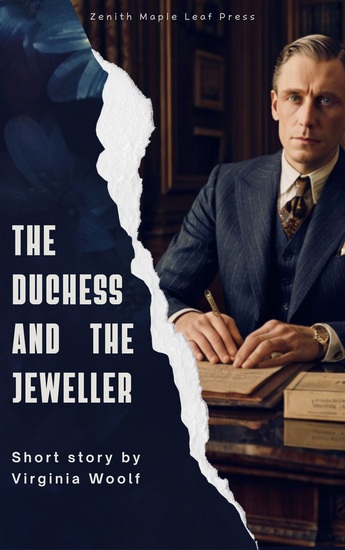
The Duchess and the Jeweller - A Brilliant Tale of Vanity Ambition and Social Intrigue - cover

The Duchess and the Jeweller - A Brilliant Tale of Vanity Ambition and Social Intrigue

Virginia Woolf, Zenith Maple Leaf Press

Verlag: Zenith Maple Leaf Press

  • 0
  • 0
  • 0

Beschreibung

In the glittering world of high society, everything has a price.
In this sharp and witty short story, Virginia Woolf explores the intersecting lives of Oliver Bacon, London's most successful jeweller, and a titled but financially troubled Duchess. When the Duchess offers Oliver a chance to buy a set of pearls—along with entry into her aristocratic circle—desire, pride, and ambition collide.

Through keen psychological insight and elegant prose, Woolf examines themes of class, materialism, and the seductive pull of social status. Both satirical and poignant, The Duchess and the Jeweller reveals the subtle power plays and vulnerabilities hidden beneath wealth and refinement.

"A masterclass in character study and social commentary."
– The Times Literary Supplement

"Woolf distills an entire world of ambition and pretense into a brief, brilliant narrative."
– The Guardian

✅ Why Readers Love It:
💎 A concise yet layered exploration of greed, charm, and self-deception

🏰 Offers a vivid snapshot of 20th-century British high society

📚 Perfect for fans of Woolf's sharp observational style

🎯 Click 'Buy Now' to enjoy Virginia Woolf's glittering and incisive portrait of ambition, vanity, and the games people play.
Verfügbar seit: 11.08.2025.
Drucklänge: 14 Seiten.

Weitere Bücher, die Sie mögen werden

  • Jewel Box - Stories - cover

    Jewel Box - Stories

    E. Lily Yu

    • 0
    • 0
    • 0
    “Like Oscar Wilde or Ray Bradbury, E. Lily Yu writes the kind of delicious short stories that come with a sting in the tail. Utterly beguiling.” —KELLY LINK, bestselling author of Get in Trouble 
     
    * A Finalist for the L.A. Times Book Prize, World Fantasy Award, and Washington State Book Award 
     
    * A Library Journal Best Books of the Year 
     
    * Featured on LeVar Burton Reads 
     
    The strange, the sublime, and the monstrous confront one another with astonishing consequences in this collection of twenty-two stories from award-winning writer E. Lily Yu.  
     
    In the village of Yiwei, a fallen wasp nest unfurls into a beautifully accurate map. In a field in Louisiana, birdwatchers forge an indelible connection over a shared glimpse of a Vermilion Flycatcher, and fall. In Nineveh, a judge who prides himself on impartiality finds himself questioned by a mysterious god. On a nameless shore, a small monster searches for refuge and finds unexpected courage. 
     
    At turns bittersweet and boundary-breaking, poignant and profound, these twenty-two stories sing, as the oldest fables do, of what it means to be alive in this strange, terrible, beautiful world. For readers who loved the intelligence and compassion in Kim Fu's Lesser Known Monsters of the 21st Century and the dreamlike prose of Kelly Link's Magic for Beginners, this collection introduces the short fiction of E. Lily Yu, winner of the Astounding Award for Best New Writer and author of the Washington Book Award–winning novel On Fragile Waves, praised by the New York Times Book Review as "devastating and perfect."
    Zum Buch
  • Free Fall - Writings on Voice Desire and Surrender - cover

    Free Fall - Writings on Voice...

    Dustin Beall Smith

    • 0
    • 0
    • 0
    A stirring literary collection that explores the human experience with wisdom and honesty, by award-winning author Dustin Beall Smith 
    In Free Fall, author and writing teacher Dustin Beall Smith delivers a powerful collection of personal essays, talks, short fiction, and poetry. With a broad range of subjects—from American culture and academia to desire, failure, love, and the impermanence of all things—Smith delves into the lived life. At the same time, he champions the importance of process over product, attention over intention, and implicit meaning over overt messaging. He infuses his writing with humor, risk, and raw emotion, using these elements to write honestly about teaching, learning, and letting go. 
      
    Told from first-, second-, and third-person perspectives—and in poetry that dives deep into life’s vicissitudes—Smith’s work embraces the power of writing in one’s true voice.
    Zum Buch
  • Mouth - Stories - cover

    Mouth - Stories

    Puloma Ghosh

    • 0
    • 0
    • 0
    BESTIARY MEETS THE DANGERS OF SMOKING IN BED IN THIS COLLECTION OF ELEVEN EERIE, UNCANNY, AND SURREAL SHORT STORIESMouth stretches reality to reach for truth. 


    "Desiccation" follows a teen figure skater with necrophiliac fantasies who is convinced the other Indian girl at the rink is a vampire. When a woman returns to Kolkata in "The Fig Tree," she can't tell if she is haunted by her dead mother or a shakchunni—or both. "Nip" bottles up the consuming and addictive nature of infatuation, while "Natalya" is a hair-raising autopsy of an ex-lover. In "Persimmons," a girl comes to terms with her own community sacrifice. 


    Full of fangs and talons, Mouth lays bare the otherwise awkward and unmentionable with a singular sharpness. Through surreal and captivating prose, Puloma Ghosh delves into otherworldly spaces to reimagine ordinary struggles of isolation, longing, and the aching desires of our flesh. 


    Contains mature themes.
    Zum Buch
  • 3 Stories - Blind Characters - A trio of classic tales perfect for a commute walk or quiet night in - cover

    3 Stories - Blind Characters - A...

    Mikhail Lermontov, Aphra Behn,...

    • 0
    • 0
    • 0
    There is something about the number 3.    
     
    The Ancient Greeks believed 3 was the perfect number, and in China 3 has always been a lucky number, and they know a thing or two.   
     
    Most religions also have 3 this and 3 that and, of course, in these more modern times, three’s a crowd may be too many, except when it’s a ménage à trois.  It seems good things usually come in threes. 
     
    Whatever history and culture says WE think 3, a hat-trick of stories, is a great number to explore themes and literary avenues that classic authors were so adept at creating. 
     
    From their pens to your your ears.
    Zum Buch
  • Forgotten Authors The - Volume 6 - Fergus Hume to Stanley Victor Makower - cover

    Forgotten Authors The - Volume 6...

    Fergus Hume, Violet Jacob,...

    • 0
    • 0
    • 0
    Throughout the long centuries of human history is the want, and the need, to share information, to exchange ideas and for that knowledge and experience, for curiosity and learning, to be the basis of a civil society. 
    In literature the ambition is much narrower.  In order to be known, to be popular, you had to be published.  And for that people had to know you existed and your ideas worth reading.  Obviously for most of humanity’s time people couldn’t read and texts couldn’t be published in any great number. 
    In the 15th Century Gutenberg’s printing press began the revolution to address the second and by the 19th century had gathered pace with startling speed and mass distribution.  Education for the many was brought in to help people understand more of their world and, with new skills, how to have a better place within it.  Now, if the powers that owned the presses and means of distribution agreed an audience would now be able to avail themselves of your ideas, your printed words.  
    Sadly, in the thirst for the new, the recent and the past fell from sight, relegated to dark corners and dusty shelves.   
    But the printed word is rarely without someone, somewhere busying themselves through piles of papers and books rediscovering what a good story is, whatever its age. 
    Sadly, in the thirst for the new, the recent and the past fell from sight, relegated to dark corners and dusty shelves.    
    But the printed word is rarely without someone, somewhere busying themselves through piles of papers and books rediscovering what a good story is, whatever its age. 
    In this volume we offer up a small selection of those talents whose time has now come again.
    Zum Buch
  • A Model Crime - From their pens to your ears genius in every story - cover

    A Model Crime - From their pens...

    William Pett Ridge

    • 0
    • 0
    • 0
    William Pett Ridge was born at Chartham, near Canterbury, Kent, on 22nd April 1859.  
    His family’s resources were certainly limited. His father was a railway porter, and the young Pett Ridge, after schooling in Marden, Kent became a clerk in a railway clearing-house. The hours were long and arduous, but self-improvement was Pett Ridge’s goal.  After working from nine until seven o’clock he would attend evening classes at Birkbeck Literary and Scientific Institute and then to follow his passion; the ambition to write.  He was heavily influenced by Dickens and several critics thought he had the capability to be his successor.  
    From 1891 many of his humourous sketches were published in the St James's Gazette, the Idler, Windsor Magazine and other literary periodicals of the day. 
    Pett Ridge published his first novel in 1895, A Clever Wife. By the advent of his fifth novel, Mord Em'ly, a mere three years later in 1898, his success was obvious.  His writing was written from the perspective of those born with no privilege and relied on his great talent to find humour and sympathy in his portrayal of working class life. 
    Today Pett Ridge and other East End novelists including Arthur Nevinson, Arthur Morrison and Edwin Pugh are being grouped together as the Cockney Novelists.   
    In 1924, Pugh set out his recollections of Pett Ridge from the 1890s: “I see him most clearly, as he was in those days, through a blue haze of tobacco smoke. We used sometimes to travel together from Waterloo to Worcester Park on our way to spend a Saturday afternoon and evening with H. G. Wells. Pett Ridge does not know it, but it was through watching him fill his pipe, as he sat opposite me in a stuffy little railway compartment, that I completed my own education as a smoker... Pett Ridge had a small, dark, rather spiky moustache in those days, and thick, dark, sleek hair which is perhaps not quite so thick or dark, though hardly less sleek nowadays than it was then”. 
    With his success, on the back of his prolific output and commercial success, Pett Ridge gave generously of both time and money to charity. In 1907 he founded the Babies Home at Hoxton.  This was one of several organisations that he supported that had the welfare of children as their mission.  
    His circle considered Pett Ridge to be one of life's natural bachelors. In 1909 they were rather surprised therefore when he married Olga Hentschel.  
    As the 1920’s arrived Pett Ridge added to his popularity with the movies. Four of his books were adapted into films.  
    Pett Ridge now found the peak of his fame had passed. Although he still managed to produce a book a year he was falling out of fashion and favour with the reading public and his popularity declined rapidly.  His canon runs to over sixty novels and short-story collections as well as many pieces for magazines and periodicals. 
    William Pett Ridge died, on 29th September 1930, at his home, Ampthill, Willow Grove, Chislehurst, at the age of 71. 
    He was cremated at West Norwood on 2nd October 1930.
    Zum Buch