Unisciti a noi in un viaggio nel mondo dei libri!
Aggiungi questo libro allo scaffale
Grey
Scrivi un nuovo commento Default profile 50px
Grey
Iscriviti per leggere l'intero libro o leggi le prime pagine gratuitamente!
All characters reduced
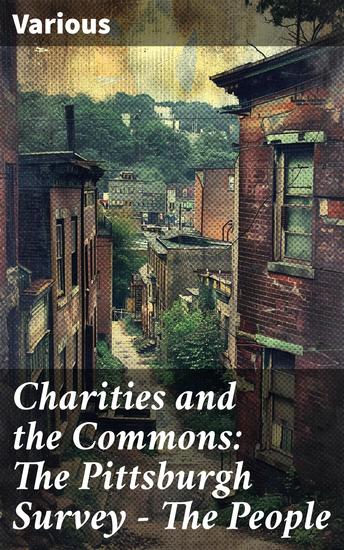
Charities and the Commons: The Pittsburgh Survey - The People - A Sociological Study of Progressive Era Urban Life - cover

Charities and the Commons: The Pittsburgh Survey - The People - A Sociological Study of Progressive Era Urban Life

Various Various

Casa editrice: Good Press

  • 0
  • 0
  • 0

Sinossi

"Charities and the Commons: The Pittsburgh Survey - The People" serves as a critical examination of early 20th-century urban social dynamics, encapsulated in a meticulous collection of essays and reports from various contributors to the Pittsburgh Survey. The work employs an interdisciplinary approach, intertwining sociology, economics, and social justice, as it offers an in-depth analysis of the challenges faced by the impoverished working class in industrial Pittsburgh. The literary style is both informative and evocative, drawing readers into the lived realities of the city's marginalized populations while maintaining a clear, analytical lens that reflects the progressive reformist spirit of its time. The authorship of this work is a collective of prominent sociologists and reformers, including notable figures like Jane Addams and Robert A. Woods, who were deeply influenced by the social upheavals of the Gilded Age. Their commitment to social reform and public welfare inspired them to document the pervasive social inequalities and to advocate for systemic changes. This historical context enhances the reader's understanding of the sociopolitical implications of the survey's findings, revealing a society grappling with industrialization's moral and ethical dilemmas. This book is an essential read for those interested in social reform, urban studies, and American history. It not only sheds light on the struggles of the past but also urges contemporary readers to critically engage with ongoing issues of inequality and social justice. Scholars and general readers alike will find themselves enriched by this foundational work that continues to resonate today.
Disponibile da: 12/10/2023.
Lunghezza di stampa: 242 pagine.
Altri libri che potrebbero interessarti

  • Burnt - Fighting for Climate Justice - cover

    Burnt - Fighting for Climate...

    Chris Saltmarsh

    • 0
    • 0
    • 0
    Time is up. The climate crisis is no longer a future to be feared, but a devastating reality. We see it in the wildfires in California and floods across Britain—the "once in a generation" extreme weather events that now happen every year. 


    In a world where those in charge are constantly letting us down, real change in our lifetime means taking power into our own hands. The task ahead of us is daunting, but the emergence of a new wave of movements focused on climate justice, equality, and solidarity also brings hope. 


    Asking how we have arrived at this moment, Chris Saltmarsh argues that the profoundly political nature of the environmental crisis has been relentlessly downplayed. After all, how can solar panels save us while capitalism places profit over the future of the planet? Analyzing the failures of NGOs, the limitations of Extinction Rebellion and Youth Strikes, the role of trade unions, and the possibilities of a Green New Deal, Burnt issues a powerful call for a radical collective movement: saving the world is not enough; we must build a better one in the process.
    Mostra libro
  • Secrets of Mesoamerica - What Did the Aztec Maya and Olmec Really Know? - cover

    Secrets of Mesoamerica - What...

    Alda Dagny

    • 0
    • 0
    • 0
    How much do you know about the ancient civilizations that molded our world today? 
    Modern society has come a long way. The digital era is well and truly upon us, and technology continues to advance and dominate our everyday lives. 
    While there are many benefits to this, it has also led to many people wanting to learn more about those who came before us, with one big question they want to answer. 
    How did ancient civilizations survive with so many fewer resources than we have available today? 
    You’ve come to the right place to find the answer! 
    Introducing Secrets of Mesoamerica, a must-read for anyone who wants to know everything there is to learn about the rich history of this significant era of our history. 
    With all of the commodities and knowledge available today, it is almost impossible to fathom how civilizations survived before us. 
    But not only did the Mesoamericans survive, they also thrived. 
    This book will show you how and teach you everything you could want to know about this fascinating time. 
    Inside Secrets of Mesoamerica, discoverthe Olmec, Mayan, and Aztec civilizations.the inventions and progress made during these civilizations.how Mesoamerican society and politics operated.the medical advancements made in this era.the most famous mysteries from this era. 
    Immerse yourself in this incredible cultural period, which helped shape our modern society. 
    Grab a copy of Secrets of Mesoamerica today!
    Mostra libro
  • Things Kept Secret from the Foundation of the World - cover

    Things Kept Secret from the...

    Premel Adaros

    • 0
    • 0
    • 0
    Probably you have read of the great successes of certain men who have made such wonderful and astounding names in the history of the world. Such men, whether they consciously or unconsciously knew the secret of their powers and successes, made themselves famous by unfolding their super-conscious minds. 
    Now the super-conscious mind contains all the secrets of occult and magnetic power. Napoleon, who was a master of the super-conscious state, used to obtain practically eight hours rest in fifteen minutes by looking intently at a dark spot on the walls of his room. 
    Now this super-conscious state is called by the Hindus "samadhi" or super-consciousness. I will give you the principal secrets of this state and how to enter into it so that you may develop psychic power. There are many methods to do this with, but they are not practical and most of them are so mystical that the majority of sensible people would be foolish to think even of doing them for they are dangerous. I think that the so-called trance states should be left alone, especially with the beginner. 
    Every night for at least a week, just before you retire, or better just before you fall asleep, give to yourself this suggestion: "I will unfold super-consciously." Now, in a few days you will find that you are actually thinking and acting super-consciously; this is the secret of Napoleon's power. 
    This exercise that I am going to give you will enable you to go into the super-conscious state, but you will have to practice and practice to do it. For if you do not you will merely hypnotize yourself. 
    There are what might be termed three bodies in man: First, the conscious, then the thinking body, and then the causal body. If you succeed--and you should do so--in entering into this causal body, you may levitate your body, accomplish materialization, and also astral body travelling and projection.
    Mostra libro
  • A Rare Recording of Sigmund Freud - cover

    A Rare Recording of Sigmund Freud

    Sigmund Freud

    • 0
    • 0
    • 0
    As the founder of psychoanalysis, Sigmund Freud developed theories that made him one of the most influential psychologists of the last century. In this rare actual recording from 1938, Freud talks about his professional career and his escape from the Nazis at the age of 82. (Some German is spoken.)
    Mostra libro
  • Ecce Homo - cover

    Ecce Homo

    Friedrich Nietzsche

    • 0
    • 0
    • 0
    “Without music, life would be a mistake.”“It is not a lack of love, but a lack of friendship that makes unhappy marriages.” ...“That which does not kill us makes us stronger.”“I'm not upset that you lied to me, I'm upset that from now on I can't believe you.” 
    Nietzsche 
     
    The philosopher Friedrich Nietzsche's autobiography, Ecce Homo, was the last prose work that he wrote before his illness in 1889. Coming at the end of an extraordinarily productive year in which he had produced The Twilight of the Idols and The Antichrist, Nietzsche shuns any pretense at modesty with chapter titles include “Why I am so Wise”, “Why I am so Clever” and “Why I Write Such Excellent Books”. His translator Anthony M. Ludovici states, Ecce Homo “is not only a coping-stone worthy of the wonderful creations of that year, but also a fitting conclusion to his whole life, in the form of a grand summing up of his character as a man, his purpose as a reformer, and his achievement as a thinker. 
     
    Friedrich Wilhelm Nietzsche was a German philosopher, cultural critic and philologist whose work has exerted a profound influence on modern intellectual history. He began his career as a classical philologist before turning to philosophy.
    Mostra libro
  • The Black Man's President - Abraham Lincoln African Americans & the Pursuit of Racial Equality - cover

    The Black Man's President -...

    Michael Burlingame

    • 0
    • 0
    • 0
    In a little-noted eulogy delivered after Lincoln's assassination, Frederick Douglass called the president "emphatically the black man's president," the "first to show any respect for their rights as men." Douglass pointed not just to Lincoln's official acts and utterances, like the Emancipation Proclamation or the Second Inaugural Address, but also to the president's own personal experiences with Black people. 


    But Lincoln's description as "emphatically the black man's president" rests on more than his relationship with Douglass or on his official words and deeds. Lincoln interacted with many other African Americans during his presidency. His unfailing cordiality to them, his willingness to meet with them in the White House, to honor their requests, to invite them to consult on public policy, to treat them with respect whether they were kitchen servants or leaders of the Black community, to invite them to attend receptions, to sing and pray with them in their neighborhoods—all those manifestations of an egalitarian spirit justified the tributes paid to him by Frederick Douglass and other African Americans. 


    Historian David S. Reynolds observed that only by examining Lincoln's "personal interchange with Black people do we see the complete falsity of the charges of innate racism that some have leveled against him over the years."
    Mostra libro