Unisciti a noi in un viaggio nel mondo dei libri!
Aggiungi questo libro allo scaffale
Grey
Scrivi un nuovo commento Default profile 50px
Grey
Iscriviti per leggere l'intero libro o leggi le prime pagine gratuitamente!
All characters reduced
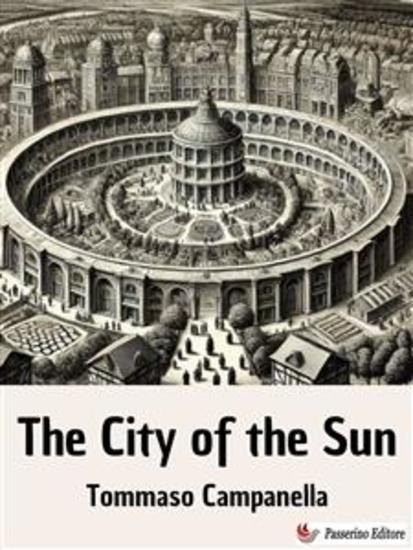
The City of the Sun - cover

The City of the Sun

Tommaso Campanella

Casa editrice: Passerino

  • 0
  • 0
  • 0

Sinossi

The City of the Sun is a philosophical work by the Italian Dominican philosopher Tommaso Campanella. It is an important early utopian work. The work was written in Italian in 1602, shortly after Campanella's imprisonment for heresy and sedition. A Latin version was written in 1613–14 and published in Frankfurt in 1623.

Tommaso Campanella (5 September 1568 – 21 May 1639), baptized Giovanni Domenico Campanella, was an Italian Dominican friar, philosopher, theologian, astrologer, and poet.
Campanella was prosecuted by the Roman Inquisition for heresy in 1594 and was confined to house arrest for two years. Accused of conspiring against the Spanish rulers of Calabria in 1599, he was tortured and sent to prison, where he spent 27 years. He wrote his most significant works during this time, including The City of the Sun, a utopia describing an egalitarian theocratic society where property is held in common.
Disponibile da: 20/06/2024.
Altri libri che potrebbero interessarti

  • Fall of Rome and Constantinople The: The History of the Attacks that Destroyed the Western Roman Empire and Byzantine Empire - cover

    Fall of Rome and Constantinople...

    Charles River Editors

    • 0
    • 0
    • 0
    For the people of the ancient Mediterranean and beyond, the city of Rome had been a symbol of power for centuries, and entering the early 5th century CE, the Eternal City hadn’t been taken by an enemy force since the Gauls had done it about 800 years earlier, an unheard of period of tranquility in a world wracked with almost constant warfare. 
    	Thus, when the Visigoths, whom the Romans considered uncultured and inferior, took the city of Rome and sacked it in 410, the world was stunned. It made theologians of the newly Christianized empire question God’s plan on Earth, and it encouraged many leading Romans to look east to Constantinople for their future. Indeed, the Western Roman Empire would completely collapse in the late 5th century, less than 70 years after the Visigoths sacked Rome, and just how it went from being a superpower to a poorly led, weak, and vulnerable shadow of its former self has preoccupied historians for centuries.  
    To this day, it remains difficult to trace just when the decline began, but it’s fair to say that the sack of Rome was the result of a number of factors that had been coalescing for many years. 	In the end, the fall of the Roman Empire was not a tale of cataclysmic events that shattered the sprawling power, but the culmination of centuries of internal dissent and decay, combined with growing external threats that led to gradual decline and eventually to the empire’s final destruction.  
    	In terms of geopolitics, perhaps the most seminal event of the Middle Ages was the successful Ottoman siege of Constantinople in 1453. The city had been an imperial capital as far back as the 4th century, when Constantine the Great shifted the power center of the Roman Empire there, effectively establishing two almost equally powerful halves of antiquity’s greatest empire. Constantinople would continue to serve as the capital of the Byzantine Empire even after the Western half of the Roman Empire collapsed.
    Mostra libro
  • Savings and Trust - The Rise and Betrayal of the Freedman's Bank - cover

    Savings and Trust - The Rise and...

    Justene Hill Edwards

    • 0
    • 0
    • 0
    In the years immediately after the Civil War, tens of thousands of former slaves deposited millions of dollars into the Freedman's Bank. African Americans envisioned this new bank as a launching pad for economic growth and self-determination. But only nine years after it opened, their trust was betrayed and the Freedman's Bank collapsed. 


    Fully informed by new archival findings, historian Justene Hill Edwards unearths a major turning point in American history in this comprehensive account of the Freedman's Bank and its depositors. She illuminates the hope with which the bank was first envisioned and demonstrates the significant setback that the sabotage of the bank caused in the fight for economic autonomy. Hill Edwards argues for a new interpretation of its tragic failure: the bank's white financiers drove the bank into the ground, not Fredrick Douglass, its final president, or its Black depositors and cashiers. A compelling story filled with both well-known figures like Abraham Lincoln, Frederick Douglass, Jay and Henry Cooke, and General O. O. Howard, and less well-known figures like Dr. Charles B. Purvis, John Mercer Langston, Congressman Robert Smalls, and Ellen Baptiste Lubin. Savings and Trust is a must-listen for those seeking to understand the roots of racial economic inequality in America.
    Mostra libro
  • A Fragile Life - Accepting Our Vulnerability - cover

    A Fragile Life - Accepting Our...

    Todd May

    • 0
    • 0
    • 0
    It is perhaps our noblest cause, and certainly one of our oldest: to end suffering. Think of the Buddha, Chuang Tzu, or Marcus Aurelius: stoically composed figures impervious to the torments of the wider world, living their lives in complete serenity—and teaching us how to do the same. After all, isn’t a life free from suffering the ideal? Absolutely not, argues Todd May in this provocative but compassionate book. In a moving examination of life and the trials that beset it, he shows that our fragility is actually one of the most important aspects of our humanity. 
     
    May starts with a simple but hard truth: suffering is inevitable. At the most basic level, we suffer physically—a sprained ankle or a bad back. But we also suffer insults and indifference. We suffer from overburdened schedules and unforeseen circumstances, from moral dilemmas and emotional heartaches. Even just thinking about our own mortality—the fact that we only live one life—can lead us to tremendous suffering. No wonder philosophies such as Buddhism, Taosim, Stoicism, and even Epicureanism—all of which counsel us to rise above these plights—have had appeal over the centuries. May highlights the tremendous value of these philosophies and the ways they can guide us toward better lives, but he also exposes a major drawback to their tenets: such invulnerability is too emotionally disengaged from the world, leading us to place too great a distance between ourselves and our experience. Rather than seeking absolute immunity, he argues most of us just want to hurt less and learn how to embrace and accept what suffering we do endure in a meaningful way. 
     
    Offering a guide on how to positively engage suffering, May ultimately lays out a new way of thinking about how we exist in the world, one that reassures us that our suffering, rather than a failure of physical or psychological resilience, is a powerful and essential part of life itself.
    Mostra libro
  • What Shall I Do? - cover

    What Shall I Do?

    Becky Erkkila

    • 0
    • 0
    • 0
    Looking back, it was amazing how my brain processed the whole incident. Even though I had repeated my statement numerous times to the police, family and friends, it was as if I was telling a story about someone else.Becky Erkkila is courageously sharing her story to enlighten others about the domestic violence victim mentality. Through her challenging experiences, she has come to realize that whatever situation we are in, the vital point is to perceive what would be the best thing for us to do at the time. Whether you are trying to discern the truth about your present situation, seeking confidence for yourself to go forward with a decision, frantically struggling to defend yourself, or convincing yourself that you are of some value, what you need most is a clear answer to "what shall I do?" I pray reading this book will bring light to your "what shall I do?"
    Mostra libro
  • Public Speaking Coaching Session & Meditation - Be your best self: social anxiety stage fright overcome the fears Successful speaking presentation work self-hypnosis technique subconscious mind - cover

    Public Speaking Coaching Session...

    Think ThinkAndBloom

    • 0
    • 0
    • 0
    Are you have a fear of public speaking? Are you having panics or anxieties when you are on stage? Are you insecure about your ability to make presentations? Do your fears hold you back in career advancement? 
    Every one of us can deliver a speech or do public speaking. Remember how you were relaxed and confident when you are with your friends and families. It is not about your abilities to deliver a speech but fears that your mind created. 
    Your mind is powerful. We can create fears. We can also undo the fears. You only need to rewire your brain into a state of confidence, relaxation just like when you are speaking to your friends and families. When you are completely relaxed and be yourself, you deliver your message effortlessly. 
    In this audiobook, we will, be your personal coachIdentify the fears and anxieties behind your phobiasHave a hypnosis sessionovercome the fear of public speakingRewire your identitybe your true selfTransform your fearsand much more... 
    When you are in your best self, your public speaking is shaped with confidence, engagement, and magnetic charm. This book will rewire your confident self into your public-speaking reality, providing you with solutions in an effortless way.
    Mostra libro
  • Design Any Disaster - The Revolutionary Blueprint to Master Your Next Crisis or Emergency - cover

    Design Any Disaster - The...

    Patrick Hardy

    • 0
    • 0
    • 0
    What determines whether an unexpected event becomes a disaster is you. 


    In Design Any Disaster, certified emergency manager and master business continuity practitioner Patrick Hardy reveals the secrets of disaster preparedness that helped him build the largest and most successful small business and family disaster planning company in the world. He explains why: You should never, ever "remain calm" during a disaster, 99% of all disaster plans are a complete waste of time, and fancy disaster equipment and supplies actually leave you less prepared. 


    Design Any Disaster is not a survival manual. It's a revolutionary approach to disaster preparedness, response, and recovery for families and small businesses that can be used whether you live in the middle of a big city, in a quiet suburban neighborhood, or in a rural county with more cows than people. Using the powerful C3 Method Hardy uses with his clients, from Fortune 500 CEOs to average families, you will discover how to get ready (plan effectively), react (focus without panicking), respond (protect yourself and your possessions), and recover (overcome swiftly). And in a revolutionary section you will not find in any other disaster book, Hardy also reveals how to reverse disaster, converting the experience into an opportunity to become wiser and happier.
    Mostra libro