Unisciti a noi in un viaggio nel mondo dei libri!
Aggiungi questo libro allo scaffale
Grey
Scrivi un nuovo commento Default profile 50px
Grey
Iscriviti per leggere l'intero libro o leggi le prime pagine gratuitamente!
All characters reduced
Bandit Country - The IRA and South Armagh - cover

Bandit Country - The IRA and South Armagh

Toby Harnden

Casa editrice: Biteback Publishing

  • 0
  • 0
  • 0

Sinossi

A NEW EDITION OF ONE OF THE MOST CELEBRATED BOOKS ON THE TROUBLES
Branded as 'Bandit Country' by the British government, South Armagh was the heartland of the Provisional IRA. It was the rebel Irish stronghold where Thomas 'Slab' Murphy reigned supreme, bomb attacks on England were planned and the SAS tracked the IRA snipers who hunted British soldiers.
In this acclaimed and remarkable book – originally published in 1999 – Toby Harnden, winner of the Orwell Prize, brings to bear his skills as a fearless journalist, inspired investigator and gifted historian, threatened with imprisonment for protecting his sources in Northern Ireland but undeterred. He draws on secret documents and unsparing interviews with key protagonists on both sides to produce perhaps the most compelling and essential account of the IRA and the Troubles.
Disponibile da: 18/04/2024.
Lunghezza di stampa: 554 pagine.
Altri libri che potrebbero interessarti

  • Super Simple CBT - Six Skills to Improve Your Mood in Minutes - cover

    Super Simple CBT - Six Skills to...

    PhD Matthew McKay, PhD Martha...

    • 0
    • 0
    • 0
    Quick skills grounded in cognitive behavioral therapy (CBT) to help you find lasting relief from the painful thoughts that drive anxiety, depression, and more. 


    In today's increasingly uncertain world, it's natural to feel anxious, scared, sad, lonely, angry, worried, or hopeless. Everybody experiences intense emotions sometimes. It's normal. But when the pain becomes too strong and too enduring, it's time for a change. 


    CBT is widely regarded as the gold standard in psychotherapy for treating anxiety and depression. Based on the self-help classic, Thoughts and Feelings, this take-anywhere guide offers distilled CBT skills you can use anytime to challenge the negative thinking that leads to anxiety and depression, balance your emotions, and start engaging in activities that make you feel good about yourself.  Most importantly, you'll learn how your thoughts affect your mood, and how changing your thoughts can actually change your life! 


    This super simple guide presents the most effective therapy for managing anxiety and depression in an easy-to-listen format that therapists can refer to clients, and listeners can refer to again and again.
    Mostra libro
  • The Amateur Hour - A History of College Teaching in America - cover

    The Amateur Hour - A History of...

    Jonathan Zimmerman

    • 0
    • 0
    • 0
    American college teaching is in crisis, or so we are told. But we've heard that complaint for the past 150 years, as critics have denounced the poor quality of instruction in undergraduate classrooms. Students daydream in gigantic lecture halls while a professor drones on, or they meet with a teaching assistant for an hour of aimless discussion. The modern university does not reward teaching, so faculty members at every level neglect it in favor of research and publication. In the first book-length history of American college teaching, Jonathan Zimmerman confirms but also contradicts these perennial complaints. Drawing upon a wide range of previously unexamined sources, The Amateur Hour shows how generations of undergraduates indicted the weak instruction they received. But Zimmerman also chronicles institutional efforts to improve it, especially by making teaching more "personal." As higher education grew into a gigantic industry, he writes, American colleges and universities introduced small-group activities and other reforms designed to counter the anonymity of mass instruction. They also experimented with new technologies like television and computers, which promised to "personalize" teaching by tailoring it to the individual interests and abilities of each student.But, Zimmerman reveals, the emphasis on the personal inhibited the professionalization of college teaching, which remains, ultimately, an amateur enterprise. The more that Americans treated teaching as a highly personal endeavor, dependent on the idiosyncrasies of the instructor, the less they could develop shared standards for it. Nor have they rigorously documented college instruction, a highly public activity which has taken place mostly in private. Pushing open the classroom door, The Amateur Hour illuminates American college teaching and frames a fresh case for restoring intimate learning communities, especially for America's least privileged students. Anyone who wants to change college teaching will have to start here.
    Mostra libro
  • Evolution Is Wrong - A Radical Approach to the Origin and Transformation of Life - cover

    Evolution Is Wrong - A Radical...

    Erich von Däniken

    • 1
    • 1
    • 0
    A Fascinating Exploration on Why the Darwinists’ Theory No Longer Explains Everything 
    There was once a set of ideas called the theory of evolution, conceived by clever people and confirmed by countless scientists. Then people discovered the electron microscope. This made it possible to make the molecules within the cell visible, and suddenly questions about evolution arose that were not possible before. Which force actually bundles the atoms in the right order? What moves the molecular chains into the correct position? How did the first living unit within the cell actually come about? How does inheritance work, how does information pass on to the next generation? Did humans descend only and exclusively from primates—as Charles Darwin and countless other great minds assumed—or did additional “engines” intervene in evolution?  
    Today it is clear: countless questions can no longer be answered with the previous theory of evolution. There is a form of life called “Blob” (Physarum polycephalum). The “thing” has neither eyes nor ears, neither a mouth nor a nose or even a brain. Nevertheless, it takes in food, overcomes obstacles by the shortest route and exchanges information with other “blobs.” The “blob” contradicts any evolutionary thought that one develops from the other. Or the “gastric-brooding frogs” (Rheobatrachus) found in Australia. They hatch their young in the stomach. Impossible in a slow, evolutionary process.  
    Everywhere there are characteristics of animals that do not want to fit into the theory of evolution anywhere. And man? Are we really the most adapted life-form on this planet? Today, more and more scientists who contradict the previous theory of evolution speak out. The theory fits the changes within the species, but it can no longer be reconciled with the inner workings of the cell. Some other influence that has so far escaped us is affecting evolution. It is called “Intelligent Design.” Intelligent planning is suspected behind this. Anyone or anything—a spirit of the universe? Aliens?—could be behind this planning.  
    Erich von Däniken uses countless examples to demonstrate the impossibility of the previous evolutionary idea. He quotes scientists who argue against the previous teaching, but also those who defend it. Unfortunately, established science still refuses to look at discrepancies and holes in the theory of evolution, even though it is quite obvious that there is more going on with regard to the development of all species, as well as human culture, than could be explained by the theory of evolution alone.
    Mostra libro
  • History of Christianity for Kids: A Captivating Guide to Church History Starting from Jesus to the Present - cover

    History of Christianity for...

    Captivating History

    • 0
    • 0
    • 0
    Discover the Exciting History of Christianity—A Kid-Friendly Adventure! 
    Parents, are you looking for a fun and educational way to introduce your child to the fascinating world of history? Look no further! This captivating audiobook takes young listeners on a thrilling journey through the history of Christianity, all told in easy-to-understand language. 
    Why This Audiobook is a Must-Have for Your Child Learning About History 
    Understanding the past helps kids make sense of the world today. This audiobook offers a kid-friendly exploration of how Christianity has shaped our culture and values over the centuries. 
    Engaging and Educational 
    The audiobook includes exciting stories and interesting facts, making history come alive. Your child will be eager to learn about important events and figures, like saints, the Reformation, and the Crusades. 
    Simple and Clear Language 
    Created specifically for young listeners, this audiobook breaks down complex ideas into simple, relatable explanations. 
    What Your Child Will Discover:Who was Jesus? Learn about the life and teachings of one of history’s most influential figures.What is a saint? Discover the fascinating stories of people who have been called saints and why they are important.The Reformation and the Church of England: Find out how one big change led to the creation of a whole new church.The Crusades: Understand why people went to war for their beliefs and how it changed the world.Protestantism and the pope: Learn about different branches of Christianity and the role of the pope in the church. 
    Scroll up and click the “add to cart” button to give your child the gift of knowledge and curiosity today!
    Mostra libro
  • Biggest Battles of the Pacific Theater The: The History of the Decisive Campaigns that Led to Victory Over Japan in World War II - cover

    Biggest Battles of the Pacific...

    Editors Charles River

    • 0
    • 0
    • 0
    The waters of the Pacific Ocean – stretching deep blue under the tropical sun, or scourged by typhoons – provided World War II's most far-flung battlefield. Two of the world's premier mid 20th century maritime powers, the United States of American and the Empire of Japan, grappled for supremacy across that vast expanse.  
    	Although not as well-remembered as D-Day or even the attack at Pearl Harbor that preceded it, the Battle of Midway was one of the most unique and important battles fought during World War II. In fact, the turning point in the Pacific theater took place between June 4-7, 1942 as a Japanese fleet moved a sizable fleet intending to occupy Midway Island and draw the American navy near. Instead, American aircraft flying from three aircraft carriers that had been away from Pearl Harbor in December 1941 got a bearing on the Japanese fleet and sunk four Japanese aircraft carriers, permanently crippling Japan’s navy. The Battle of Midway was one of the first major naval battles in history where the enemy fleets never actually saw or came into contact with each other.  
    	By the time the Battle of Midway was over, the defeat was so devastating that it was actually kept secret from all but the highest echelons of the Japanese government. Along with the loss of hundreds of aircraft and over 3,000 men killed, the four Japanese aircraft carriers lost, when compared to America’s one lost carrier, was critical considering America’s huge shipbuilding superiority. However, the Battle of Midway could also have easily turned out differently.
    Mostra libro
  • Feudalism: An Overview - The Structure and Dynamics of Medieval Societies - cover

    Feudalism: An Overview - The...

    Arlo Holders

    • 0
    • 0
    • 0
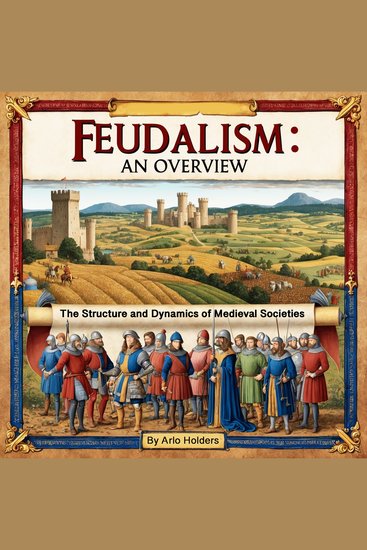
    Feudalism is often regarded as one of the defining features of medieval European society, deeply influencing the social, political, and economic structures from the 9th to the 15th century. At its core, feudalism is a system of reciprocal relationships based on land ownership, loyalty, and service. It is a hierarchical structure where power and land are distributed among various levels of society, creating an intricate web of obligations and rights. Understanding the foundations of feudalism requires examining its emergence, the key concepts involved, and its significance in shaping medieval societies. 
    The origins of feudalism can be traced back to the collapse of the Western Roman Empire in the 5th century. With the fall of centralized Roman authority, European territories faced instability and frequent invasions, notably from the Vikings, Magyars, and Muslims. As local rulers sought to protect their lands and people, they established systems of landholding that were based on personal loyalty rather than the centralized control of a king or emperor. This shift marked the beginning of feudalism. The need for defense and local governance led to a system where lords granted land, known as fiefs, to vassals in exchange for military service or other forms of support. The vassals, in turn, would offer protection and land to lower-ranking individuals, establishing a hierarchical pyramid of power. 
    At the heart of feudalism lies the concept of mutual obligations. Lords, who were often nobility or monarchs, provided land to their vassals, who were typically knights or lesser nobles. In return, vassals pledged their loyalty, military service, and counsel to their lords.
    Mostra libro