Unisciti a noi in un viaggio nel mondo dei libri!
Aggiungi questo libro allo scaffale
Grey
Scrivi un nuovo commento Default profile 50px
Grey
Iscriviti per leggere l'intero libro o leggi le prime pagine gratuitamente!
All characters reduced
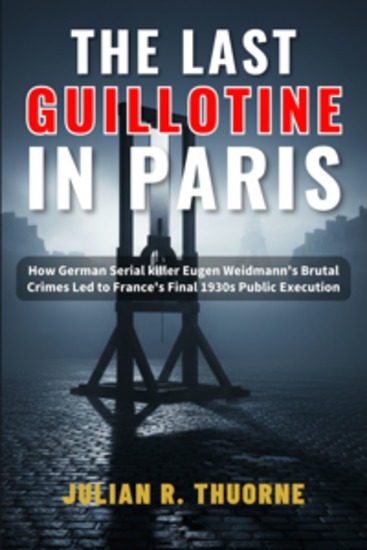
The Last Guillotine in Paris - How German Serial Killer Eugen Weidmann's Brutal Crimes Led to France's Final 1930s Public Execution - cover

The Last Guillotine in Paris - How German Serial Killer Eugen Weidmann's Brutal Crimes Led to France's Final 1930s Public Execution

Thuorne Julian R.

Casa editrice: BookRix

  • 0
  • 0
  • 0

Sinossi

Paris, 1939. A city glittering with cultural vibrancy, yet shadowed by looming war and economic despair. Into this volatile tapestry steps Eugen Weidmann, a charismatic German con man whose escalating greed will soon plunge the City of Lights into a terror unlike any it has known. Julian R. Thuorne's "The Last Guillotine in Paris" is the definitive true crime account of Weidmann's chilling reign, a story that rips through the veneer of 1930s Parisian society to expose the brutal depths of human depravity and the profound, unforeseen consequences of justice on public display.From his origins as a petty criminal in post-WWI Germany to his meticulous orchestration of murder in France, Weidmann's journey is a chilling study in the corrosion of empathy. With smooth charm and ruthless cunning, he selected his victims—a wealthy American banker, a diligent chauffeur, an aspiring dancer, an intrepid private investigator, and a trusting estate agent—each lured to his unassuming suburban lair, the Villa La Faisanderie. There, Weidmann, aided by his ruthless accomplices, transformed a seemingly ordinary home into a factory of fear, meticulously robbing, abducting, and ultimately murdering, leaving a trail of vanished lives and a city gripped by a mounting sense of dread.Thuorne meticulously reconstructs the painstaking police investigation, detailing the scattered clues, the forensic challenges, and the relentless pursuit that eventually led to Weidmann's dramatic capture in a violent shootout. The book delves into his chilling interrogations, revealing his calculated confessions and persistent attempts to manipulate authorities, even as the full, horrifying scope of his six premeditated murders came to light.The narrative culminates in Weidmann's sensational trial, a "Trial of the Century" that captivated a nation. Experience the courtroom drama, the harrowing testimonies of victims' families, the legal battle between an impassioned prosecution and a desperate defense, and the overwhelming public and media frenzy that demanded nothing less than the ultimate retribution: death by guillotine.But Weidmann's story doesn't end with his death sentence. It marks a pivotal turning point in French history. "The Last Guillotine in Paris" unearths the complex cultural context of capital punishment, tracing the guillotine's legacy from its revolutionary origins to its anachronistic presence in the 20th century. Witness the unparalleled public anticipation for Weidmann's execution, the chaotic, undignified spectacle outside La Santé Prison, and the immediate, widespread outcry that followed the controversial release of illicit film footage.This book explores the immediate and long-term impact of this single event on French society, its justice system, and media ethics. It reveals how the final public execution of a German serial killer inadvertently forced a nation to confront its own definition of justice, to reconsider the balance between retribution and civilization, and ultimately, to ban public executions, setting France on an irreversible path toward the abolition of capital punishment. All this unfolds just as Europe stood on the brink of World War II, adding a layer of poignant historical urgency to a story that resonates with timeless questions about good, evil, and society's enduring quest for moral clarity.
Disponibile da: 27/01/2026.

Altri libri che potrebbero interessarti

  • Live Dead - The Grateful Dead Live Recordings and the Ideology of Liveness - cover

    Live Dead - The Grateful Dead...

    John Brackett

    • 0
    • 0
    • 0
    The Grateful Dead were one of the most successful live acts of the rock era. Performing more than 2,300 shows between 1965 and 1995, the Grateful Dead's reputation as a "live band" was—and continues to be—sustained by thousands of live concert recordings from every era of the group's long and colorful career. In Live Dead, musicologist John Brackett examines how live recordings—from the group's official releases to fan-produced tapes, bootlegs to "Betty Boards," and Dick's Picks to From the Vault—have shaped the general history and popular mythology of the Grateful Dead for more than fifty years. Drawing on a diverse array of materials and documents contained in the Grateful Dead Archive, Live Dead details how live recordings became meaningful among the band and their fans not only as sonic souvenirs of past musical performances but also as expressions of assorted ideals, including notions of "liveness," authenticity, and the power of recorded sound.
    Mostra libro
  • The Story of One Girl - cover

    The Story of One Girl

    Magdalena Sizova

    • 0
    • 0
    • 0
    The story of the childhood, school years, and early career of the great Russian ballerina Galina Ulanova, her struggles, her victories, and her search for her own unique artistic identity.
    Mostra libro
  • Bellerophon To Anteia - From their pens to your ears genius in every story - cover

    Bellerophon To Anteia - From...

    Mary Butts

    • 0
    • 0
    • 0
    Mary Frances Butts was born on 13th December 1890 in Poole, Dorset. 
    Her early years were spent at Salterns, an 18th-century house overlooking Poole Harbour.  Sadly in 1905 her father died, and she was sent for boarding at St Leonard's school for girls in St Andrews. 
    Her mother remarried and, from 1909, Mary studied at Westfield College in London, and here, first became aware of her bisexual feelings.  She was sent down for organising a trip to Epsom races and only completed her degree in 1914 when she graduated from the London School of Economics.  By then Mary had become an admirer of the occultist Aleister Crowley and she was given a co-authorship credit on his ‘Magick (Book 4)’. 
    In 1916, she began the diary which would now detail her future life and be a constant reference point for her observations and her absorbing experiences. 
    During World War I, she was doing social work for the London County Council in Hackney Wick, and involved in a lesbian relationship.  Life changed after meeting the modernist poet, John Rodker and they married in 1918. 
    In 1921 she spent 3 months at Aleister Crowley's Abbey of Thelema in Sicily; she found the practices dreadful and also acquired a drug habit.  Mary now spent time writing in Dorset, including her celebrated book of short stories ‘Speed the Plough’ which saw fully develop her unique Modernist prose style. 
    Europe now beckoned and several years were spent in Paris befriending many artists and writing further extraordinary stories.   
    She was continually sought after by literary magazines and also published several short story collections as books. Although a Modernist writer she worked in other genres but is essentially only known for her short stories.  Mary was deeply committed to nature conservation and wrote several pamphlets attacking the growing pollution of the countryside. 
    In 1927, she divorced and the following year her novel ‘Armed with Madness’ was published.  A further marriage followed in 1930 and time was spent attempting to settle in London and Newcastle before setting up home on the western tip of Cornwall.  By 1934 the marriage had failed. 
    Mary Butts died on 5th March 1937, at the West Cornwall Hospital, Penzance, after an operation for a perforated gastric ulcer. She was 46.
    Mostra libro
  • Abraham Lincoln - His Complete Life & Times - cover

    Abraham Lincoln - His Complete...

    Ida M. Tarbell

    • 0
    • 0
    • 0
    Abraham Lincoln was born into poverty in a log cabin and was raised on the frontier primarily in Indiana. He was self-educated and became a lawyer, Whig Party leader, Illinois state legislator, and U.S. Congressman from Illinois. In 1849, he returned to his law practice but became vexed by the opening of additional lands to slavery. He reentered politics in 1854, becoming a leader in the Republican Party, and reached a national audience in the 1858 debates against Stephen Douglas. Lincoln ran for President in 1860, sweeping the North in victory. To secure its independence, the new Confederate States fired on Fort Sumter, a U.S. fort in the South, and Lincoln called up forces to suppress the rebellion and restore the Union. 
     
    Lincoln, a moderate Republican, had to navigate an array of factions with friends and opponents from both the Democratic and Republican parties. He managed the factions by exploiting their mutual enmity, carefully distributing political patronage, and by appealing to the American people. His Gettysburg Address appealed to nationalistic, republican, egalitarian, libertarian, and democratic sentiments. Lincoln scrutinized the strategy and tactics in the war effort, including the selection of generals and the naval blockade of the South's trade. He suspended habeas corpus in Maryland, and he averted British intervention by defusing the Trent Affair.
    Mostra libro
  • A Woman Among Wolves - My Journey Through Forty Years of Wolf Recovery - cover

    A Woman Among Wolves - My...

    Diane K. Boyd, Douglas H. Chadwick

    • 0
    • 0
    • 0
    Called the Jane Goodall of wolves, world-renowned wildlife biologist Diane Boyd has spent four decades studying and advocating for wolves in the wilds of Montana near Glacier National Park. When she started in the 1970s, she was the only female biologist in the United States researching and radio-collaring wild wolves. With her two dogs for company, she faced the rigors of the Montana winter in an isolated cabin. 


    Boyd fearlessly forded icy rivers, strapped on skis to navigate thick stands of lodgepole pine, and monitored packs from the air in a tiny bush plane so she could count wolves and see what they were feeding on. She faced down grizzly bears, mountain lions, wolverines—and the occasional trapper—as she stalked her quarry: a handful of wolves that were making their way south from Canada into Montana. She devised her own trapping methods and negotiated with locals as wolf populations grew from the first natural colonizer to more than 3,000 wolves in the West today. 


    Boyd takes the listener on a wild ride from the early days of wolf research to the present-day challenges of wolf management across the globe, highlighting her interactions with an apex predator that captured her heart and her undying admiration. Her writing resonates with her indomitable spirit as she explores the intricate balance of human and wolf coexistence.
    Mostra libro
  • The Minotaur at Calle Lanza - cover

    The Minotaur at Calle Lanza

    Zito Madu

    • 0
    • 0
    • 0
    A "hauntingly effective" surrealist travel memoir about the mysterious transformations that may lurk inside us all (Library Journal, starred review). 


    Venice, 2020. As a pandemic rages across the globe, Zito Madu finds himself in a nearly deserted city, its walls and basilicas humming with strange magic. As he wanders a haunted landscape, we see him twist further into his own past: his family's difficult immigration from Nigeria to Detroit, his troubled relationship with his father, the sporadic joys of daily life and solitude, his experiences with migration, poverty, foreignness, racism, and his own rage and regret. But as it is with all labyrinths, after finding its center, will he come away unscathed, or will he transform into the gripping, fantastical monstrousness that's out to consume him whole? 


    With nods to Italo Calvino and Jorge Luis Borges, this surrealist debut memoir takes us into the labyrinth of memory and the monsters lurking there.
    Mostra libro