Rejoignez-nous pour un voyage dans le monde des livres!
Ajouter ce livre à l'électronique
Grey
Ecrivez un nouveau commentaire Default profile 50px
Grey
Abonnez-vous pour lire le livre complet ou lisez les premières pages gratuitement!
All characters reduced
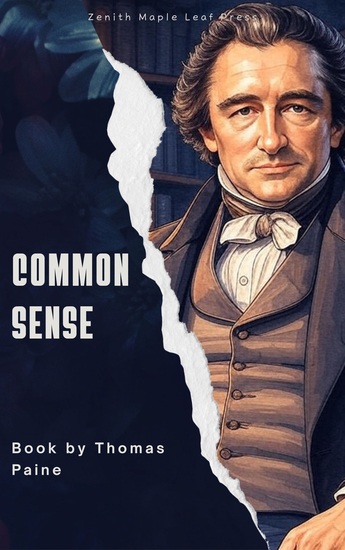
Common Sense - cover

Common Sense

Thomas Paine

Maison d'édition: Zenith Maple Leaf Press

  • 0
  • 0
  • 0

Synopsis

🔥 What if one pamphlet could ignite a revolution?

Published in 1776, Thomas Paine's Common Sense is one of the most powerful and influential works in American history. With fiery language and uncompromising conviction, Paine urged the thirteen colonies to break free from British rule and embrace independence.

Written in plain, direct style for everyday readers, Common Sense made complex political ideas accessible and persuasive. Paine's arguments against monarchy and tyranny, and his vision of liberty and self-governance, stirred the hearts of thousands and laid the intellectual groundwork for the American Revolution.

🌟 Why this book matters:

Sold over 100,000 copies in its first year—unprecedented for its time.

A cornerstone of American democracy and revolutionary thought.

Still resonates today as a passionate defense of freedom, equality, and self-rule.

More than a historical document, Common Sense is a timeless call to question injustice, think independently, and fight for liberty.

👉 Click Buy Now and read the words that sparked a revolution.
Disponible depuis: 22/08/2025.
Longueur d'impression: 81 pages.

D'autres livres qui pourraient vous intéresser

  • Can Scientists Succeed Where Politicians Fail? - Johns Hopkins Wavelengths - cover

    Can Scientists Succeed Where...

    Peter Agre, MB BChir Seema Yasmin

    • 0
    • 0
    • 0
    How can science prevail when policies fall short? 


    Sometimes in secret, sometimes as official ambassadors for their governments, scientists trade their white coats for blazers, stepping out of the lab and directly into sensitive, often life-threatening global crises. Think of the Paris Climate Agreement or the Iran Nuclear Deal, the Manhattan Project, and the Antarctic Treaty of 1959. Scientists have played a pivotal role in many of the greatest episodes in political history. 


    But what prompts their involvement in international affairs, and what are some of the impacts of their efforts? Can Scientists Succeed Where Politicians Fail? recounts Nobel laureate Dr. Peter Agre's career as a physician-scientist who went from studying malaria and other diseases to meeting with Fidel Castro in Cuba, discoursing with North Korean officials, and traveling into the Islamic Republic of Iran. 


    The book explores Agre's story alongside those of volcanologists in North Korea, epidemiologists in Latin America, and other scientists who have and are working alongside politicians, from African tribal chiefs to communist leaders, to tackle natural disasters and infectious threats in new ways.
    Voir livre
  • The Searchers - A Quest for Faith in the Valley of Doubt - cover

    The Searchers - A Quest for...

    Joseph Loconte

    • 0
    • 0
    • 0
    Never before had they known such hope. 
    In a world drenched in violence and oppression, here was a man armed with a message of peace and freedom. Into lives nearly overwhelmed by grief and sorrow, he brought compassion and healing and the deepest joy. To people who felt like outcasts and aliens, he showed the way home. And then, in one devastating night, all their hopes collapsed. 
    This is where our story begins—in the valley of despair. It is a tale of two friends, a stranger, and a search for truth in a world gone mad with doubt. 
    Historian Joseph Loconte unlocks the meaning of their exchange, set in the chaotic days following the execution of Jesus of Nazareth. Drawing from literature, film, philosophy, history, and politics, Loconte shows how this biblical drama is an integral part of our own story. Sooner or later, we will find ourselves among the searchers.
    Voir livre
  • Nato's Role - An International Coalition During the War in Afghanistan - cover

    Nato's Role - An International...

    Vince Bywaters

    • 0
    • 0
    • 0
    NATO, or the North Atlantic Treaty Organization, is a military alliance formed in 1949 to provide collective defense against aggression, primarily focused on safeguarding the democratic values and security of its member nations. Over time, its role has expanded from traditional defense to addressing global security challenges, including the fight against terrorism and the stabilization of conflict zones. The War in Afghanistan became a key test for NATO's evolving mission, showcasing its capabilities in out-of-area operations far beyond the traditional borders of its members. 
    The decision to involve NATO in Afghanistan followed the September 11, 2001, terrorist attacks on the United States, which were planned and orchestrated by al-Qaeda, a terrorist group harbored by Afghanistan's Taliban regime. In response, NATO invoked Article 5 of its founding treaty for the first time in its history, declaring an attack on one member as an attack on all. The alliance's commitment to fighting terrorism led to the deployment of NATO forces in Afghanistan, initially through Operation Enduring Freedom, and later through the more expansive International Security Assistance Force (ISAF) mission. 
    NATO’s intervention was multi-faceted, aiming not only to eliminate terrorist threats but also to assist in rebuilding a war-torn nation. The alliance’s involvement extended beyond military operations, focusing on stabilizing Afghanistan by promoting security, governance, and economic development. This commitment was based on the understanding that military force alone would not bring lasting peace. NATO recognized that its mission required close collaboration with local Afghan forces, international organizations, and governments, all working together to achieve a stable and secure Afghanistan.
    Voir livre
  • The Shortest History of Ancient Rome - A Millennium of Western Civilization from Kingdom to Republic to Empire--A Retelling for Our Times (The Shortest History Series) - cover

    The Shortest History of Ancient...

    Ross King

    • 0
    • 0
    • 0
    "For who is so indifferent or indolent as not to wish to know by what means the Romans succeeded in subjecting nearly the whole inhabited world to their sole government―a thing unique in history?"―Polybius, second century BCE 
    Ancient Rome gave rise to the Roman Empire, one of history's greatest civilizations. It flourished for roughly five hundred years and, at its height, made up at least twenty percent of the world's population. It left an indelible mark on the world, shaping politics, laws, philosophy, and architecture, and gave us Roman numerals, the calendar, aqueducts, and concrete. Alongside the Greeks, the Romans laid the groundwork for Western civilization. 
    In this fast-paced history, Ross King introduces the emperors and warriors, the madmen and upstarts, and the artists and gladiators responsible for the empire's rise, reign, and ruin. King's vivid narrative offers fresh context for key political and religious events and paints lively portraits of Rome's most formidable and notorious leaders. Spanning over one thousand years of Roman history, The Shortest History of Ancient Rome brings an ancient civilization to vibrant life, elucidating why the Romans still matter to us today.
    Voir livre
  • The Legend of Atlantis - Myths and Mysteries of the Lost Continent - cover

    The Legend of Atlantis - Myths...

    Julia Blacksmith

    • 0
    • 0
    • 0
    The legend of Atlantis has captivated human imagination for over two millennia. First introduced by the ancient Greek philosopher Plato in his dialogues Timaeus and Critias, Atlantis was described as a powerful and advanced civilization that mysteriously vanished beneath the sea. According to Plato, Atlantis existed around 9,000 years before his time and was a utopian society of great wealth, wisdom, and military might. However, its people grew corrupt, leading to their downfall when the gods punished them with a catastrophic flood. While many scholars argue that Atlantis was purely a philosophical allegory, others have dedicated their lives to searching for evidence of its existence.  
    Numerous theories have emerged over the centuries, each attempting to explain whether Atlantis was a real place or a fictional construct. Some believe Plato’s account was based on real historical events, possibly inspired by the volcanic eruption that destroyed the Minoan civilization on the island of Santorini. Others speculate that Atlantis was an advanced prehistoric civilization that disappeared due to natural disasters. Conversely, skeptics argue that Plato intended Atlantis as a cautionary tale about human hubris, using it as a metaphor for the dangers of moral and political corruption.  
    Beyond academic debates, Atlantis has remained a significant part of global culture. The story has inspired countless books, movies, and television shows, often portraying the lost civilization as a mystical underwater world or a hidden realm of extraordinary technology. Fictional adaptations range from early modern utopian literature to modern conspiracy theories suggesting that Atlanteans possessed knowledge far beyond that of other ancient civilizations. Even today, the idea of a lost, technologically advanced society continues to fuel speculation and excitement, especially among those fascinated by ancient mysteries and alternative history. 
    Voir livre
  • The Greatest Generals of the Ancient World - cover

    The Greatest Generals of the...

    Editors Charles River

    • 0
    • 0
    • 0
    Over the last 2,000 years, ambitious men have dreamed of forging vast empires and attaining eternal glory in battle, but of all the conquerors who took steps toward such dreams, none were ever as successful as antiquity’s first great conqueror. Leaders of the 20th century hoped to rival Napoleon’s accomplishments, while Napoleon aimed to emulate the accomplishments of Julius Caesar. But Caesar himself found inspiration in Alexander the Great (356-323 B.C.), the Macedonian King who managed to stretch an empire from Greece to the Himalayas in Asia at just 30 years old. It took less than 15 years for Alexander to conquer much of the known world. Although his empire was quickly divided, his legacy only grew, and Alexander became the stuff of legends even in his own time.  
    	In the history of war, only a select few men always make the list of greatest generals. Napoleon. Caesar. Alexander. They are always joined by Hannibal, who has the distinction of being the only man who nearly brought Rome to its knees before its decline almost 700 years later. Rome never suffered a more horrifying defeat in its history than at Cannae, and indeed, Hannibal nearly rewrote the course of Western history during the Second Punic War. Even today there remains great debate on just how he accomplished his masterful invasion of Italy across the Alps. Since his army included war elephants, historians still argue over exactly where and how he crossed over 2,000 years after he managed that incredible feat.  
    	The ultimate conqueror, statesman, dictator, visionary, and opportunist, during his time in power Caesar expanded the borders of Rome to almost twice their previous size, revolutionized the infrastructure of the Roman state, and destroyed the Roman Republic for good, leaving a line of emperors in its place. His legacy is so strong that his name has become, in many languages, synonymous with power.
    Voir livre