Unisciti a noi in un viaggio nel mondo dei libri!
Aggiungi questo libro allo scaffale
Grey
Scrivi un nuovo commento Default profile 50px
Grey
Iscriviti per leggere l'intero libro o leggi le prime pagine gratuitamente!
All characters reduced
Thomas More’s Utopia - cover

Thomas More’s Utopia

Thomas Moore

Casa editrice: BookRix

  • 0
  • 0
  • 0

Sinossi

Utopia is a work of fiction and political philosophy by Thomas More. The book is a frame narrative primarily depicting a fictional island society and its religious, social and political customs. 

There is no private property on Utopia, with goods being stored in warehouses and people requesting what they need. There are also no locks on the doors of the houses, which are rotated between the citizens every ten years. Agriculture is the most important job on the island. Every person is taught it and must live in the countryside, farming for two years at a time, with women doing the same work as men. Parallel to this, every citizen must learn at least one of the other essential trades: weaving (mainly done by the women), carpentry, metalsmithing and masonry. There is deliberate simplicity about these trades; for instance, all people wear the same types of simple clothes and there are no dressmakers making fine apparel. All able-bodied citizens must work; thus unemployment is eradicated, and the length of the working day can be minimised: the people only have to work six hours a day (although many willingly work for longer). More does allow scholars in his society to become the ruling officials or priests, people picked during their primary education for their ability to learn. All other citizens are however encouraged to apply themselves to learning in their leisure time.

Slavery is a feature of Utopian life and it is reported that every household has two slaves. The slaves are either from other countries or are the Utopian criminals. These criminals are weighed down with chains made out of gold. The gold is part of the community wealth of the country, and fettering criminals with it or using it for shameful things like chamber pots gives the citizens a healthy dislike of it. It also makes it difficult to steal as it is in plain view. The wealth, though, is of little importance and is only good for buying commodities from foreign nations or bribing these nations to fight each other. Slaves are periodically released for good behaviour. Jewels are worn by children, who finally give them up as they mature.

Other significant innovations of Utopia include: a welfare state with free hospitals, euthanasia permissible by the state, priests being allowed to marry, divorce permitted, premarital sex punished by a lifetime of enforced celibacy and adultery being punished by enslavement. Meals are taken in community dining halls and the job of feeding the population is given to a different household in turn. Although all are fed the same, Raphael explains that the old and the administrators are given the best of the food. Travel on the island is only permitted with an internal passport and any people found without a passport are, on a first occasion, returned in disgrace, but after a second offence they are placed in slavery. In addition, there are no lawyers and the law is made deliberately simple, as all should understand it.
Disponibile da: 19/12/2023.
Lunghezza di stampa: 175 pagine.

Altri libri che potrebbero interessarti

  • Part of Me - The Inner Team Dialogue Guide - cover

    Part of Me - The Inner Team...

    Paul Wyman

    • 0
    • 0
    • 0
    Ever heard yourself say, a part of me wants this, but another part of me wants that? Ever said, I'm in two minds...These statements make intuitive sense, because you intuitively know there are many parts to who you are, which seem to want different things. But have you ever stopped to wonder what these parts actually are?This book not only answers - in simple, accessible language, what parts are, how they work, and how they can help you understand your thinking, your emotions and your behaviors. And most importantly, how you can work with your parts to get out of your own way.Part of Me will take your self-awareness to the next level, by exploring your Inner Team, and the parts which populate it. Fifty of the most common parts are profiled in detail, so you can understand exactly what parts are driving you, and what parts you have neglected. Armed with this information, you'll be equipped to learn which parts are causing the problems you repeatedly experience, and what to do to get your Inner Team working for you, not against you.Part of Me is a comprehensive guide to the universe of parts within us, based on the Inner Team Dialogue coaching system. Written by the founder of Inner Team Dialogue, this book summarizes more than 25 years of practice, observation and exploration.The Inner Team Dialogue approach to personal development empowers you to experience:- A deeper, more nuanced understanding of who you are, and what drives you- An increase in self-compassion, and a reduction in self-criticism- Wiser decision-making, with less second guessing- Freedom to choose who you want to be- The feeling of being at peace with yourself.
    Mostra libro
  • A Midsummer Night's Dream - cover

    A Midsummer Night's Dream

    William Shakespeare

    • 0
    • 0
    • 0
    🌟 When night falls on the forest, love becomes a game of spells, dreams, and delightful chaos.
    In A Midsummer Night's Dream, William Shakespeare creates one of his most beloved comedies — a sparkling tapestry of romance, enchantment, laughter, and joyful confusion.
    
    Four young lovers flee into the woods, only to stumble into a world ruled by mischievous fairies and unpredictable magic.
    At the center of it all is Puck, the playful sprite whose tricks turn desire upside down and set hearts spinning in unexpected directions.
    
    With dueling suitors, enchanted potions, quarreling fairy royalty, and a hilariously earnest troupe of amateur actors, the play becomes a celebration of dreams, imagination, and the beautiful madness of love.
    
    Shakespeare's lyrical poetry and quick-witted humor make this play a timeless delight — a reminder that love is rarely simple, and always extraordinary.
    
    ✨ Click "Buy Now" and enter A Midsummer Night's Dream — Shakespeare's enchanting masterpiece of romance, magic, and joyful mischief.
    Mostra libro
  • The Hijacking of American Flight 119 - How DB Cooper Inspired a Skyjacking Craze and the FBI's Battle to Stop It - cover

    The Hijacking of American Flight...

    John Wigger

    • 0
    • 0
    • 0
    He pulled off what some deem the crime of the century: skyjacking a commercial jetliner, collecting a ransom of $200,000, parachuting off the aft stairs of the Boeing 727 into the night, and simply disappearing. Since November 1971, “D. B. Cooper”—no one knows his real name or identity—has become a figure of enduring fascination and obsession. The FBI pursued him for over forty years, before closing the case and leaving it unsolved.  
     
    Unsolved, perhaps, but much admired. D. B. Cooper’s exploit over the skies of the American Northwest has inspired books, films, and endless speculation. What’s less known is that it inspired imitators. None were more daring than the hijacker of American Flight 119. After commandeering the flight from St. Louis with a machine gun and collecting $502,500 in ransom, he parachuted out over Indiana. Unlike Cooper, he was tracked down. 
     
    In The Hijacking of American Flight 119, John Wigger explores the wave of hijackings that swept over commercial flights between 1961 and 1972. One hijacker ran across the ramp in Reno, Nevada, with a pillowcase over his head, gun in hand, to seize a United Airlines flight.  
     
    Another collected a large ransom in Washington, D.C., before jumping over Honduras. Yet another rode a bicycle across the tarmac with a rifle strapped to the handlebars.  
     
    Motivations involved an admixture of ideology, greed, derring-do, and a desperate need to be noticed. What they had in common was that their exploits transfixed the nation’s attention, bringing about a transformation in airline security that remains with us still.  
     
    With its focus on the parachute hijackers, Wigger’s book gathers together the stories of this period of daring criminality and recounts them in gripping fashion, showing their effect on the public, the media, and law enforcement. Using never-before-published interviews and first-hand accounts, he brings to life one of the most chaotic and fascinating periods in American aviation history.
    Mostra libro
  • The Ripple Effect - China's Complex Presence in Southeast Asia - cover

    The Ripple Effect - China's...

    Enze Han

    • 0
    • 0
    • 0
    Many studies of China's relations with and influence on Southeast Asia tend to focus on how Beijing has used its power asymmetry to achieve regional influence. Yet, scholars and pundits often fail to appreciate the complexity of the contemporary Chinese state and society, and just how fragmented, decentralized, and internationalized China is today. 


    In The Ripple Effect, Enze Han argues that a focus on the Chinese state alone is not sufficient for a comprehensive understanding of China's influence in Southeast Asia. Instead, we must look beyond the Chinese state, to non-state actors from China, such as private businesses and Chinese migrants. These actors affect people's perception of China in a variety of ways, and they often have wide-ranging as well as long-lasting effects on bilateral relations. Looking beyond the Chinese state's intentional influence reveals many situations that result in unanticipated changes in Southeast Asia. Han proposes that to understand this increasingly globalized China, we need more conceptual flexibility regarding which Chinese actors are important to China's relations, and how they wield this influence, whether intentional or not.
    Mostra libro
  • The Complete Family Guide to Dementia - Everything You Need to Know to Help Your Parent and Yourself - cover

    The Complete Family Guide to...

    Thomas F. Harrison, Brent P....

    • 0
    • 0
    • 0
    If you are facing the unique challenges of caring for a parent with dementia, you are not alone. What do you do when your loved one so plainly needs assistance, but is confused, angry, or resistant to your help? Where can you find the vital information you need, when you need it? Journalist Thomas Harrison and leading geriatric psychiatrist Brent Forester show that you don’t have to be a medical expert to be a good care provider in this authoritative guide. They explain the basics of dementia and offer effective strategies for coping with the medical, emotional, and financial toll. With the right skills, you can navigate changing family roles, communicate better with your parent, keep him or her safe, and manage difficult behaviors. Learn how to "care smarter, not harder"—and help your loved one maintain the best possible quality of life. 
    Winner (Second Place)—American Journal of Nursing Book of the Year Award, Consumer Health Category 
    Winner (Third Place)—Foreword INDIES Book of the Year Award, Family & Relationships Category
    Mostra libro
  • Carthage - Its Carnage Its History and Its Resistance to the Romans - cover

    Carthage - Its Carnage Its...

    Kelly Mass

    • 0
    • 0
    • 0
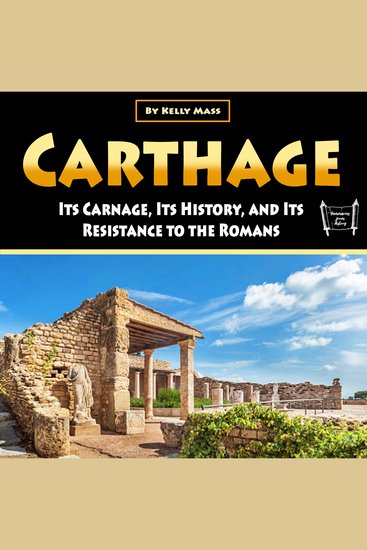
    Carthage was an ancient city-state located in what is now modern-day Tunisia. Founded by Phoenician settlers in the ninth century BC, Carthage would rise to become one of the most influential and powerful empires of the ancient Mediterranean world, only to be destroyed by the Romans in 146 BC. Despite its destruction, the Romans later lavishly rebuilt it, cementing its place in history. During its peak in the fourth century BC, Carthage was the capital of the Carthaginian Empire, a force that dominated the western Mediterranean with unmatched power and influence. 
    The origins of Carthage can be traced back to around 814 BC, when settlers from Tyre, a prosperous Phoenician city-state in modern Lebanon, arrived on the northern coast of Africa. Following the fall of Phoenicia to the Neo-Assyrian Empire in the seventh century BC, Carthage emerged as an independent entity. Over time, it expanded its influence, securing political and economic control over vast territories across the western Mediterranean. By 300 BC, Carthage controlled a sprawling empire that included the coastal regions of northwest Africa, southern Iberia (modern-day Spain, Portugal, and Gibraltar), and a series of key islands such as Sicily, Sardinia, Corsica, Malta, and the Balearic Islands. This expansion was achieved through a complex network of colonies, vassal states, and satellite territories. 
    Carthage’s strategic location played a significant role in its success. Its access to fertile agricultural lands and critical maritime trade routes allowed the city to thrive economically and become one of the wealthiest and most powerful centers of commerce in the ancient world. Carthage’s trade network extended across the Mediterranean and beyond, reaching as far as West Asia, West Africa, and northern Europe.
    Mostra libro