Unisciti a noi in un viaggio nel mondo dei libri!
Aggiungi questo libro allo scaffale
Grey
Scrivi un nuovo commento Default profile 50px
Grey
Iscriviti per leggere l'intero libro o leggi le prime pagine gratuitamente!
All characters reduced
A history of socialism - cover

A history of socialism

Thomas Kirkup

Casa editrice: Good Press

  • 0
  • 0
  • 0

Sinossi

In "A History of Socialism," Thomas Kirkup comprehensively explores the evolution of socialist thought from its early philosophical roots to its various incarnations in the modern era. Written with a keen analytical lens, Kirkup employs a narrative style that intertwines historical rigor with reflective commentary. The book meticulously chronicles key figures, ideologies, and movements, providing contextual understanding of socialism's impact on society, politics, and economics. Kirkup's exploration is not only historical; it also engages with the critical discourse surrounding socialism's successes and failures, allowing readers to grasp the complexities surrounding this multifaceted ideology. Thomas Kirkup, a keen political thinker and historian, brings a wealth of knowledge and personal conviction to this work. Born into a time of social upheaval in the late 19th century, Kirkup was influenced by the transformative ideas of his contemporaries. As an advocate for social reform and an esteemed lecturer, he dedicated much of his academic career to uncovering the philosophical underpinnings of socialism, which undoubtedly shaped his approach to this comprehensive historical account. This book is an essential reading for anyone interested in understanding the pivotal role socialism has played throughout history. It not only serves as a foundational text for students and scholars but also invites general readers to reflect on the ongoing relevance of socialist ideas in today's socio-political landscape.
Disponibile da: 02/03/2025.
Lunghezza di stampa: 90 pagine.


Altri libri che potrebbero interessarti

  • V-2 Rocket The: The Controversial History of the First Ballistic Missile during and after World War II - cover

    V-2 Rocket The: The...

    Charles River Editors

    • 0
    • 0
    • 0
    The Germans laid the groundwork for the era of ballistic missiles to follow with the “Vengeance Weapons” program. The advent of relatively advanced liquid and solid fuels for rocket weapons made them viable again after a period during which rifled artillery overshadowed them. An additional factor creating German interest in military rockets came from their complete omission among the restrictions placed on Germany's army by the Treaty of Versailles at the end of World War I. This major loophole led the Germans to hope improved rocketry could replace artillery, which the Treaty nearly banned.  
    To counter the V-weapons, the Allies implemented Operation Crossbow, which aimed to find ways to stop or at least reduce the number of V-weapons reaching their targets, and to reassure the population of Allied nations that these terrifying new weapons could be understood and overcome. The importance of Operation Crossbow was high enough that, despite being involved in massive military operations in Sicily and preparing for the Normandy landings, the Allies diverted manpower and resources to counter the V-weapon threat. This decision was made at the highest level, and those in charge were determined to ensure that Operation Crossbow would not fail. 
    All of the Allies recognized the immense strategic value of these technologies and wished to secure their benefits for themselves. As the Soviets contemplated additional expansion following the “Great Patriotic War” and the U.S. military came to understand the putative allies of today would emerge as the enemies of tomorrow, the men possessing knowledge of the V-2 rockets and other Third Reich military technology programs became seen as crucial pieces in the incipient standoff between the two new superpowers.
    Mostra libro
  • Human All Too Human - cover

    Human All Too Human

    Friedrich Nietzsche

    • 0
    • 0
    • 0
    Ranging from a few words to a few pages, the aphorisms in Human, All Too Human present Friedrich Nietzsche's thoughts on a variety of subjects, including the nature of reality (metaphysics); moral feelings, especially the concepts of good and evil; the argument that great art is the product of hard work as opposed to 'genius' and inspiration; free-thinking; the evolution of men, women and children; and the limitations that people put on their own thoughts and reasoning.
     
    The first of what became three volumes, Human, All Too Human not only represented a change in style for Nietzsche after the break-up of his friendship with the composer Richard Wagner and his rejection of Schopenhauer's influence, but also a move towards the views of the Enlightenment philosophers, particularly Voltaire and La Rochfoucauld. Human, All Too Human marks Nietzsche's decision to embrace new concepts and a fascinating turning point in the work of one of the 19th century's greatest philosophers.
    Mostra libro
  • When Panic Attacks: Book Summary & Analysis - cover

    When Panic Attacks: Book Summary...

    Briefly Summaries

    • 0
    • 0
    • 0
    This is a concise summary and analysis of When Panic Attacks, by David D. Burns. It is not the original book and is not affiliated with or endorsed by David D. Burns. Ideal for those seeking a quick and insightful overview.
     
    "When Panic Attacks" is a groundbreaking book that offers a fresh and powerful approach to overcoming anxiety, fear, and panic attacks. The authors present scientifically proven techniques that challenge traditional methods of dealing with anxiety disorders. Through cognitive behavioral therapy (CBT) and innovative exercises, this book guides readers to identify and transform the thoughts and beliefs that fuel their fears. The authors emphasize that anyone can overcome anxiety without medication by learning to change their thinking patterns. The book is filled with real-life examples, practical exercises, and a compassionate tone, making it accessible to anyone struggling with anxiety.
    Mostra libro
  • Wright Brothers: A short biography - 5 Minutes: Short on time - long on info! - cover

    Wright Brothers: A short...

    5 Minutes, 5 Minute Biographies,...

    • 0
    • 0
    • 0
    Wright Brothers, pioneers of aeronautics: Life and work in a short biography! Everything you need to know, brief and concise. Infotainment, education and entertainment at its best!
    Mostra libro
  • Why Can't I Fix It? - The Questions We Ask When We Love Someone with Addiction - cover

    Why Can't I Fix It? - The...

    Nathan Detering

    • 0
    • 0
    • 0
    Why is this happening? How do you care for yourself and your family? If you are struggling with a loved one’s addiction you are not alone. A compassionate resource for anyone stuck between a rock and a hard place. 
    When Rev. Nathan Detering shared the story of his brother’s death from a drug overdose with the members of his congregation, many of them shared their own addiction stories with him. Realizing the healing power of sharing stories and questions in community, Rev. Detering conducted interviews to identify and address the common questions that haunt us when we love someone with addiction. In conversations both within and outside his community, he heard the palpable need for those struggling with a loved one’s addictions to know they are not alone. 
    Weaving together his own and others’ deeply felt experiences of addiction, Why Can’t I Fix It? responds to sometimes desperate questions such as: Why is this happening? What can you do? What can’t you do? How do you care for yourself and the rest of your family? Can you trust your community to support you and your family? While the answers to these questions aren’t easily found, Why Can’t I Fix It? encourages those of us who are struggling with a loved one’s addictions to practice self-care and self-compassion, understand the cultural context for emotional responses and expectations of ourselves and others, and reach out for support.
    Mostra libro
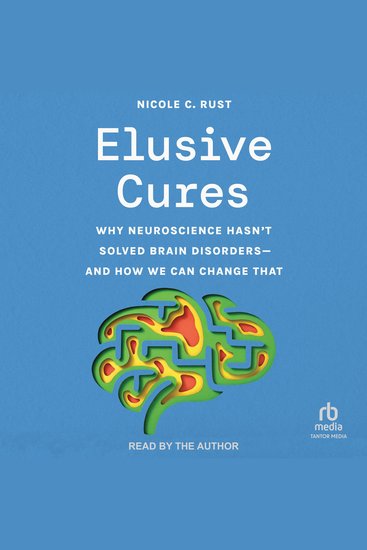
  • Elusive Cures - Why Neuroscience Hasn’t Solved Brain Disorders—and How We Can Change That - cover

    Elusive Cures - Why Neuroscience...

    Nicole C. Rust

    • 0
    • 0
    • 0
    Brain research has been accelerating rapidly in recent decades, but the translation of our many discoveries into treatments and cures for brain disorders has not happened as many expected. We do not have cures for the vast majority of brain illnesses, and many medications we have to treat the brain are derived from drugs produced in the 1950s—before we knew much about the brain at all. Tackling brain disorders is one of the biggest challenges facing humanity today. What will it take to overcome it? Nicole Rust takes listeners along on her journey to answer this question. 


    Drawing on decades of experience, Rust reflects on how far we have come in our quest to unlock the secrets of the brain and what remains to be discovered. She shows us that treating a brain disorder is more like redirecting a hurricane than fixing a domino chain of cause and effect, arguing that only once we embrace the idea of the brain as a complex system do we have any hope of finding cures. Rust profiles the pioneering ideas about the brain that are driving research at the cutting edge to illuminate exactly how much we know about disorders—and what it will take to eradicate these scourges. 


    Elusive Cures sheds light on one of the most daunting challenges confronted by science while offering hope for revolutionary new treatments and cures for the brain.
    Mostra libro