Unisciti a noi in un viaggio nel mondo dei libri!
Aggiungi questo libro allo scaffale
Grey
Scrivi un nuovo commento Default profile 50px
Grey
Iscriviti per leggere l'intero libro o leggi le prime pagine gratuitamente!
All characters reduced
The Cherry Orchard - cover

The Cherry Orchard

Anton Chekhov

Casa editrice: CLXBX

  • 0
  • 0
  • 0

Sinossi

A poignant meditation on change, loss, and the passage of time, The Cherry Orchard by Anton Chekhov is a masterful tragicomedy that captures a society standing at the edge of transformation. First performed in 1904, this timeless play explores the fading world of the Russian aristocracy and the quiet but unstoppable rise of a new social order.

At the heart of the story is Madame Lyubov Andreyevna Ranevskaya, a charming yet impractical landowner who returns to her family estate after years abroad. She is greeted by memories of her childhood and by the vast, beautiful cherry orchard that has long symbolized her family's heritage and prestige. But beneath the orchard's blossoms lies an undeniable truth: the estate is drowning in debt and will soon be auctioned unless drastic action is taken.

Surrounding Ranevskaya is a vivid ensemble of characters—her devoted but anxious brother Gayev, her practical adopted daughter Varya, her idealistic daughter Anya, and the former serf turned wealthy merchant Lopakhin. It is Lopakhin who proposes the unthinkable solution: cut down the orchard and build summer cottages to generate income. His plan represents progress, industry, and the future. To Ranevskaya and Gayev, however, it feels like a betrayal of history and beauty.

Through delicate dialogue and subtle humor, Chekhov reveals the inner conflicts of his characters. They speak of hope, love, and ambition, yet often fail to act decisively. Dreams clash with reality, and nostalgia clouds judgment. The orchard itself becomes a powerful symbol—of memory, identity, and a way of life slipping irretrievably into the past.

Blending comedy with quiet tragedy, Chekhov crafts a narrative in which life's most profound changes occur not with dramatic explosions but with the soft sound of an axe striking wood in the distance. The play's emotional depth lies in its restraint; its characters are neither heroes nor villains, but deeply human figures struggling to adapt to forces beyond their control.

The Cherry Orchard is more than a story about financial ruin—it is a reflection on generational change, social upheaval, and the bittersweet nature of progress. As the orchard falls, so too does an era defined by privilege and tradition. Yet within that loss lies the promise of renewal and possibility.

With lyrical prose, gentle irony, and penetrating insight into the human condition, Chekhov's final play remains one of the greatest works of world drama. It continues to resonate with audiences as a moving exploration of memory, resilience, and the inevitability of change.
Disponibile da: 27/02/2026.
Lunghezza di stampa: 61 pagine.
Altri libri che potrebbero interessarti

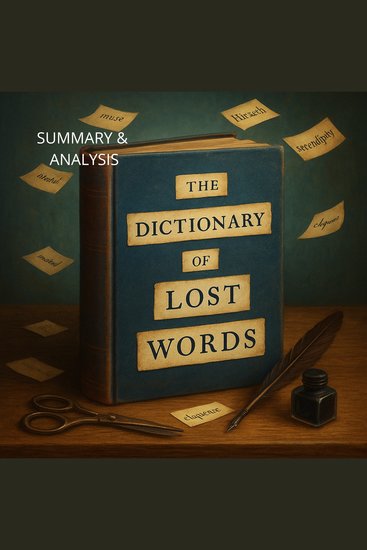
  • Dictionary of Lost Words The: Book Summary & Analysis - cover

    Dictionary of Lost Words The:...

    Alexander Pike

    • 0
    • 0
    • 0
    This content is an independent and unofficial summary created for informational and educational purposes only. It is not affiliated with, authorized, approved, licensed, or endorsed by the original author or publisher. All rights to the original work belong to its respective copyright holders. This summary is not intended to substitute the original book, but to offer a concise overview and interpretation of its main ideas.


    In the shadows of the great Oxford English Dictionary, a quiet revolution is born.
     
    The Dictionary of Lost Words tells the unforgettable story of Esme, a girl raised in a world of words—yet silenced by the very system that defines them. While her father and his colleagues work tirelessly to preserve the English language, Esme discovers a parallel truth: the most powerful words are often the ones left out—spoken by women, the working class, and the unheard.
     
    From whispered lullabies to protest chants and forgotten dialects, Esme collects discarded words, building her own dictionary in defiance of the era’s limitations. As she grows from curious child to determined woman, she begins to understand that language isn’t neutral—it’s shaped by power, history, and exclusion.
    Mostra libro
  • Flower in the River - A family tale finally told - cover

    Flower in the River - A family...

    Natalie Zett

    • 0
    • 0
    • 0
    Martha Pfeiffer, age 19, was one of 844 persons who perished when a ship chartered for the Western Electric annual picnic capsized in Chicago in 1915. Martha's surviving family members never recovered from their grief. The Eastland Disaster has been mostly overlooked in recent years. 
    In 1997, Pearl Pospisil, a retired Chicago writer, and third-generation Pfeiffer, composed a family history and delivered it to her niece, Zara Vrabel, in St. Paul, who was completely unfamiliar with its contents. Pearl had one request: "Do something with this." 
    Zara, also a journalist, was cut off from her family and had no interest in genealogy. However, learning of her great-aunt's death on the Eastland Disaster made Zara's heart sink. 
    Zara's life unravels as she becomes entangled in the plot and realizes that she and her great-aunt shared more than blood. After discovering that the accident was preventable, Zara initially seeks redress. And the release of another Titanic movie poured salt on a fresh wound. So why was the Eastland consigned to oblivion while the Titanic got all the glory? 
    Flower in the River interweaves the past and present of four generations of an Eastern-European immigrant family. It suggests that even an unknown trauma can affect a family for generations.
    Mostra libro
  • The General’s Women - A Novel - cover

    The General’s Women - A Novel

    Susan Wittig Albert

    • 0
    • 0
    • 0
    Set during the chaotic years of World War II, The General’s Women tells the story of the conflicted relationship between General Dwight Eisenhower and Kay Summersby, his Irish driver/aide, and the impact of that relationship on Mamie Eisenhower and her life in Washington during the war. Told from three alternating points of view (Kay’s, Ike’s, and Mamie’s), the novel charts the deepening of the relationship as Ike and Kay move from England to North Africa to England, France, and Germany before and after the Normandy landing. At the end of the war, Ike is faced with the heart-wrenching choice between marrying Kay and a political future. 
    The story continues into the post-war years, as Ike (returning to Mamie) becomes Army Chief of Staff, president of Columbia University, Supreme Commander of NATO, and president of the United States. Kay, meanwhile, struggles to create a life and work of her own, writing two memoirs: the first (Eisenhower Was My Boss, 1948) about her war work with Ike; the second (Past Forgetting, 1976) about their love affair. An author’s note deals with the complicated question of the truth of Kay’s story as it appeared in the posthumously published Past Forgetting.
    Mostra libro
  • Ninety-Three - cover

    Ninety-Three

    Victor Hugo

    • 0
    • 0
    • 0
    Ninety-Three is Victor Hugo's final and one of his most powerful novels—a sweeping historical epic set during the turbulent year of 1793 at the height of the French Revolution. With masterful storytelling and profound moral insight, Hugo plunges readers into a world torn apart by civil war, ideological fanaticism, and the clash between duty and compassion.
    
    The novel unfolds in Brittany, where royalist insurgents rise against the revolutionary government in Paris. At the center of the conflict stand three unforgettable figures: the Marquis de Lantenac, a resolute aristocrat and leader of the royalist forces; Gauvain, his idealistic and progressive nephew who fights for the Republic; and Cimourdain, a stern revolutionary priest turned political commissioner, bound by unyielding devotion to revolutionary principles. Their intertwined destinies form the emotional and philosophical core of the story.
    
    Through these characters, Hugo explores the moral complexities of revolution. Rather than presenting a simple battle between right and wrong, he reveals the humanity on both sides of the struggle. The aristocrat possesses courage and honor; the revolutionary general embodies mercy and hope; the revolutionary commissioner represents uncompromising justice. As violence escalates and loyalties are tested, each must confront the limits of ideology and the cost of conviction.
    
    Rich in dramatic tension, Ninety-Three portrays sea battles, prison escapes, peasant uprisings, and the relentless machinery of revolutionary tribunals. Yet beneath the action lies a deeper meditation on power, conscience, and sacrifice. Hugo examines whether true progress can be achieved through terror, and whether compassion can survive in times of extremism. The novel asks timeless questions: Can mercy coexist with justice? Is loyalty to an ideal greater than loyalty to family? What is the true meaning of revolution?
    
    Hugo's prose is vivid and lyrical, blending grand historical scope with intimate psychological depth. He paints sweeping landscapes of storm-tossed seas and war-scarred villages while also delving into the inner conflicts of his characters. His portrayal of 1793 is not merely historical—it is symbolic, representing a moment when humanity stood at a crossroads between destruction and renewal.
    
    Written during Hugo's later years, Ninety-Three reflects his mature political thought and deep belief in human progress tempered by compassion. Though set in the past, its themes of ideological division, moral responsibility, and reconciliation remain strikingly relevant.
    
    Powerful, dramatic, and philosophically rich, Ninety-Three stands as a monumental work of historical fiction. It is a story of war and mercy, fanaticism and forgiveness, and the enduring struggle to reconcile justice with humanity.
    Mostra libro
  • Echoes of Empire: Book summary & analysis - cover

    Echoes of Empire: Book summary &...

    Alexander Pike

    • 0
    • 0
    • 0
    This content is an independent and unofficial summary created for informational and educational purposes only. It is not affiliated with, authorized, approved, licensed, or endorsed by the original author or publisher. All rights to the original work belong to its respective copyright holders. This summary is not intended to substitute the original book, but to offer a concise overview and interpretation of its main ideas. 
    Amid the crumbling grandeur of a fallen empire, whispers of power, betrayal, and redemption echo through the corridors of history. Echoes of Empire weaves a gripping tale of loyalty tested and destinies reshaped, as heroes and villains alike navigate the ruins of a once-glorious civilization. Each step forward uncovers ancient secrets and dangerous alliances, blurring the line between past and present. Rich in atmosphere and suspense, this compelling journey explores how the remnants of greatness still shape the lives of those left behind.
    Mostra libro
  • The Scandalous Love of a Duke - A opposites attract sizzling Regency romance from Jane Lark - cover

    The Scandalous Love of a Duke -...

    Jane Lark

    • 0
    • 0
    • 0
    A sensual Regency romance full of secrets and a love powerful enough to rewrite the rules. 
    Can she conquer his pride - and society's prejudice? 
    John Harding, Duke of Pembroke, has everything: wealth, power and status. But beneath the facade is a man bruised by betrayal, haunted by loss and trained never to trust. Love, to John, is a myth. 
    Years ago, Katherine Spencer secretly loved her brother's best friend, John. But she has always known her place: born of scandal and followed by whispers and prejudice. A future with a duke was never for her. Now, she has the chance of marriage to a respectable clergyman. But when John strides back into her life, will Katherine compromise her reputation and let everything unravel? 
    The sixth novel in the addictively passionate Regency romance series The Marlow Family Secrets, for fans of Beverley Watts, Eloisa James and Bridgerton. Perfect for readers who love STEAMY, SPICY historical and regency romance, opposites attract, rags to riches and second chances. 
    'Delicious, thoroughly enjoyed it! What a great romance and so wonderful I could not put it down. If it was possible to score more than five stars I would.' 5-star reader review 
    'Excellent read. Loved it loved it.' 5-star reader review 
    'So romantic! This is the best book I have read in a really long time.' 5-star reader review 
    Praise for Jane Lark's historical romances: 
    'Beautifully descriptive, emotional and can I say, just plain delicious reading?' My Devastating Reads 
    'What a brilliant read!! Jane Lark has an incredible talent to draw the reader in from the first page... It's a display of raw emotion, drama and intimacy.' Cosmo Chicklitan
    Mostra libro